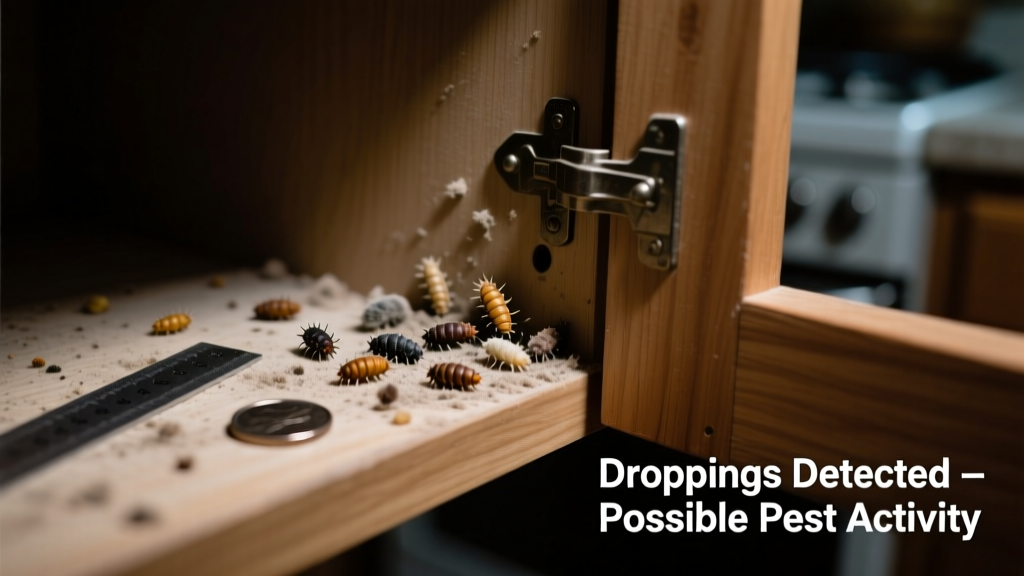
Droppings in cabinets are rarely random — they’re evidence of an active pest using your storage space as shelter, feeding ground, or nesting site. Left unaddressed, even a few droppings can signal dozens of hidden pests, contamination risks, and potential structural damage.
Identification
Not all droppings are created equal. Mouse, cockroach, rat, and even bat droppings differ in size, texture, color, and clustering behavior. Visual inspection — combined with where you find them — is your first diagnostic tool.
| Pest | Size & Shape | Color & Texture | Typical Location in Cabinet |
|---|---|---|---|
| House mouse | 3–6 mm, rice-grain shaped, pointed ends | Dark brown, dry, crumbles easily when pressed | Behind appliances, under sinks, near flour/sugar bags |
| Norway rat | 10–14 mm, blunt-ended, banana-shaped | Dark brown, moist when fresh; hardens over time | Lower cabinet corners, near plumbing access points |
| Cockroach (German) | 1–2 mm, cylindrical, often with ridges | Black or dark brown, greasy sheen; may appear speckled | Inside spice jars, behind cereal boxes, near damp corners |
| Bat | 3–5 mm, segmented, shiny, crumbles to powder | Dark gray to black, contains visible insect parts | Upper cabinet shelves, especially near attic access or soffits |
Also check for supporting signs: gnaw marks on cardboard or plastic packaging, greasy smudges along cabinet edges (mice/rats), shed exoskeletons (cockroaches), or faint ammonia odor (rodents).
What Attracts Them
Cabinets offer three things pests need: food, shelter, and moisture. Even clean kitchens provide enough residue, crumbs, or humidity to sustain small populations.
- Open or poorly sealed food containers — especially grains, nuts, pet food, and dried fruit
- Cracks around pipes, gaps under cabinet doors, or holes behind baseboards (entry points)
- Standing water from leaky faucets or condensation under sinks
- Cluttered interiors that hide nests and reduce light exposure
According to the National Pest Management Association’s 2023 Rodent Behavior Report, 68% of residential mouse infestations begin within 10 feet of food prep areas — cabinets being the most common launch point.
Treatment Methods
Natural Options
Start here if droppings are sparse (<5 per cabinet) and no live pests have been seen. These methods disrupt behavior without chemicals.
- Peppermint oil spray (10 drops per ounce of water) applied along cabinet baseboards and hinges — deters mice but not rats or roaches
- Silica gel dust (food-grade) lightly puffed into wall voids behind cabinets — dehydrates insects and small rodents
- Sticky traps placed inside cabinets at night (check every 12 hours) — best for initial monitoring, not elimination
Chemical Options
Use only when droppings persist after 72 hours of natural intervention or when live pests are observed.
- First-generation anticoagulant baits (e.g., warfarin-based) in tamper-resistant bait stations — effective for mice and rats, requires 5–7 days to work
- Gel baits containing fipronil or hydramethylnon — target cockroaches hiding in hinge crevices and shelf grooves
- Residual insecticide sprays (bifenthrin 0.05%) applied only to cabinet framing — never on shelves or food-contact surfaces
"If you find more than 10 fresh droppings in one cabinet, assume at least 3 breeding adults are present — and that they’ve likely been there for 2–3 weeks." — Dr. Lena Cho, Urban Entomologist, Purdue University Extension, 2022
Prevention
Preventing reinfestation means making cabinets physically inhospitable and behaviorally unattractive.
- Replace cardboard and paperboard food packaging with glass or thick plastic containers with silicone-sealed lids
- Install door sweeps and caulk gaps >1/8 inch around cabinet frames and plumbing penetrations
- Run exhaust fans during cooking and wipe down cabinet interiors weekly with vinegar-water solution (1:1) to remove scent trails
- Store seasonal items (holiday dishes, bulk grains) in sealed bins off-floor — never directly on shelves
For long-term success, pair these steps with regular inspection of your kitchen pests hotspots and monitor your pantry moth signs, since overlapping infestations are common.
When to Call an Exterminator
Call a licensed professional if:
- You find droppings in >3 separate cabinets across different rooms
- Droppings reappear within 48 hours after thorough cleaning and sealing
- You hear scratching, squeaking, or rustling inside walls or above cabinets
- You spot nesting material (shredded paper, insulation, fabric) alongside droppings
Licensed exterminators use thermal imaging and borescopes to locate hidden nests — something DIY methods can’t reliably do. The U.S. EPA notes that improper rodenticide use causes over 12,000 accidental pet exposures annually, making expert application critical.
Are mouse droppings dangerous to touch?
Yes. Hantavirus, salmonella, and leptospirosis can survive in dried mouse feces for up to 2–3 days. Always wear N95 masks and disposable gloves when cleaning — never vacuum or sweep dry droppings. Instead, spray with 10% bleach solution, wait 5 minutes, then wipe with disposable cloths.
Why are droppings only in upper cabinets?
This strongly suggests bats or flying insects — not rodents. Bats roost overhead and defecate while hanging; their droppings accumulate on upper shelves and don’t smear when touched. Confirm by checking for guano piles near attic vents or soffit gaps. Also inspect for winged adult psocids, which leave tiny black specks near humid cabinet corners.
Can cockroach droppings look like coffee grounds?
Yes — especially German cockroach feces, which resemble coarse black pepper or ground coffee. Unlike mouse droppings, they’re often scattered rather than clustered, and may be accompanied by a musty, oily odor. A telltale sign: tiny white eggs (oothecae) glued to cabinet undersides or inside drawer tracks.
Do rats avoid cabinets with strong smells?
Not reliably. While peppermint oil may deter mice temporarily, Norway and roof rats ignore most essential oils once acclimated. They’ll chew through sealed containers for food — odor alone won’t stop them. Physical exclusion and sanitation matter far more than scent masking.
How long until droppings stop after treatment?
With proper baiting and sealing, new droppings should cease within 3–5 days for mice, 7–10 days for rats, and 10–14 days for cockroaches. If activity continues past that window, the nest is likely outside the cabinet — possibly in walls, crawlspaces, or adjacent garages.
Is it safe to keep food in cabinets after droppings?
No — discard any open or porous-packaged food (cereal, pasta, flour, spices) stored within 3 feet of droppings. Hard-shell containers (glass jars, metal tins) can be wiped with bleach solution and reused. For peace of mind, replace all pantry staples if droppings were found in multiple locations.
Identifying the pest behind cabinet droppings isn’t guesswork — it’s pattern recognition backed by physical evidence. Match what you see to this guide, act within 48 hours, and prioritize exclusion over eradication. Most infestations are caught early enough to resolve without fumigation or major renovation — if you know what to look for.