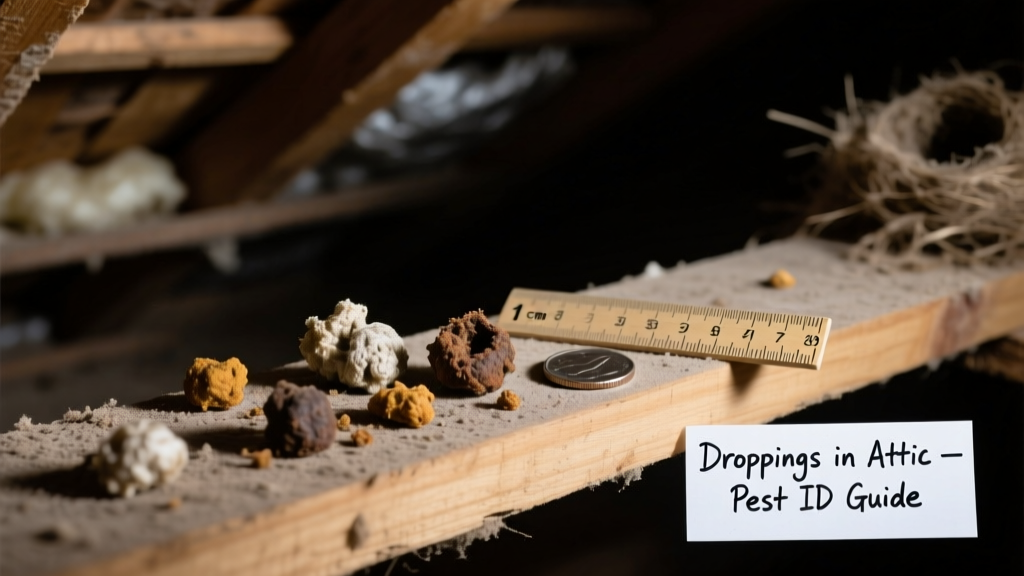
Attic droppings aren’t just unsanitary—they’re a red flag that a wild animal has breached your home’s insulation, wiring, or structural wood. Left unchecked, these intruders spread disease, chew through electrical lines (causing fire risk), and contaminate insulation with urine and pathogens.
Identification
Not all droppings are created equal. Size, texture, clustering behavior, and location tell you exactly who’s moving in upstairs. Mouse pellets are rice-sized and scattered; bat guano is crumbly, shiny, and piles near roosting beams; squirrel scat is barrel-shaped and often found near entry points or nesting material.
| Pest | Dropping Size & Shape | Color & Texture | Typical Location |
|---|---|---|---|
| Mice | 3–6 mm, pointed ends | Dark brown, dry, granular | Along rafters, near insulation seams |
| Rats (Norway) | 10–18 mm, blunt ends | Dark, moist when fresh; hardens over time | Near vents, soffits, or stored boxes |
| Squirrels | 8–12 mm, cylindrical, slightly curved | Dark brown, firm but not sticky | In nests, near attic access points |
| Bats | 5–8 mm, segmented, crumbles easily | Black-gray, glossy, often contains insect wings | Under roof peaks, on insulation below roosts |
| Raccoons | 15–25 mm, tubular, often tapered | Dark, moist, may contain berry seeds or fur | Concentrated in one area—like a latrine spot |
What Attracts Them
Attics offer shelter, warmth, and quiet—exactly what wildlife seeks during breeding season or cold months. Gaps larger than ¼ inch let mice in; holes >2 inches invite squirrels and raccoons. Overhanging tree branches act as bridges. Unsecured soffit vents, cracked fascia boards, and damaged roof shingles are top entry points.
- Uncapped chimneys (especially attractive to raccoons and birds)
- Loose or missing gable vent screens
- Rotting wood around eaves or roofline
- Insulation that’s been disturbed or compressed
Treatment Methods
Natural First Steps
Start non-invasively—especially if bats or nesting squirrels are involved (protected species in many states). Seal all but one entry point at dusk, then install a one-way exclusion door. Use peppermint oil-soaked cotton balls near suspected runs—but don’t rely on scent alone. Remove food sources outside: secure trash, eliminate bird feeders, trim shrubs within 3 feet of the house.
Chemical Options
Only consider rodenticides for persistent mouse or rat infestations—and never in open attics where pets or children could access bait. The U.S. EPA restricts second-generation anticoagulants (like brodifacoum) to licensed applicators as of 2024 due to secondary poisoning risks. If used, place tamper-resistant bait stations along baseboards, not loose on insulation.
Prevention
Exclusion is 90% of long-term success. Inspect your roofline twice yearly—spring and fall—with binoculars and a ladder. Replace aluminum or steel mesh (not hardware cloth alone) over vents. Install chimney caps rated for raccoons (minimum 16-gauge steel, ½-inch mesh). Seal gaps with copper wool + expanding foam—rodents can’t chew through copper.
- Install motion-activated LED lights in attic access points
- Use ultrasonic emitters only as supplemental deterrents—not primary solutions
- Replace fiberglass insulation contaminated with droppings; it cannot be cleaned safely
When to Call an Exterminator
Call a licensed wildlife control operator (WCO) if you hear scratching at night *and* find fresh droppings daily—or if droppings reappear within 72 hours after cleaning. According to the National Wildlife Control Operators Association’s 2023 field survey, 68% of attic infestations require professional exclusion because homeowners miss >3 of 5 entry points.
"If you see more than five fresh droppings in one spot, assume breeding activity is underway—and act before young are weaned." — Dr. Elena Ruiz, Wildlife Biologist, NWCOA Field Manual (2022)
Are bat droppings dangerous?
Yes. Bat guano supports Histoplasma capsulatum, a fungus that causes histoplasmosis when spores become airborne. Never sweep or vacuum dry guano—hire a certified mold remediation specialist trained in bat guano removal protocols.
Can I clean attic droppings myself?
You can—if it’s mouse or squirrel droppings and volume is under a cupful. Wear N95 respirator, rubber gloves, and disposable coveralls. Spray with 10% bleach solution (1 part bleach to 9 parts water), wait 10 minutes, then wipe with paper towels. Bag waste in double plastic. For larger contamination, refer to attic decontamination standards from the IICRC S520.
Why do droppings appear only in winter?
Cold weather forces rodents and squirrels indoors to nest. Squirrels may enter in late fall to prepare for January–February litters. Bats hibernate in attics only in northern climates—and their guano accumulates slowly, often going unnoticed until spring cleanup.
Do raccoons leave droppings in the attic?
Yes—and they create latrine sites, returning repeatedly to the same spot. Raccoon feces often contain undigested berries or insect parts and emit a pungent, musky odor. Always test for Baylisascaris procyonis roundworm eggs before cleanup; this parasite is fatal to humans if ingested.
How fast do attic droppings accumulate?
A single adult rat produces ~40 droppings per day. A family of 5 gray squirrels can generate 75+ pellets daily. According to the University of Nebraska-Lincoln Extension’s 2021 rodent behavior study, droppings increase 300% in volume between first detection and full infestation (typically 3–6 weeks).
Will attic fans or bright lights scare them off?
Temporary disruption only. Squirrels adapt to fan noise within 48 hours. Bats ignore light entirely—they’re nocturnal and echolocating. Fans may even help disperse fungal spores from old guano. Focus instead on sealing, not startling.
Identifying droppings correctly prevents wasted time, misapplied treatments, and unnecessary expense. Once you know who’s up there, you can choose the right exclusion method—and restore safety to your attic space. For ongoing monitoring, install a battery-powered trail camera near suspected entry points. Pair it with regular visual checks every 14 days to catch recurrence early.