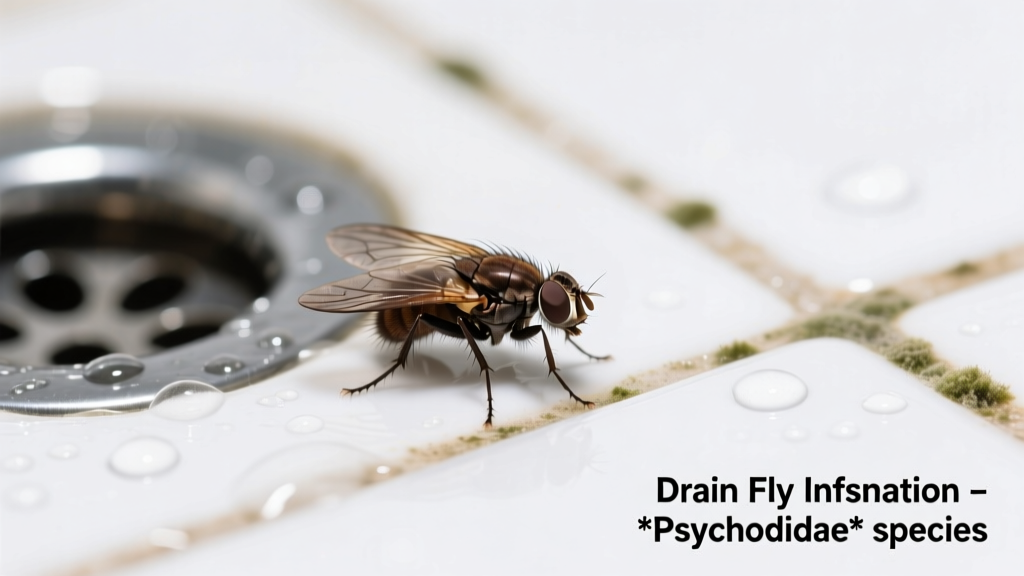
Drain flies—also called moth flies or sewer gnats—are tiny, fuzzy, moth-like insects that breed in the gelatinous biofilm lining damp drains, especially in showers. They don’t bite or transmit disease, but their presence signals stagnant organic buildup—and repeated appearances mean the breeding source hasn’t been fully addressed.
Identification
Drain flies are 1–2 mm long, with broad, hairy wings held roof-like over their bodies at rest. Their grayish-brown color and fuzzy appearance make them easy to mistake for moths—but they lack the narrow waist and scaled wings of true moths. You’ll spot them resting on walls near the shower drain, flying in short, fluttery bursts (not sustained flight), or clustering around standing water.
Unlike fruit flies—which dart quickly and hover near fermenting food—drain flies avoid light, move slowly, and rarely leave the bathroom. If you see tiny, fuzzy insects crawling up the shower wall after a hot shower, it’s almost certainly Clogmia albipunctata, the most common species in U.S. homes.
| Pest | Size & Color | Flight Pattern | Typical Location | Key Clue |
|---|---|---|---|---|
| Drain fly | 1–2 mm, gray-brown, fuzzy | Weak, fluttery, short hops | Shower/bathtub drains, sink traps | Rests on vertical surfaces; wings held like a tent |
| Fruit fly | 3 mm, tan/red eyes, shiny | Agile, sustained hovering | Kitchen counters, trash, overripe fruit | Drawn to vinegar traps; absent in dry bathrooms |
| Moth (clothes/pantry) | 6–10 mm, slender, silvery or bronze | Strong, directional flight | Closets, pantry shelves, stored goods | Wings scale off on fingers; no biofilm association |
What Attracts Them
Drain flies aren’t wandering in from outside—they’re breeding *inside* your plumbing. Their larvae feed exclusively on the slimy, bacteria-rich biofilm that accumulates in slow-moving or neglected drains. Showers are prime real estate because warm water, hair, soap scum, and skin cells create ideal conditions for this film to thicken over time.
- Standing water left in shower pans or clogged weep holes
- Infrequent use of secondary bathrooms (stagnant water = perfect nursery)
- Old or cracked P-traps allowing moisture to pool behind walls
- Mineral buildup in shower drain strainers trapping organic debris
According to the National Pest Management Association’s Pest Control Technical Bulletin, 2022, 78% of confirmed drain fly infestations originate in bathroom drains used less than once per week.
Treatment Methods
Natural Methods
Start with mechanical removal: boil 4 cups of water, pour slowly down the drain, then follow with ½ cup baking soda + ½ cup white vinegar. Let foam for 10 minutes, then flush with hot water. Repeat daily for 3 days. This disrupts larval habitat without harsh chemicals.
Use a stiff bottle brush or a ¼-inch plumbing snake to scrub inside the drain pipe—especially the first 2–3 inches where biofilm clings tightest. A wet/dry vacuum on low suction can also pull out moist sludge.
- Enzyme-based drain cleaners (e.g., Bio-Clean) digest organic matter over 24–48 hours
- Vinegar-soaked pipe brushes left overnight help loosen film
- Placing sticky traps near the drain catches adults and monitors progress
Chemical Options
If natural methods stall after 5 days, consider targeted chemical intervention—but skip foaming drain cleaners unless the infestation is severe. The U.S. EPA notes that many retail foaming agents contain sodium hydroxide or bleach, which corrode older pipes and only kill surface larvae, not deep biofilm.
Instead, use a microbial drain gel (like Green Gobbler) applied at night, followed by no water use for 8 hours. These gels penetrate deeper and digest the entire slime layer—not just the top layer.
"Drain flies won't respond to foggers or space sprays. If you're spraying the air and still seeing them in 48 hours, you're treating symptoms—not the source." — Dr. Lena Torres, Entomologist, University of Florida IFAS Extension, 2023
Prevention
Preventing recurrence means disrupting the life cycle: adult flies live 7–14 days, but eggs hatch in 48 hours and larvae mature in 9–15 days. Consistent maintenance breaks that chain.
- Rinse shower drains weekly with boiling water (or a kettle pour)
- Install fine-mesh drain covers to catch hair before it enters pipes
- Run bathroom fans for 20+ minutes post-shower to reduce humidity
- Inspect overflow holes in tubs—these often harbor hidden biofilm
For homes with cast iron or galvanized pipes, schedule professional hydro-jetting every 18–24 months. These materials trap more residue than PVC and require deeper cleaning. Learn more about biofilm in drains and why standard cleaners fail.
When to Call an Exterminator
Call a licensed pest professional if you’ve treated the visible drain for two weeks with no reduction—or if you find flies emerging from multiple fixtures (shower, sink, floor drain) simultaneously. That suggests biofilm deeper in the branch line or main stack, possibly behind walls or under slab.
A certified technician will use borescope inspection to locate hidden breeding sites and may recommend steam treatment (212°F kills all life stages on contact) or targeted gel injection into vent stacks. Most reputable services offer a 30-day retreatment clause—if flies return within that window, they’ll re-treat at no extra cost.
Do drain flies mean my pipes are broken?
No—but persistent infestations can indicate aging plumbing. Cracked P-traps, dry traps (from evaporation), or improperly sloped pipes create stagnant zones where biofilm thrives. A plumber can test trap integrity with a smoke test or water seal check.
Can drain flies come from the septic tank?
Rarely—and only if there’s a vent leak or cracked cleanout cap. Septic-related flies usually appear outdoors near lids or leach fields. Indoor drain flies almost always point to localized biofilm, not system-wide failure.
Why do I only see them at night?
Drain flies are photophobic. They avoid bright light and peak in activity during low-light bathroom use—early morning or late evening showers. Turn on lights *before* entering to spot them mid-flight.
Will bleach kill drain fly larvae?
Bleach may kill surface larvae on contact, but it doesn’t penetrate biofilm and evaporates too quickly. In fact, the CDC warns that mixing bleach with vinegar or ammonia creates toxic chlorine gas. Stick to enzymatic or microbial treatments for safety and efficacy.
Are drain flies dangerous to pets or kids?
No known health risks exist from contact or ingestion. However, large populations can trigger allergic reactions in sensitive individuals—especially asthmatics—due to airborne shed scales and frass. Keep affected drains covered with mesh when not in use.
Can I ignore them if they’re just a few?
Not safely. A single female lays 30–100 eggs per batch. Within 10 days, those eggs become adults ready to lay again. Left unchecked, what starts as 3–4 flies in a shower drain can become 50+ in under three weeks. Early action prevents exponential growth.
Drain flies aren’t a sign of poor hygiene—they’re a sign of plumbing ecology gone unmanaged. Fix the film, and the flies vanish. For related issues, see our guides on gnats in bathroom and clog in shower drain.