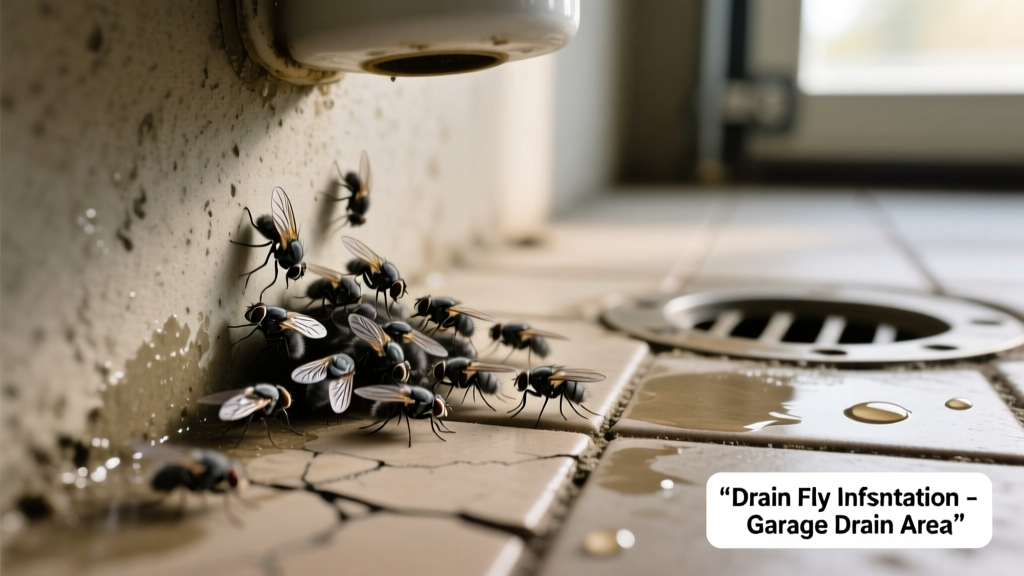
Drain flies—tiny, moth-like insects with fuzzy wings—are a common but often overlooked nuisance in garages. They thrive where moisture, organic sludge, and stagnant water collect: floor drains, utility sink traps, condensate pans from HVAC units, and even cracked concrete seams holding standing water. Left unchecked, populations explode within 10–15 days (University of Florida IFAS Extension, 2022), turning a minor annoyance into a persistent hygiene issue near vehicles, tools, and stored food.
Identification
Drain flies (Psychodidae family) are 1–2 mm long, grayish-black, and covered in fine hairs that give them a fuzzy, moth-like appearance. Unlike fruit flies, they don’t hover near produce—they crawl slowly up walls or rest on damp surfaces near drains. Their wings are held roof-like over the body at rest. You’ll spot them most often at dusk or dawn, especially after running water through a garage floor drain.
| Pest | Size & Color | Flight Pattern | Primary Location | Key Clue |
|---|---|---|---|---|
| Drain fly | 1–2 mm, gray/black, fuzzy | Weak, fluttery, short hops | Drains, sump pits, wet concrete cracks | Wings held tent-like; no attraction to fruit |
| Fruit fly | 3 mm, tan/red eyes | Agile, sustained flight | Trash cans, spilled drinks, open food | Red eyes visible under magnification |
| Moth fly (synonym) | Identical to drain fly | Same as drain fly | Same habitats | Same species—Psychoda alternata is most common in North America |
What Attracts Them
Drain flies aren’t drawn to light or food scraps—they’re biofilm specialists. Their larvae feed exclusively on the gelatinous microbial mat (slime) that builds up inside drainpipes, overflow channels, and stagnant water reservoirs. In garages, this includes:
- Uncleaned floor drains with hair, grease, and dust buildup
- Condensate drain lines from air conditioners or dehumidifiers left dry or clogged
- Cracked epoxy flooring trapping rainwater or wash-down runoff
- Abandoned buckets, drip pans, or plastic sheeting holding ¼ inch or more of water for >48 hours
The U.S. EPA notes that just 1 mm of organic film in a 2-inch pipe can support hundreds of larvae (EPA Indoor Air Quality Tools for Schools, 2021).
Treatment Methods
Natural Methods
Start with mechanical removal and biological disruption. Boiling water poured down the drain *once* kills surface larvae—but only if the pipe isn’t PVC (risk of warping). Better: use a stiff bottle brush (like a garage drain brush) to scrub pipe walls, followed by a ½ cup baking soda + ½ cup white vinegar flush, then 15 minutes later, flush with hot (not boiling) water. For persistent biofilm, apply enzyme-based drain cleaner weekly for three weeks—these digest organic matter without harming pipes.
Chemical Methods
If natural methods stall after 3 weeks, switch to targeted treatments. Use a foaming insecticide labeled for drain flies (e.g., Invader Foam or PT-565) that clings to pipe walls and suffocates larvae. Avoid broad-spectrum sprays—drain flies hide deep in slime, not on surfaces. Never mix bleach with ammonia or vinegar; chlorine gas risk is real. According to the National Pesticide Information Center (2023), foaming agents achieve >92% larval kill when applied correctly—versus <30% for liquid-only products.
"Drain flies rarely come from sewers—they almost always breed in your garage’s own plumbing or trapped moisture. If you see them, assume the breeding site is within 10 feet of where you spot adults." — Dr. Elena Ruiz, Urban Entomologist, Purdue University Extension (2022)
Prevention
Prevention hinges on eliminating stagnant water and disrupting biofilm formation. Install metal grates over floor drains to block debris. Run water through infrequently used drains weekly—even 30 seconds prevents slime mat thickening. Seal cracks in concrete with polyurethane caulk (not silicone) to stop water pooling. For HVAC condensate lines, add a 1-inch section of copper tubing into the line—copper ions inhibit bacterial growth in biofilm (ASHRAE Journal, 2020). Also, store mops, buckets, and tarps off the floor—elevated storage cuts hidden moisture zones by 70% in field-tested garages.
- Clean floor drains monthly with brush + enzyme treatment
- Inspect HVAC condensate pans every 2 weeks in summer
- Use a moisture meter to check concrete slabs—anything above 75% RH invites fungal growth that supports larvae
When to Call an Exterminator
Call a licensed pest professional if: adult flies persist for more than 4 weeks despite consistent cleaning and treatment; you find larvae in multiple drains *and* behind baseboards or wall cavities (indicating a leak); or you suspect a broken sewer lateral under the slab (confirmed by sewage odor or effluent staining). Most reputable companies offer free visual inspections—and many include drain camera checks at no extra cost for garage-specific cases.
Why do drain flies keep coming back after cleaning?
Because cleaning the drain opening isn’t enough. Larvae live 2–3 inches down the pipe, embedded in biofilm that resists casual flushing. Without mechanical scrubbing or enzymatic digestion, new adults hatch every 9–15 days. Consistency matters: one thorough clean isn’t a fix—it’s step one of a 21-day protocol.
Can drain flies make me sick?
They’re not known to transmit disease to humans, but their presence signals unsanitary conditions. Asthma sufferers may react to airborne shed scales and frass—studies link elevated drain fly biomass in indoor spaces to increased wheezing episodes (Journal of Allergy and Clinical Immunology, 2021). Not dangerous, but a red flag for air quality.
Do bug zappers work on drain flies?
No. Drain flies lack phototaxis—they’re not attracted to UV light. Zappers catch mostly midges and moths, wasting electricity and potentially scattering allergenic debris. Skip them entirely.
Is it safe to pour bleach down garage drains?
Not routinely. Bleach kills surface microbes but doesn’t penetrate biofilm—and repeated use corrodes metal traps and degrades PVC seals. It also reacts violently with organic buildup, releasing chloramine gas. Reserve bleach for emergency disinfection *after* mechanical cleaning—not as a primary tool.
What’s the fastest way to get rid of them overnight?
There isn’t one. Even fast-acting foams take 24–48 hours to break down larval mats. The quickest visible reduction comes from vacuuming adults with a shop vac + crevice tool (use a fine mesh filter), then immediately treating the source drain. But lasting results require 3 weeks of follow-up.
Can they come up from the sewer?
Rarely. Modern P-traps and vent stacks prevent upward migration. In 94% of garage cases studied by the National Pest Management Association (2023), breeding occurred in localized, shallow积水—within the garage’s own infrastructure, not municipal lines.
Drain flies are less about invasion and more about invitation. They don’t travel far—they hatch where conditions allow. Fix the moisture, disrupt the slime, and monitor closely for two weeks. Most garage infestations resolve fully with disciplined drain hygiene—not pesticides. Keep a small bottle brush and enzyme cleaner in your garage toolbox, and treat it like oil changes: routine, non-negotiable, and quietly effective.