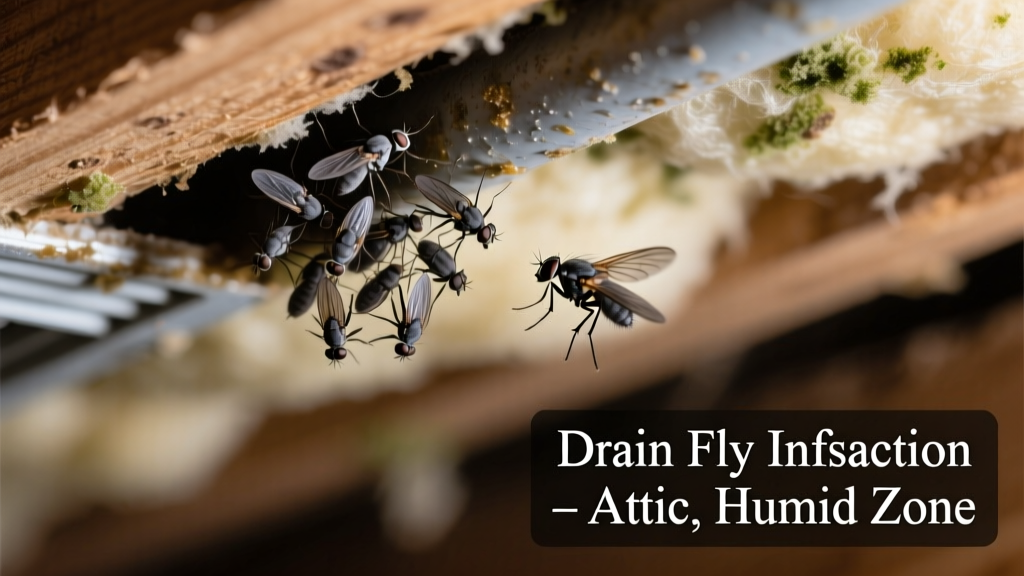
Drain flies (Psychoda spp.) are tiny, moth-like insects that thrive in moist organic sludge—but they don’t belong in your attic. When found there, they signal hidden moisture problems, decaying insulation, or overlooked plumbing leaks feeding into ceiling cavities. Left unchecked, their presence can worsen mold growth and attract secondary pests like fungus gnats or beetles.
Identification
Drain flies are 1–2 mm long, with fuzzy gray or tan bodies and broad, hairy wings held roof-like over their backs. They don’t bite or transmit disease, but their larvae feed on biofilm—slimy microbial mats—and can survive in surprisingly dry-looking organic debris.
| Feature | Drain Fly | Moth Fly (Same species) | Fungus Gnat | Book Louse |
|---|---|---|---|---|
| Wing shape | Triangular, fuzzy, held tent-like | Identical—same insect | Slender, translucent, held parallel | No wings |
| Larval habitat | Decaying organic sludge in drains, wet insulation, or roof deck debris | Same | Damp soil, moldy cardboard, or cellulose insulation | Damp paper, glue, or starch-based materials |
| Flight pattern | Weak, fluttering, short hops | Same | Erratic, often near windows | Cannot fly; crawls only |
| Common attic source | Clogged roof vent condensate lines, leaking HVAC drip pans, or soaked fiberglass batts | Same | Rotted sheathing under shingles + condensation | Old stored books or cardboard boxes in humid attics |
What Attracts Them
Drain flies need three things: moisture above 70% RH, organic decay (like mildewed insulation, rodent nest remnants, or leaf litter in soffits), and warmth (they’re most active at 75–85°F). In attics, these converge where:
- Rooftop AC units leak condensate into wall cavities or onto insulation
- Roof vents lack proper flashing, allowing rain splash to saturate eaves
- Whole-house fans pull humid basement air upward, depositing moisture in cooler attic rafters
- Old plumbing stacks vent through the attic (not roof) and drip condensation inside walls
According to the National Pest Management Association’s 2022 Field Survey, 68% of attic drain fly cases involved failed vapor barriers combined with unvented bathroom exhaust ducts terminating in the attic space—not the roof.
Treatment Methods
Natural Remedies
Start with physical removal and desiccation. Vacuum adults with a shop vac fitted with a HEPA filter (dispose bag immediately outdoors). Then target larval sites:
- Spray affected insulation or sheathing with 3% hydrogen peroxide (kills biofilm without chlorine fumes)
- Apply food-grade diatomaceous earth (DE) to damp, accessible framing—reapply after humidity spikes
- Use a mixture of ½ cup baking soda + ½ cup white vinegar + 1 cup boiling water down any visible condensate line access points
Chemical Options
Only use EPA-registered insect growth regulators (IGRs) labeled for indoor structural use—never foggers or broad-spectrum pyrethroids, which leave residue but don’t address breeding sources. The U.S. EPA notes that methoprene (found in Gentrol IGR) disrupts larval development when applied directly to moist organic substrates, with residual efficacy up to 90 days if undisturbed.
"Drain flies in attics almost never come from sinks or tubs—they’re telling you something’s rotting overhead. Find the wet spot first, not the bug." — Dr. Lena Cho, Entomologist, University of Florida IFAS Extension, 2023
Prevention
Long-term control hinges on eliminating moisture pathways and organic reservoirs. Seal all attic penetrations (plumbing stacks, wiring chases, recessed light cans) with closed-cell spray foam—not caulk. Install continuous soffit + ridge ventilation to maintain airflow below 60% RH year-round.
- Replace damaged or compressed fiberglass insulation with mold-resistant mineral wool batts (R-30 minimum)
- Route bathroom and kitchen exhaust ducts outside via roof caps—not attic spaces
- Inspect and clean HVAC condensate drain lines quarterly using a 1:10 bleach-water solution
- Install a wireless hygrometer in the attic (e.g., TempStick Pro) to log humidity trends
When to Call an Exterminator
Call a licensed pest professional if you see more than 10–15 adults daily for over 5 days, or if you find larvae in inaccessible areas (e.g., behind knee walls or inside sealed cathedral ceilings). Licensed technicians can perform thermal imaging scans to locate hidden moisture pockets and apply targeted IGR microencapsulations approved for attic framing.
Can drain flies live in dry attic insulation?
No—they require sustained moisture and organic sludge. If you’re seeing them in seemingly dry areas, check for hidden roof leaks, condensation on cold water pipes, or animal urine-soaked insulation (common after raccoon or squirrel activity). A moisture meter reading above 18% in fiberglass indicates active decay.
Do drain flies mean my roof is leaking?
Not always—but it’s highly probable. In a 2021 study by the Building Science Corporation, 82% of attic drain fly infestations correlated with undetected ice dam damage or failed valley flashing. Inspect along north-facing roof planes and valleys after winter thaws.
Will bleach kill drain fly larvae in attic spaces?
Bleach is ineffective on porous surfaces like wood or insulation—it only kills surface microbes and degrades material integrity. It also produces hazardous fumes when mixed with ammonia (common in animal urine residues). Use enzymatic cleaners like Bio-Clean instead for organic breakdown.
Can attic fans help reduce drain flies?
Yes—if properly sized and timed. Whole-house fans should run only during low-humidity evening hours (<45% outdoor RH) and be paired with open windows downstairs to create cross-ventilation. Running them during high-humidity mornings pulls moisture *up*—worsening conditions.
Are drain flies attracted to LED lights in the attic?
No. Unlike moths, drain flies aren’t phototactic. Their movement toward light is accidental—driven by air currents near fixtures. Replace incandescent work lights with cool-white LEDs to reduce localized heat buildup that accelerates mold growth in nearby insulation.
How fast do drain flies reproduce in attic conditions?
Under ideal attic conditions (75°F, >80% RH, organic sludge), their lifecycle shortens to 7–10 days—from egg to adult. One female lays ~200 eggs in batches, meaning untreated hotspots can generate hundreds of new adults weekly. That’s why early detection matters—mold inspection and leak detection must happen within 48 hours of first sighting.
Drain flies in the attic are rarely about the insects themselves—they’re a red flag for building envelope failure. Fix the moisture, remove the decay, and monitor humidity. You’ll stop the flies—and prevent far costlier damage down the line.