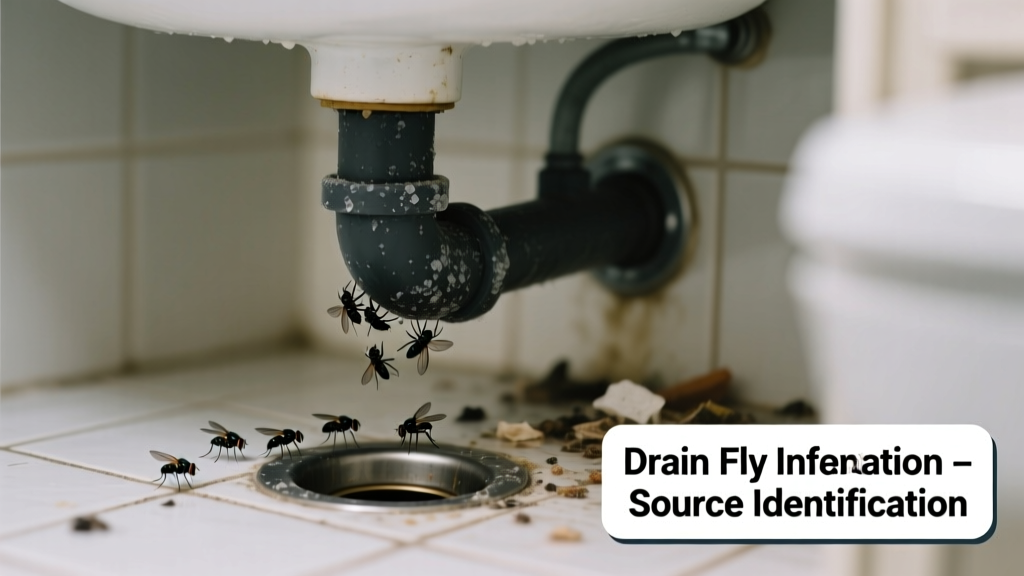
Drain flies (Psychoda spp.) are small, fuzzy, moth-like insects that thrive in the gelatinous biofilm lining slow or clogged drains. They don’t bite or transmit disease directly, but their presence signals plumbing neglect—and a single female can lay up to 300 eggs in just 48 hours, leading to rapid infestations in bathrooms, kitchens, and laundry rooms.
Identification
Drain flies are 1–2 mm long, with broad, hairy wings held roof-like over their bodies at rest. Their grayish-black color and velvety appearance make them easy to confuse with moths—but unlike moths, they’re weak fliers and often crawl or hop short distances. You’ll spot them resting on walls near sinks, showers, or floor drains, especially at dusk.
| Pest | Size | Wing Shape | Typical Location | Behavior |
|---|---|---|---|---|
| Drain fly | 1–2 mm | Rectangular, fuzzy, held roof-like | Drain openings, pipe walls | Weak flier; hovers near moisture |
| Fruit fly | 2–4 mm | Clear, slender, held flat | Overripe fruit, trash, recycling bins | Strong flier; drawn to fermentation |
| Moth fly (same as drain fly) | 1–2 mm | Identical—synonym for Psychoda | Same | Same |
Confirm their identity by placing clear tape—sticky side down—over a drain opening overnight. Check it at dawn: if you catch tiny, fuzzy, winged insects stuck to the tape, it’s almost certainly drain flies.
What Attracts Them
Drain flies aren’t flying in from outside—they’re breeding inside your pipes. They need three things: stagnant water, organic buildup (hair, soap scum, food particles), and warm temperatures (65–85°F). Slow-moving drains, infrequently used floor drains (like in basements or utility rooms), and neglected garbage disposals are prime hotspots.
- A single inch of biofilm in a 2-inch-diameter pipe can support thousands of larvae (University of Florida IFAS Extension, 2022)
- They’re most active in summer and early fall, when indoor humidity rises and plumbing usage increases
- Older homes with cast-iron or galvanized pipes have rougher interiors—ideal for biofilm accumulation
Treatment Methods
Natural Remedies
Start here—especially if you have pets, kids, or prefer non-toxic options. Boiling water alone rarely works because it cools before reaching deep biofilm. Instead, combine methods:
- Pour ½ cup baking soda followed by ½ cup white vinegar down the drain; cover for 10 minutes, then flush with boiling water
- Use a stiff bottle brush or a drain snake with brush attachment to physically scrub pipe walls
- Apply a thin layer of enzyme-based drain cleaner (e.g., Green Gobbler) weekly for 3 weeks—these digest organic matter without harming pipes
Chemical Options
Reserve these for persistent infestations where biofilm is thick or inaccessible. Avoid foaming insecticides unless labeled specifically for drain flies—their larvae live *in* the slime, not just in standing water.
- Pyrethrin-based aerosol sprays (like CB 80) can kill adults on contact—but won’t touch eggs or larvae
- Drain gels containing sodium hydroxide (lye) break down organic sludge effectively, but corrode older pipes and harm septic systems
- The U.S. EPA advises against using chlorine bleach for drain fly control—it reacts poorly with pipe gunk and produces toxic fumes (EPA Safer Choice Program, 2023)
Prevention
Drain flies return fast if conditions remain unchanged. Prevention isn’t about killing adults—it’s about eliminating larval habitat. Focus on moisture control and mechanical cleaning.
"Most homeowners treat the symptom—the flying adults—when they should be treating the source: the 3mm-thick biofilm layer clinging to PVC pipe walls. That’s where 98% of the lifecycle happens." — Dr. Elena Ruiz, Entomologist, National Pest Management Association (2021)
- Clean sink and shower drains weekly with a shower drain brush
- Run hot water for 2 minutes after each use of kitchen or bathroom sinks
- Cover unused floor drains with plastic wrap and rubber bands—or install removable drain plugs
- Fix leaky faucets and P-traps; standing water in traps invites breeding
When to Call an Exterminator
Call a licensed pest professional if you’ve treated all visible drains for 3+ weeks with no reduction—or if you see adult flies emerging from walls, baseboards, or vents. That suggests breeding in hidden areas: behind tiles, under slab foundations, or inside vent stacks. A pro will use borescopes to inspect pipes and may recommend steam cleaning (212°F steam kills all life stages on contact).
Why do drain flies keep coming back after cleaning?
Because surface cleaning doesn’t reach the biofilm layer embedded in pipe crevices. Larvae survive in micro-pockets even after vinegar or enzyme treatments—especially in older pipes with scale or corrosion. Re-treatment every 5–7 days for three cycles is essential.
Can drain flies live in my septic tank?
Yes—but only if there’s a breach between the tank and your home’s drain lines (e.g., cracked cleanout cap or broken pipe joint). Septic tanks themselves are too anaerobic for Psychoda larvae. If flies emerge near the septic access point, inspect for cracks or loose fittings.
Do drain flies mean my pipes are clogged?
Not necessarily. They thrive in slow-moving, nutrient-rich water—even in pipes flowing freely. A 2022 study in the Journal of Medical Entomology found 63% of homes with confirmed drain fly infestations had no measurable flow restriction.
Will pouring bleach down the drain help?
No. Bleach disinfects but doesn’t dissolve biofilm. It also reacts with organic debris to form chloramines—irritating gases that worsen indoor air quality. Skip it.
Can I use a plunger to get rid of them?
A plunger may dislodge some surface gunk, but it won’t remove biofilm from pipe walls. In fact, aggressive plunging can aerosolize larvae and eggs into the air. Better to scrub mechanically or use enzymatic cleaners.
Are drain flies dangerous to pets or kids?
Not directly—they don’t bite or carry human pathogens. However, large numbers indicate poor sanitation and potential mold or bacterial growth in pipes. In rare cases, airborne larvae fragments have triggered asthma symptoms in sensitive individuals (American College of Allergy, Asthma & Immunology, 2020).
Drain flies are more nuisance than threat—but they’re a loud, fuzzy alarm bell telling you something’s off in your plumbing hygiene. Tackle the slime, not just the flies, and you’ll break the cycle for good. For deeper issues like recurring infestations in rental units or multi-unit buildings, consult a plumber alongside pest control—because sometimes, the real problem isn’t the bug, it’s the pipe.