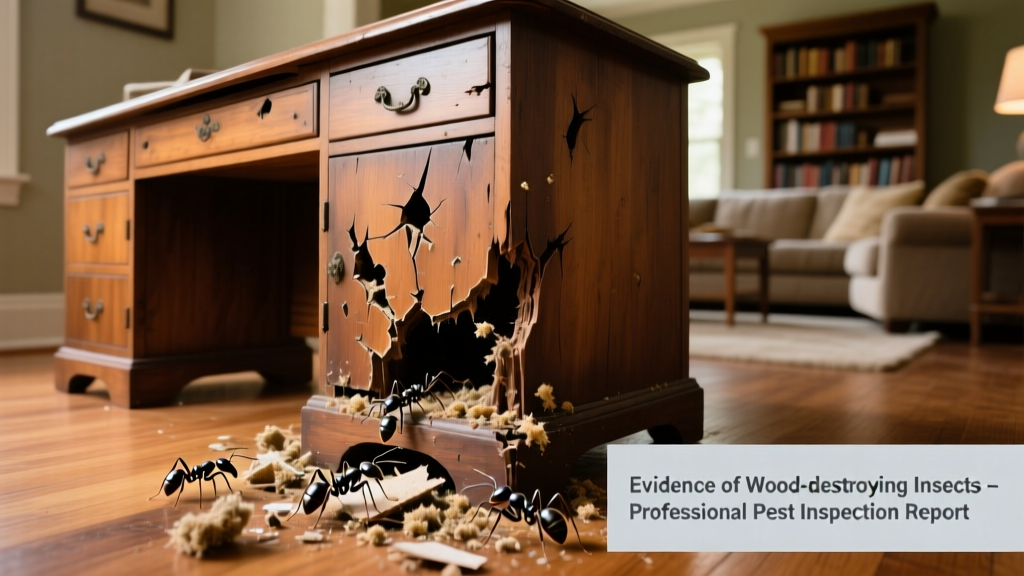
Furniture damage—chewed legs, powdery residue under drawers, tiny exit holes in antique chairs—is rarely random. It’s a clear signal that a pest has moved in and made itself at home. Left unchecked, these invaders can destroy heirlooms, compromise structural integrity, and even spread to walls and flooring.
Identification
Three pests most commonly attack furniture: powderpost beetles, carpenter ants, and termites. Each leaves distinct evidence—and misidentifying them leads to wasted time and ineffective treatments.
| Pest | Visible Signs | Hole Size & Shape | Frass (Debris) | Active Season |
|---|---|---|---|---|
| Powderpost Beetle | Small round exit holes (1/32”–1/16”), often dozens per square inch | Perfectly round, 1–2 mm | Fine, flour-like dust (not pellets) | Spring–summer emergence; larvae live 1–5 years inside wood |
| Carpenter Ant | Smooth, hollowed-out galleries; sometimes audible rustling at night | Oval or irregular, 1/8”–3/8”, often with sawdust piles below | Coarse, fibrous sawdust mixed with insect parts | Most active March–October; nests may persist year-round indoors |
| Subterranean Termite | Mud tubes on legs or frame; blistered veneer; hollow-sounding wood | No visible exit holes—they don’t emerge from finished wood | None (they consume cellulose, leaving no frass) | Year-round activity in heated homes; swarming peaks March–May |
- Powderpost beetles prefer hardwoods: oak, ash, hickory, bamboo—common in flooring, trim, and antique furniture.
- Carpenter ants avoid dry, finished wood—they excavate damp or decaying sections, often near leaky windows or plumbing.
- Termites target both softwoods and hardwoods but almost always enter via soil contact or moisture-damaged areas.
What Attracts Them
These pests don’t wander in for curiosity. They respond to specific environmental cues—most tied to moisture, wood condition, and access points.
- High indoor humidity (>60% RH) encourages beetle egg development and termite survival.
- Wood with moisture content above 20% attracts carpenter ants—check under sinks, behind baseboards, and in crawlspaces.
- Unfinished or raw wood edges (e.g., drawer undersides, chair rungs) offer easy entry for powderpost beetles.
- Old furniture stored in garages or sheds—especially if damp or uninspected for months—acts as a reservoir for infesting beetles.
Treatment Methods
Natural Options
For light, localized damage—especially in non-structural pieces—non-chemical methods can work if applied early and thoroughly.
- Freeze infested small items (e.g., wooden bowls, picture frames) at 0°F for 72+ hours—kills all life stages of powderpost beetles (University of Kentucky Entomology, 2022).
- Heat treatment: Professional kiln drying at 130°F for 24 hours eliminates beetles and larvae—but not safe for glued joints or finishes.
- Vacuum all frass and debris aggressively, then seal openings with wood filler or shellac—blocks re-entry and suffocates surface eggs.
Chemical Treatments
When damage is widespread or structural, targeted chemical intervention becomes necessary—but precision matters.
- Borate-based sprays (e.g., Bora-Care) penetrate unfinished wood, creating a long-lasting barrier against termites and beetles. Apply only to bare wood—won’t adhere to varnish or paint.
- Non-repellent ant baits (e.g., Advion Ant Gel) placed near suspected trails can eliminate entire carpenter ant colonies within 1–3 weeks.
- Fumigation with sulfuryl fluoride is the only reliable method for severe powderpost infestations in large furniture collections—but requires evacuation and licensed applicators.
Prevention
Preventing reinfestation means altering conditions—not just treating symptoms. Focus on wood health, moisture control, and inspection discipline.
- Use a hygrometer to monitor room humidity; maintain 30–50% RH with dehumidifiers or AC in basements and storage areas.
- Inspect secondhand furniture before bringing it inside—check undersides, joints, and back panels with a magnifier and flashlight.
- Apply shellac or polyurethane to raw wood edges on new or refinished pieces—creates a physical barrier beetles can’t penetrate.
- Store unused wooden items off concrete floors, elevated on pallets, and wrapped in breathable cotton—not plastic, which traps condensation.
When to Call an Exterminator
Call a licensed pest professional immediately if you see any of these red flags:
- Multiple exit holes across more than one piece of furniture—suggests breeding population, not isolated infestation.
- Mud tubes on furniture legs or adjacent baseboards—97% of mud tube sightings indicate active subterranean termite colonies (National Pest Management Association, 2023).
- Swarmers (winged insects) indoors between March and June—especially near windows or light fixtures.
- Structural softness or sagging in chair rails, table aprons, or bed frames—means internal damage has progressed beyond surface level.
Can carpet beetles damage furniture?
No—they feed on natural fibers like wool, silk, and feathers, not wood. If you find shed larval skins or tiny brown beetles near upholstered furniture or rugs, it’s likely carpet beetles, not wood-borers.
Does furniture polish prevent infestations?
Not directly—but consistent cleaning removes dust and organic residue that attract some pests. More importantly, polishing helps you spot early signs: a sticky sheen over exit holes or dull patches where frass has settled.
Why do I only see damage in summer?
Powderpost beetles and carpenter ants are temperature-dependent. Larvae develop faster above 70°F, and adults emerge or become more active when ambient temps rise—making spring and summer peak detection windows.
Is my solid oak dining table salvageable?
Yes—if damage is superficial (less than 1/4” deep). Sand, fill holes with epoxy wood filler, and refinish. But if tapping reveals hollow sounds or you see interconnected tunnels, consult a restoration specialist before sanding—it may weaken the piece further.
Do termites eat painted or sealed wood?
Rarely. Subterranean termites need soil-to-wood contact or moisture bridges (like leaking pipes) to bypass finishes. However, they’ll exploit cracks in paint, gaps around nails, or untreated end-grain—so sealing isn’t foolproof without addressing moisture sources.
Can I treat infested furniture myself if it’s valuable?
Proceed with extreme caution. DIY heat or freezing may warp veneers or loosen glue. For antiques or high-value pieces, contact a conservator first—many museums partner with entomologists for low-impact protocols. As pest biologist Dr. Elena Ruiz notes: “Killing the pest is easy. Preserving the object’s integrity—that’s where expertise pays off.”
Identifying the right pest saves money, time, and furniture. Start with careful observation—not assumptions. Match what you see to the signs above, act fast on moisture issues, and remember: the best treatment begins before the first hole appears. For ongoing protection, pair regular inspections with wood-destroying insect monitoring and consider annual checks in high-risk zones like basements and attics.