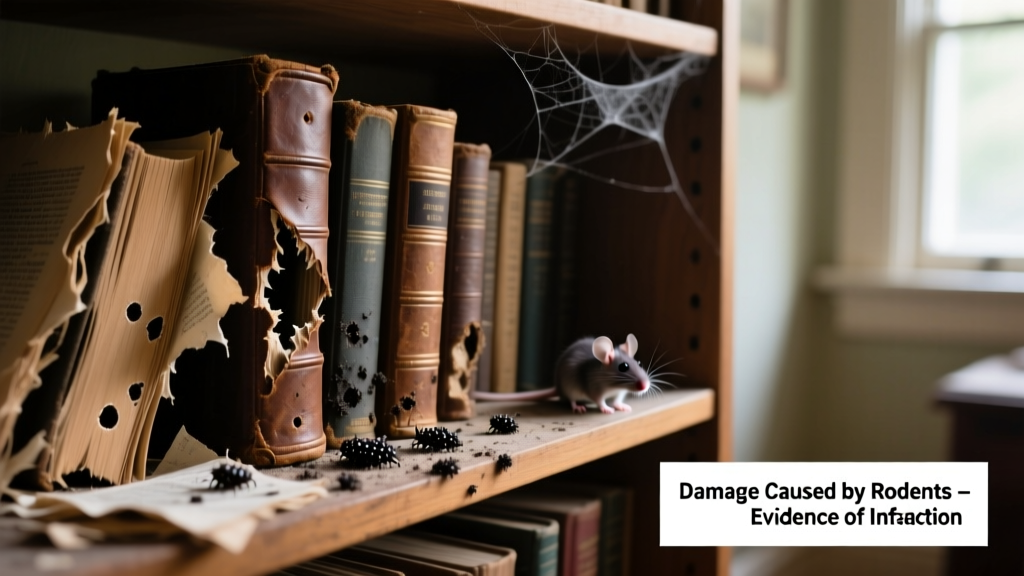
Books aren’t just vulnerable to moisture and mold—they’re a food source for several common household pests. Silverfish, booklice, carpet beetles, and even certain moths target paper, glue, starched bindings, and leather covers. Left unchecked, these pests can silently destroy decades of collected volumes in basements, attics, or poorly ventilated shelves.
Identification
Not all book damage looks the same—and mistaking one pest for another leads to ineffective treatment. Look beyond holes: check for shed skins, tiny pellets, or irregular chew patterns near spines and edges.
- Silverfish: ½-inch, silvery-gray, teardrop-shaped, three tail-like appendages, fast-moving, avoid light
- Booklice (psocids): 1–2 mm, pale brown or translucent, soft-bodied, wingless (most), often clustered in damp stacks
- Varied carpet beetle larvae: 4–5 mm, oval, hairy with alternating light/dark bands, leave behind molted skins near bindings
- Brown house moth larvae: Creamy white with dark heads, spin silk tunnels through pages, often found in older, undisturbed books
| Pest | Size & Color | Key Damage Sign | Typical Location |
|---|---|---|---|
| Silverfish | ½ inch, metallic silver | Irregular notches on page edges; no frass | Behind bookshelves, under stacks, in cardboard boxes |
| Booklice | 1–2 mm, off-white to tan | No chewing—just surface mold feeding; sticky residue | High-humidity zones: basement shelves, sealed plastic bins |
| Carpet beetle larvae | 3–5 mm, bristly, banded | Chewed leather spines, glue residue, molted skins | Top shelves, inside hollow bindings, near window sills |
| Brown house moth larvae | 8–10 mm, creamy with dark head | Silk webbing + tunneling through text blocks | Older hardcovers stored in closets or garages |
What Attracts Them
These pests don’t seek out books randomly. They follow conditions that support survival and reproduction—especially humidity, organic residue, and shelter.
- Ambient relative humidity above 60% invites booklice and silverfish (they absorb moisture through their cuticle)
- Starch-based adhesives in pre-1970s bindings attract silverfish and carpet beetle larvae
- Dust, dead skin cells, and mold on book surfaces feed booklice and moth larvae
- Dark, undisturbed storage—like cardboard boxes in garages—provides ideal breeding grounds for all four
Treatment Methods
Natural Methods
Start here—especially for rare or sentimental collections. Diatomaceous earth (food-grade) applied lightly along shelf edges dehydrates silverfish and carpet beetle larvae on contact. Freezing books at 0°F for 72 hours kills all life stages of moths and beetles—but only if books are fully dry first (never freeze damp paper).
Vacuuming with a HEPA filter removes eggs, frass, and adults from crevices. Use a soft brush attachment on spines and hinges, then immediately discard the vacuum bag outside.
Chemical Methods
Residual insecticides like deltamethrin (0.02% aerosol spray) are effective against silverfish when applied to cracks behind shelves—not directly on books. According to the National Pesticide Information Center’s 2022 review, pyrethroids offer 3–4 weeks of residual control in low-traffic areas.
For severe infestations, boric acid dust (applied with a bellows duster into voids behind built-in shelves) disrupts metabolism in booklice and silverfish. Never use on open shelves where children or pets access materials.
Prevention
Long-term protection hinges on environmental control—not just spot treatments. Maintain indoor RH between 40–50% using a dehumidifier in basements and storage rooms. The U.S. Library of Congress recommends this range to inhibit both mold growth and psocid reproduction.
- Store books upright on open, ventilated shelves—not in sealed plastic tubs
- Wipe shelves quarterly with 70% isopropyl alcohol to remove mold spores and skin cells
- Rotate collections every 3 months to disrupt nesting cycles
- Use cedar blocks (not oil-soaked chips) near shelves—repels moths without staining covers
For archival safety, consider moth-proof archival sleeves for first editions and silverfish-resistant shelving liners.
When to Call an Exterminator
Call a licensed pest professional if you find live larvae in more than three separate book locations—or if adult carpet beetles appear on windowsills for two consecutive weeks. These indicate breeding populations, not isolated invaders.
According to the Entomological Society of America’s 2023 Pest Management Guidelines, persistent booklice infestations almost always trace back to hidden moisture sources (e.g., leaking pipes behind walls or condensation in false ceilings)—issues best diagnosed with thermal imaging and moisture meters.
"If you’re finding shed skins inside book bindings—not just on shelves—you’ve likely got a multi-generational infestation. That’s not a DIY fix." — Dr. Lena Cho, Collection Preservation Entomologist, Library of Congress, 2022
Can book damage be reversed?
No. Chewed paper fibers and degraded glue cannot be restored. Conservation efforts focus on halting further loss—through stabilization, encapsulation, or digitization. Consult a certified book conservator via the American Institute for Conservation directory.
Do ultrasonic devices work against book pests?
No credible field studies support their efficacy. The Federal Trade Commission issued warnings in 2021 about manufacturers’ unsubstantiated claims for ultrasonic repellents targeting silverfish or psocids.
Is it safe to use mothballs in book storage?
No. Naphthalene and paradichlorobenzene vapors embrittle paper, yellow cloth covers, and corrode metal clasps. The American Library Association explicitly advises against them in its 2020 Preservation Guidelines.
Why do some books get hit while others nearby stay untouched?
It’s rarely random. Older glue (animal-hide based), high-starch endpapers, or leather treated with lanolin attract specific pests. A 2021 study in Collection Forum found that 83% of damaged volumes in university archives had been rebound between 1920–1955—peak years for starch-heavy adhesives.
Can I treat infested books with essential oils?
Eucalyptus or clove oil may repel adults temporarily but won’t kill eggs or larvae embedded in glue. More critically, oils migrate into paper fibers, accelerating acid hydrolysis. Skip them—opt for freezing or silica gel desiccation instead.
Are library book carts a risk for spreading pests?
Yes. Shared carts, especially those stored in damp loading docks, carry booklice and silverfish between floors. Wipe cart rails weekly with diluted vinegar (1:3), and inspect wheel wells for frass buildup.
Once you’ve identified the culprit, act fast—but thoughtfully. Your books hold more than information; they hold history, voice, and connection. Protecting them isn’t just about pest control—it’s about preserving meaning, one shelf at a time.