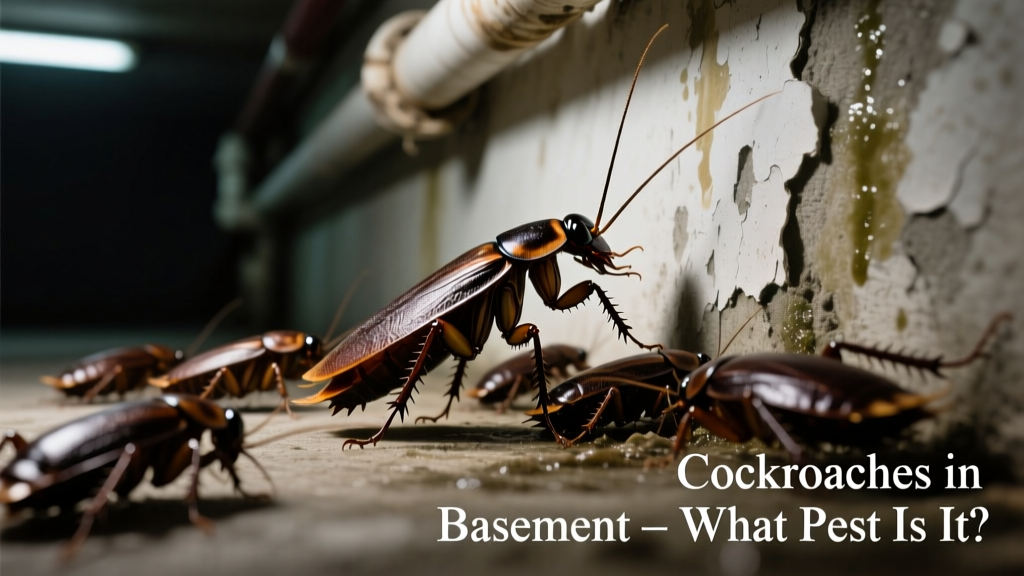
Cockroaches in your basement aren’t just unsanitary—they’re a sign of moisture, access points, and often, multiple generations already established in wall voids or under slabs. German, American, and Oriental cockroaches all appear in basements, but each behaves differently, breeds at different rates, and responds to distinct control tactics.
Identification
Basement cockroaches are most commonly one of three species—German (Blattella germanica), American (Periplaneta americana), or Oriental (Blatta orientalis). All thrive in damp, cluttered, low-light environments—but size, color, markings, and behavior differ sharply.
| Feature | German | American | Oriental |
|---|---|---|---|
| Size | 1/4–3/8 inch | 1–1.5 inches | 1–1.25 inches |
| Color | Tan with two dark parallel stripes on thorax | Reddish-brown with light tan edges on wings | Shiny black or dark brown |
| Wings | Full wings, but rarely flies | Full wings, capable of short glides | Wings cover abdomen but don’t enable flight |
| Preferred Habitat | Warm, humid, near food/water (e.g., sump pump area, laundry room) | Warm, moist, near drains or sewer lines; often enters via floor drains | Cooler, damp areas—under debris, in crawl spaces, behind furnaces |
| Egg Case (Ootheca) | Held externally for ~24–36 hrs before depositing; 30–40 nymphs per case | Carried ~1 day, then glued in hidden crevices; 12–16 nymphs per case | Carried ~12 hrs, then deposited in sheltered spots; 16–18 nymphs per case |
Look for live adults at night with a flashlight—especially near pipes, sump pits, or where concrete meets foundation walls. Check behind water heaters, under stored boxes, and inside floor drain grates.
- German roaches leave tiny, pepper-like droppings near cabinets or baseboards
- Oriental roaches produce larger, cylindrical feces resembling mouse droppings but with blunt ends and a greasy sheen
- American roaches may emit a musty odor detectable near infested drains or utility rooms
What Attracts Them
Basements offer the trifecta: moisture, warmth, and shelter. Leaky sump pumps, condensation on cold pipes, cracked foundation walls, and poor ventilation create ideal conditions. But attraction isn’t passive—it’s driven by specific cues.
According to the National Pest Management Association’s 2022 Residential Pest Survey, 78% of basement cockroach reports involved at least one active moisture source within 10 feet of the primary activity zone. That includes:
- Standing water in sump pits or window wells
- Leaking water heater or washing machine supply lines
- Unsealed gaps around plumbing penetrations (≥1/8 inch wide)
- Piles of cardboard, old furniture, or unused carpet padding
- Overgrown ivy or mulch within 18 inches of foundation walls
Treatment Methods
Natural First Steps
Start with sanitation and physical removal—especially if numbers are low and you’ve confirmed German or Oriental roaches. Vacuum adults and oothecae with a shop vac (dispose of bag immediately outdoors). Use silica gel dust (not diatomaceous earth) in wall voids and behind baseboards—this desiccant works even in high-humidity basements.
Place bait stations containing boric acid + sugar paste in corners, behind appliances, and along pipe chases. Rotate baits every 10 days to prevent aversion. Avoid sprays at this stage—they scatter roaches deeper into walls.
Chemical Options
When populations exceed 10–15 visible adults per night, targeted insecticides become necessary. The U.S. EPA recommends using products with imidacloprid or fipronil as active ingredients for basement applications—these resist moisture degradation better than pyrethroids.
Apply microencapsulated sprays only to harborage zones: behind outlet covers, under door thresholds, and along foundation cracks. Never spray directly into sump pits or near electrical panels without disconnecting power first.
"In basements, residual dusts outperform liquid sprays 3-to-1 when humidity exceeds 65%. I see failed treatments almost exclusively where technicians skipped dusting wall voids and relied only on perimeter sprays." — Dr. Lena Cho, Entomologist, Purdue University Extension, 2023
Prevention
Sealing entry points and managing moisture stops new infestations before they begin. Focus on structural fixes—not just cleaning.
- Install metal mesh screens over floor drains and sump pump vents
- Seal cracks in concrete floors and walls with hydraulic cement (not caulk)
- Use dehumidifiers to maintain basement RH below 50%—Oriental roaches decline sharply below that threshold
- Store items in sealed plastic totes—not cardboard or fabric bins
- Trim shrubs and vines to 24 inches from foundation walls
Pair these with quarterly inspections of pipe chases and utility entry points. Replace worn weatherstripping on basement doors—especially those leading to garages or crawl spaces. For more on sealing techniques, see our sealing basement cracks guide.
When to Call an Exterminator
Call a licensed pest professional if you see:
- More than 20 live roaches in a single 15-minute inspection
- Roaches during daylight hours (indicates overcrowding and advanced infestation)
- Evidence of nesting—clumped oothecae, molted skins, or aggregations behind drywall
- Roaches emerging from ceiling fixtures, HVAC ducts, or interior walls upstairs
Most reputable firms use thermal imaging to locate wall void nests and apply targeted dusts via drill-and-fill methods. Ask for a written treatment plan that specifies product names, application sites, and re-inspection intervals. Avoid companies offering “one-time fogging” packages—they rarely address basement-specific harborages.
Why do cockroaches prefer basements over other parts of the house?
Basements provide stable temperatures year-round, higher ambient humidity (especially near foundations), and minimal human disturbance. Unlike kitchens or bathrooms, basements rarely get thorough vacuuming or disinfecting—so food residue, skin flakes, and fungal growth accumulate unnoticed. Oriental roaches, in particular, thrive at 55–70°F—the exact range found in unconditioned basements across the Midwest and Northeast.
Can cockroaches come up through floor drains?
Yes—especially American and Oriental roaches. They can survive underwater for up to 40 minutes and navigate smooth PVC pipes using tarsal claws. A 2021 study in the Journal of Economic Entomology documented American roaches traveling 12 feet upward through 2-inch-diameter vertical drain lines. Install removable drain plugs or use enzymatic drain cleaners weekly to disrupt biofilm—a key food source.
Do cockroaches in the basement mean my house is dirty?
No. While clutter and crumbs help sustain them, cockroaches enter clean homes daily through utility lines, cracks, and vents. In fact, 63% of homes with confirmed German roach infestations in the NPMA’s 2022 survey reported “regular deep cleaning” but had undetected moisture issues behind walls. Focus on moisture control—not shame.
Will sealing basement windows stop cockroaches?
Partially. Windows are secondary entry points—most roaches enter via plumbing, electrical conduits, or foundation cracks. However, sealing basement windows with compression weatherstripping reduces drafts that carry pheromone trails indoors and blocks access for flying males (especially American roaches). Pair this with vent screen installation for full perimeter defense.
How long does it take to eliminate a basement cockroach infestation?
With consistent treatment, German roaches drop to non-detectable levels in 4–6 weeks; Oriental and American roaches require 8–12 weeks due to longer development cycles and greater environmental resilience. Success hinges on eliminating all harborages—not just killing visible adults. Re-treat every 10 days for the first month, then shift to monitoring with sticky traps.
Are basement cockroaches dangerous to pets?
Indirectly. Roaches carry Salmonella, E. coli, and parasitic worms—some of which can infect dogs and cats through contaminated water bowls or grooming. More critically, roach feces and shed skins contain potent allergens linked to feline asthma exacerbations (per the American College of Veterinary Allergy, 2021). Keep pet food sealed and wash bowls daily.
Eliminating basement cockroaches isn’t about eradicating bugs—it’s about restoring environmental balance. Fix the leak, seal the gap, reduce the clutter, and you’ll break the cycle faster than any spray ever could. For ongoing monitoring, try our cockroach sticky trap placement guide to catch early recurrences before they spread upstairs.