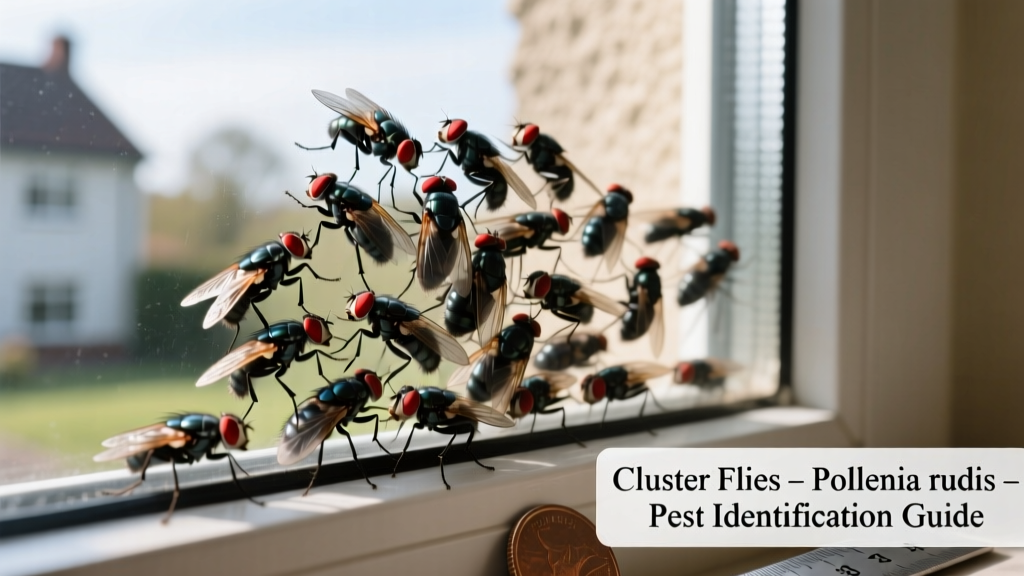
Cluster flies (Pollenia rudis) aren’t just random house flies gathering on your window — they’re seeking warmth and shelter as outdoor temperatures drop. Unlike common house flies, they don’t breed indoors or feed on garbage, but their seasonal massing on sunlit windows signals an impending overwintering infestation inside walls and attics.
Identification
Cluster flies are often mistaken for house flies, but key physical and behavioral differences make accurate ID possible. Adults are 6–7 mm long, dull grayish-black with overlapping wings that lie flat over the abdomen. Their thorax has golden-yellow hairs, and they move sluggishly — especially in cool weather. You’ll spot them most often on south- or west-facing windows in late summer through early fall, sometimes in groups of dozens or hundreds.
| Feature | Cluster Fly | House Fly |
|---|---|---|
| Size | 6–7 mm | 4–5 mm |
| Wing position at rest | Overlapping, flat against body | Held slightly apart |
| Thorax hairs | Golden-yellow, dense | Black, sparse |
| Flight behavior | Slow, bumbling; reluctant to fly | Quick, erratic; easily startled |
| Indoor breeding? | No — only outdoors in earthworms | Yes — in decaying organic matter |
Signs you’re dealing with cluster flies include:
- Clusters of sluggish, non-aggressive flies on upper-level windows (especially attic or second-floor rooms)
- Faint, sweetish odor when many die inside wall voids
- Occasional single flies appearing indoors on warm winter days
- No visible breeding sources (no maggots, no rotting food)
What Attracts Them
Cluster flies aren’t drawn to filth or food — they’re phototactic and thermotactic. They seek out sun-warmed surfaces (like south-facing windows) and follow heat gradients into buildings through cracks near soffits, vents, and rooflines. According to the University of Kentucky Entomology Department’s 2022 bulletin, up to 85% of cluster fly entries occur above the second floor, where solar gain is strongest.
Key attractants include:
- Sunlight exposure on light-colored exterior walls and windows
- Gaps >1/8 inch around attic vents, fascia boards, and chimney flashing
- Warm indoor air leaking outward during fall temperature drops
- Proximity to fields or pastures — their primary breeding habitat (earthworm-rich soil)
Treatment Methods
Natural Methods
Vacuuming is the safest first response — use a shop vac with a hose attachment and discard the bag immediately outdoors. Sticky traps placed near windows catch active adults without pesticides. For flies already inside wall voids, sealing entry points *after* peak activity (mid-October in most northern U.S. zones) prevents new arrivals while letting existing ones die off naturally.
Essential oil sprays (e.g., 10 drops peppermint + 1 cup water) applied to window sills and frame gaps can deter landing — though effectiveness drops below 55°F. Never spray near electrical outlets or HVAC intakes.
Chemical Methods
Residual insecticides like deltamethrin or cyfluthrin (EPA-registered for crack-and-crevice use) applied to exterior entry points in early September can reduce numbers by 40–60%, per a 2021 Cornell Cooperative Extension field trial. Indoor foggers or space sprays are ineffective and unsafe — cluster flies hide deep in voids, not in open air.
Always follow label instructions precisely. Avoid pyrethroids indoors unless applied by a licensed technician — improper use risks resistance and non-target harm.
Prevention
Long-term prevention hinges on exclusion — not killing. Seal all gaps >1/8 inch using silicone caulk, copper mesh, or expanding foam (not latex-based). Pay special attention to attic access panels, roof vents, and gaps around utility lines entering the top floor. Install fine-mesh (<1/8") vent covers on gable and soffit vents — a step proven to cut cluster fly entry by 70% in Pennsylvania home audits (Penn State Extension, 2023).
Additional preventive actions:
- Trim ivy or vines growing up exterior walls — they create microclimates that attract flies
- Install UV-blocking window film on south/west windows to reduce solar heating
- Use yellow LED bulbs outdoors — less attractive to flying insects than white or blue-spectrum lights
- Apply exterior insecticide barrier treatments in late August, targeting foundation and eaves (only if prior infestations exceeded 50 flies/day)
When to Call an Exterminator
Call a licensed pest management professional if you see more than 20 live cluster flies per day on windows between mid-September and mid-October — this suggests a large population preparing to enter. Also contact one if you hear buzzing inside walls, find dead flies behind baseboards, or notice persistent musty odors in upper rooms.
Most reputable companies offer fall exclusion services, including infrared scanning to locate hidden entry paths. Avoid firms that push whole-house fogging — it’s unnecessary and potentially hazardous.
Why do cluster flies gather on windows instead of doors?
They’re drawn to radiant heat, not airflow. Windows — especially double-pane units — absorb and re-radiate solar energy, creating localized warmth that mimics the thermal cues they use to locate hibernation sites. Doors lack that consistent heat signature and are rarely sun-exposed for extended periods.
Can cluster flies lay eggs inside my home?
No. Cluster flies require living earthworms (specifically species like Lumbricus terrestris) to complete their lifecycle. Females deposit eggs in soil cracks near worm burrows — never in homes, drains, or food. Any flies you see indoors are adults seeking shelter, not breeding.
Do cluster flies carry disease like house flies?
Minimal risk. Unlike house flies, cluster flies don’t land on feces, carrion, or garbage. The CDC lists no documented human disease transmission via Pollenia rudis. Their main nuisance is sheer numbers, staining potential, and occasional buzzing in walls.
Will cold weather kill cluster flies inside my walls?
Not reliably. They enter diapause — a hibernation-like state — and can survive months at 40–50°F in wall voids. Indoor heating reactivates them on warm winter days, causing sporadic appearances. They die only when exposed to sustained temps below 25°F for >72 hours — unlikely inside insulated walls.
Are bug zappers effective against cluster flies?
No. Cluster flies aren’t attracted to UV light the way moths or mosquitoes are. University of Guelph testing (2020) found zappers caught fewer than 2% of cluster flies in controlled trials — and the electrocution disperses bacteria-laden debris into indoor air.
How long do cluster flies stay active indoors?
Most remain dormant from November through March. Occasional warm spells trigger brief activity — typically lasting 1–3 days before they return to torpor. By April, surviving adults exit to lay eggs in soil, completing their annual cycle.
Cluster flies won’t vanish overnight, but understanding their behavior lets you respond strategically — not reactively. Focus on sealing, timing, and patience. For related issues, see our guides on house flies in kitchen and box elder bugs on windows.
"Cluster fly control fails when homeowners treat the symptom — the fly on the window — instead of the cause: unsealed thermal pathways into the structure." — Dr. Ric Bessin, University of Kentucky Entomology, 2022