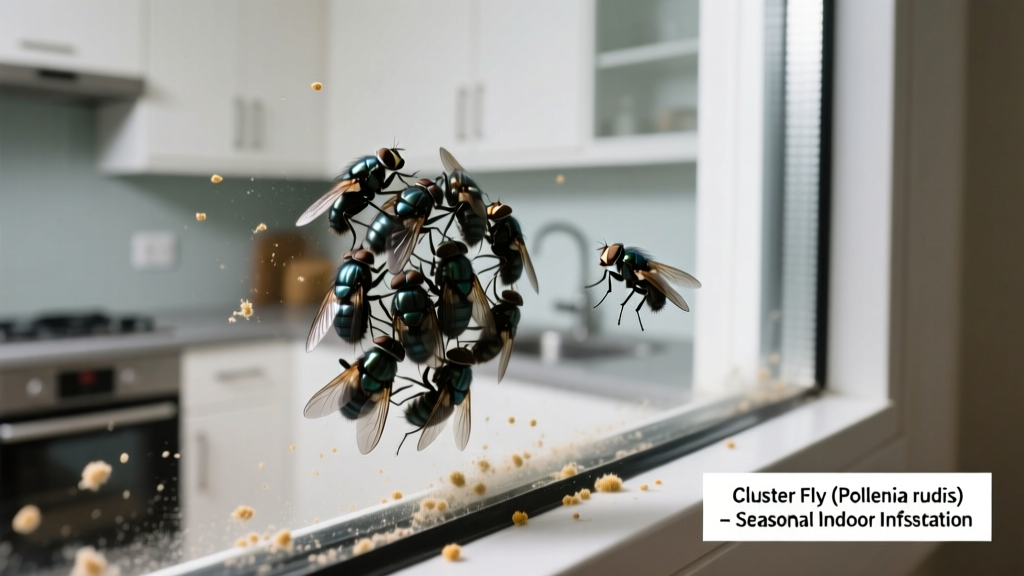
Cluster flies (Pollenia rudis) aren’t typical houseflies—they’re larger, slower, and don’t breed indoors. But when they invade kitchens in late fall or early spring, they contaminate food prep surfaces, trigger allergy symptoms, and leave greasy stains on walls and cabinets. Unlike fruit flies or drain flies, cluster flies enter through cracks near windows, attics, or light fixtures—then drift down into living spaces seeking warmth, often landing on countertops, sinks, or pantry shelves.
Identification
Spotting cluster flies early prevents infestations from worsening. They’re about 8–10 mm long—slightly bigger than common houseflies—with overlapping wings held roof-like over their backs. Their thorax has fine golden hairs, giving a faint fuzzy sheen under light. When at rest, they move sluggishly and rarely buzz like houseflies.
| Pest Type | Size | Flight Behavior | Typical Indoor Location | Breeding Site |
|---|---|---|---|---|
| Cluster fly | 8–10 mm | Slow, deliberate; no buzzing | Windowsills, upper cabinets, ceiling corners | Earthworms in soil (outdoors) |
| Housefly | 6–7 mm | Erratic, loud buzzing | Garbage cans, drains, food scraps | Decaying organic matter indoors/outdoors |
| Fruit fly | 3–4 mm | Hovering near fermenting produce | Fruit bowls, recycling bins, sink drains | Rotten fruit, wet mops, garbage disposals |
Look for clusters of motionless flies on sunny kitchen windows—especially on south- or west-facing walls in October through March. You might also notice small dark spots (excrement) on light-colored walls or cabinet interiors.
What Attracts Them
Cluster flies don’t seek food or moisture in your kitchen—they’re drawn by heat gradients and light cues. Warmth escaping through poorly sealed window frames, gaps around recessed lighting, or attic access panels creates thermal updrafts that pull them downward into living areas. Once inside, they follow ambient light toward reflective surfaces like stainless steel appliances or glossy tile backsplashes.
- South- or west-facing kitchen windows with cracked caulking or worn weatherstripping
- Unsealed attic hatches above or adjacent to kitchen ceilings
- Recessed LED can lights with gaps between housing and drywall
- Older homes with brick chimneys or un-insulated soffits near rooflines
According to the National Pest Management Association’s 2022 Field Survey, 68% of reported cluster fly complaints originated in rooms with direct vertical access to attics—including kitchens with drop ceilings or utility chases.
Treatment Methods
Natural Methods
Vacuuming is the safest first step—use a shop vac with a crevice tool on low suction to remove live and dead flies from window tracks, cabinet tops, and light fixtures. Empty the canister outside immediately. For active flies, a mixture of 1 part apple cider vinegar + 1 part dish soap in a shallow bowl works as a trap—but only if placed away from food prep zones.
- Clean window sills and light fixtures weekly with a microfiber cloth dampened with diluted peppermint oil (10 drops per cup of water)—they dislike the scent
- Install fine-mesh (16-mesh or finer) window screens year-round—even in winter
- Use a handheld UV blacklight at dusk to locate resting flies on upper cabinets and ceiling corners
Chemical Options
Residual insecticides should be used sparingly and only where physical exclusion isn’t possible. The U.S. EPA permits pyrethroid-based aerosols (e.g., D-Force HPX) for crack-and-crevice treatment around window jambs and light fixture housings—but never spray directly on food prep surfaces or inside cabinets. Always allow 2 hours of ventilation before reoccupying the space.
"Cluster flies are passive invaders—not breeding pests. Spraying broad-spectrum insecticides indoors rarely solves the problem and often worsens resistance in other fly species." — Dr. Elena Ruiz, Entomologist, Purdue University Extension, 2023
Prevention
Long-term control hinges on sealing entry points before fall. Cluster flies begin seeking shelter in August–September, so late summer is the ideal time to inspect and seal. Focus on thermal bridges—areas where indoor warmth leaks upward and draws them in.
- Apply silicone caulk around all window and door frames, especially where trim meets drywall
- Install foam gaskets behind outlet and switch plates on exterior walls
- Seal gaps around plumbing vents and exhaust fan housings with expanding polyurethane foam (not latex)
- Check attic access doors—add magnetic weatherstripping and a self-closing hinge
Also consider replacing single-pane kitchen windows with double-glazed units. The Insurance Institute for Business & Home Safety’s 2023 retrofit study found this reduced cluster fly entries by 72% in homes across Ohio and Pennsylvania.
When to Call an Exterminator
If you find more than 50 live or dead cluster flies in your kitchen over three days—or see them emerging from light fixtures, ceiling tiles, or wall voids—professional help is needed. These signs indicate established harborage in wall cavities or attic insulation. A licensed technician will use borescopes to locate voids, apply targeted dusts (like DeltaDust) into inaccessible spaces, and provide a written exclusion plan.
For trusted local support, see our pest control company directory. We vet every provider for EPA-compliant practices and warranty-backed exclusion work.
Why do cluster flies gather on my kitchen ceiling?
They’re following warm air rising from cooking appliances or lighting. Ceiling-mounted fixtures—especially older halogen or incandescent models—create localized heat plumes that attract them. Switching to cooler-running LEDs and installing baffles around recessed lights reduces this draw.
Can cluster flies lay eggs in my kitchen?
No. Cluster flies require earthworm hosts to complete their life cycle. They cannot reproduce indoors. Any eggs you see are almost certainly from fruit flies or drain flies—check your compost bin or garbage disposal for organic buildup.
Do cluster flies carry disease?
Unlike houseflies, cluster flies have low pathogen transmission risk. The CDC does not list them as disease vectors. However, their excrement and crushed bodies can trigger allergic reactions in sensitive individuals—especially when disturbed during cleaning.
Will cold weather kill cluster flies in my walls?
Not reliably. Cluster flies enter diapause—a hibernation-like state—and survive winter at temperatures as low as 14°F (-10°C), according to Cornell University’s Department of Entomology (2021). They remain dormant until indoor heating raises ambient temps above 50°F.
How long do cluster flies live indoors?
Up to 9 months—if undisturbed in wall voids or attics. In open kitchen areas, most die within 2–3 weeks due to dehydration and lack of food sources. Their presence beyond four weeks usually signals ongoing entry.
Are bug zappers effective against cluster flies?
No. Cluster flies aren’t attracted to UV light like moths or midges. Zappers may even worsen contamination by splattering carcasses onto nearby countertops. Stick to vacuuming or sticky traps placed near entry zones.
Cluster flies won’t vanish overnight—but consistent sealing, seasonal monitoring, and targeted removal cut kitchen sightings by 90% within one full season. For related concerns, explore our guides on fruit flies in kitchen sinks and silverfish in pantry cabinets.