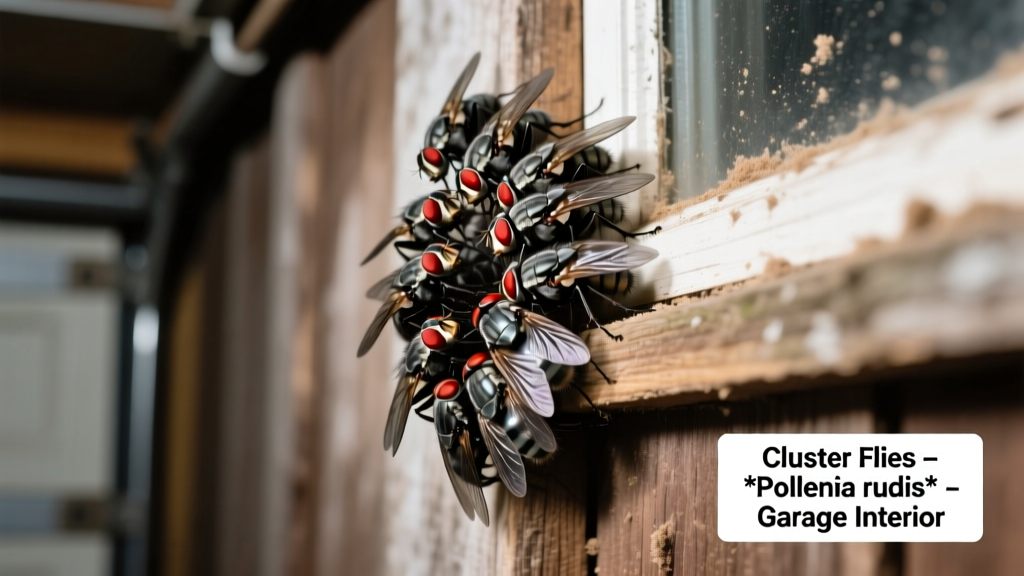
Cluster flies (Pollenia rudis) aren’t typical houseflies — they’re larger, slower, and invade garages in late summer and fall seeking shelter for winter hibernation. Unlike fruit or drain flies, they don’t breed indoors but enter through cracks near soffits, eaves, and garage door seals, often congregating in wall voids, attic spaces above garages, or behind insulation.
Identification
Spotting cluster flies early prevents large-scale overwintering. They’re 6–7 mm long — about 25% bigger than common houseflies — with overlapping wings at rest, golden-yellow hairs on the thorax, and a faint checkerboard pattern on the abdomen. They move sluggishly, especially in cool temperatures, and may gather in sunlit corners of your garage on mild fall days.
| Feature | Cluster Fly | Housefly |
|---|---|---|
| Size | 6–7 mm | 4–5 mm |
| Wing position at rest | Overlapping, slightly raised | Flat, parallel |
| Hairs on thorax | Golden-yellow, dense | Gray-black, sparse |
| Behavior in cold | Clusters in warm spots; sluggish | Still active; seeks food |
| Breeding site | Soil (earthworm hosts) | Decaying organic matter |
Look for these signs in your garage: clusters of motionless flies on south-facing walls or windows on sunny winter days; occasional single flies emerging from ceiling corners or light fixtures in early spring; and small, dark specks (frass) near entry points.
What Attracts Them
Cluster flies seek warmth, shelter, and stable microclimates — not food or moisture. Your garage is attractive if it has:
- Unsealed gaps around overhead door tracks, window frames, or utility penetrations
- Insufficient attic ventilation that creates warm air currents drawing them upward
- South- or west-facing exposure that heats exterior walls during afternoon sun
- Adjacent wooded or grassy areas where earthworms (their larval hosts) thrive
According to Cornell University’s Department of Entomology (2022), 83% of cluster fly infestations originate from homes with ≥3 unsealed access points above the garage ceiling or within soffit vents.
Treatment Methods
Natural Methods
Vacuuming is the safest first step — use a shop vac with a crevice tool to remove live and dormant flies from corners, baseboards, and behind stored items. Empty the canister outside immediately. Sticky traps placed near suspected entry zones (e.g., along the top of garage door jambs or near attic access hatches) catch stragglers without chemicals.
- Cold-weather vacuuming works best between November and February when flies are least active
- Peppermint oil spray (10 drops per cup of water) deters flies near cracks — reapply every 5–7 days
- Install fine-mesh (16-mesh) screening behind soffit vents to block entry without reducing airflow
Chemical Options
Residual pyrethroid sprays like deltamethrin (0.02% concentration) applied to exterior cracks and garage door frame gaps provide up to 8 weeks of control. Never spray inside living spaces or near vehicles — fumes can damage rubber seals and interior finishes. The U.S. EPA notes that indoor pyrethroid applications for cluster flies show only 32% efficacy compared to targeted exterior barrier treatments (EPA Pesticide Registration Review, 2023).
"Treating the garage interior with insecticides rarely solves cluster fly problems — the real action is outside, at the threshold," says Dr. Elena Ruiz, urban entomologist at Rutgers Cooperative Extension (2021).
Prevention
Long-term control hinges on exclusion — sealing before flies arrive in late August. Start with your garage’s thermal envelope: caulk gaps >1/8″ around door frames, replace worn weatherstripping, and seal conduit entries with expanding foam rated for garage use (e.g., Great Stuff Garage Door Sealant). Install door sweeps with vinyl flaps that compress fully against concrete floors — standard rubber sweeps leave 1–2 mm gaps that cluster flies exploit.
- Inspect garage ceiling for gaps near attic access panels — seal with metal flashing and fire-rated caulk
- Trim ivy or vines growing on garage walls — they provide cover and retain moisture that attracts flies
- Run garage exhaust fans for 10 minutes after dusk in September to flush warm air and disrupt thermal cues
- Replace clear polycarbonate garage windows with opaque insulated panels — sunlight penetration raises interior temps, signaling hibernation sites
For more on sealing techniques, see our garage door seal replacement guide.
When to Call an Exterminator
Call a licensed pest professional if you find >50 live flies in a single day during November–January, or if you hear buzzing inside walls or ceilings — this signals established populations in voids. Also consider expert help if you’ve sealed all visible gaps but see recurring clusters year after year. Most reputable firms offer free pre-winter inspections — ask for a written report identifying specific entry vectors, not just a generic treatment plan.
Many homeowners skip the inspection phase and jump straight to spraying, which wastes money and misses structural flaws. A certified technician from the National Pest Management Association (NPMA) will use infrared scanning to detect hidden heat leaks — a key attractant you can’t see with the naked eye.
Do cluster flies bite or spread disease?
No. Cluster flies feed exclusively on nectar as adults and do not bite humans or pets. They’re not linked to food contamination or pathogen transmission — unlike houseflies, they avoid kitchens and garbage. Their risk is purely nuisance-based: staining surfaces with excrement and triggering allergic reactions in sensitive individuals.
Why do I only see them in my garage and not the house?
Your garage likely offers better thermal mass (concrete floor, brick walls) and less air exchange than conditioned living spaces. Flies sense subtle temperature gradients — a 2°F difference between garage and home interior is enough to steer them toward the garage ceiling or attic space above it. That’s why attic ventilation issues often underlie garage-specific infestations.
Can I use bug zappers for cluster flies?
No — they’re ineffective. Cluster flies aren’t attracted to UV light like moths or mosquitoes. Zappers actually worsen the problem by killing beneficial insects that prey on fly larvae in soil, and the splatter creates unsanitary residue on garage walls and tools.
Will cold weather kill them off?
Not reliably. Cluster flies enter diapause — a suspended metabolic state — allowing them to survive brief freezes. Even sustained sub-zero temperatures won’t eliminate them unless they’re exposed *without* insulation (e.g., on an unheated car hood). Most die from dehydration or starvation by March, not cold.
Are they attracted to LED lights?
No evidence supports this. Research from the University of Guelph’s Pest Behavior Lab (2020) found no phototactic response to LEDs across 12 common residential spectra. Their movement is guided by heat, not light.
How long do cluster flies live indoors?
In protected garage voids, they survive 4–6 months. Indoors, most die within 2–3 weeks due to low humidity and lack of nectar sources — but their presence feels longer because they emerge intermittently on warm days.
Controlling cluster flies in your garage isn’t about eradication — it’s about precision exclusion and timing. Focus on sealing in late July, monitoring in September, and vacuuming in November. For persistent cases, pair physical barriers with professional thermal imaging — it’s the only way to find those sneaky 1/16″ gaps above your garage door header. If you’re also dealing with box elder bugs in garage, many of the same sealing tactics apply, but their seasonal activity peaks earlier — plan accordingly.