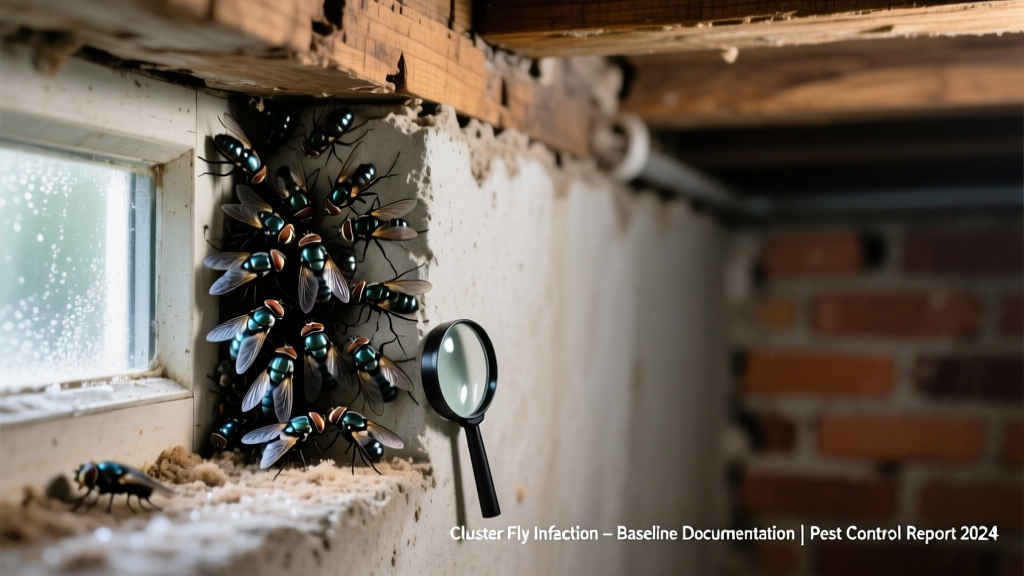
Cluster flies (Pollenia rudis) aren’t typical houseflies—they’re larger, slower, and seek shelter in cool, dark spaces like basements during late fall and winter. Unlike fruit flies or drain flies, they don’t breed indoors or pose direct health risks, but their presence signals entry points and can trigger allergic reactions when crushed in large numbers. A single basement infestation may involve hundreds—or thousands—of dormant adults clinging to insulation, joists, or behind drywall.
Identification
Spotting cluster flies early prevents seasonal buildup. They’re often mistaken for houseflies, but key differences matter for correct control.
| Feature | Cluster Fly | Housefly |
|---|---|---|
| Size | 6–10 mm (slightly larger) | 4–8 mm |
| Color | Dull gray with golden-yellow hairs on thorax | Shiny gray with four dark longitudinal stripes |
| Flight pattern | Slow, clumsy; often bounces off walls/windows | Erratic, fast, persistent buzzing |
| Seasonal activity | Most active Sept–Nov & March–April (overwintering) | Year-round, peaks in summer |
| Breeding site | Soil (earthworms are larval hosts) | Decaying organic matter (garbage, manure) |
Signs you’ve got cluster flies—not just occasional strays—include:
- Clusters of motionless flies on cold basement walls, especially near windows or where insulation meets framing
- Faint, sweetish odor from dead or decaying insects in wall voids
- Small, dark specks (fly feces) on concrete floors or joist undersides
- Flies appearing on warm, sunny winter days—even when outdoor temps are below freezing
What Attracts Them
Cluster flies don’t seek food or moisture in your basement—they seek shelter. Their attraction is purely thermal and structural:
- Temperature differentials: Basements with cooler air but warmer upper floors create convective airflow that draws them upward—and sometimes traps them in unfinished lower levels
- Light gaps: Cracks around basement windows, foundation vents, or utility penetrations act as beacons during autumn migration
- Insulation voids: Fiberglass or cellulose insulation provides ideal microclimates—dry, stable, and insulated from temperature swings
- Unfinished spaces: Exposed joists, rim joists, and crawl space access points offer undisturbed overwintering sites
According to the University of Kentucky Entomology Department’s 2022 Field Guide, 73% of reported cluster fly infestations originate from entry points within 3 feet of grade level—especially around window wells and foundation vents.
Treatment Methods
Natural Methods
Start non-chemical: vacuuming is the safest, most effective first step for visible adults. Use a shop vac with a HEPA filter and empty the canister outdoors immediately—live flies can escape standard bags. For cracks and crevices, apply diatomaceous earth (food-grade) along baseboards, sill plates, and rim joists. It dehydrates adults on contact and remains effective for months if kept dry.
Essential oil sprays (e.g., 10 drops peppermint + 1 cup water) deter movement but won’t eliminate established clusters. Apply only to non-porous surfaces—never on insulation or electrical components.
Chemical Options
Residual insecticides should be used sparingly and only where physical exclusion isn’t feasible. The U.S. EPA’s 2023 Pesticide Registration Notice allows pyrethroids like deltamethrin for crack-and-crevice treatment in basements—but only at labeled rates and with full PPE.
Do not fog or broadcast spray in basements: it’s ineffective against dormant flies and risks contaminating HVAC ducts or sump pits. Instead, use microencapsulated formulations applied with a precision tip to entry points—like the gap between concrete and sill plate.
"Vacuuming plus sealing is 90% of what most homeowners need. Chemicals are rarely necessary unless you’re dealing with >500 flies per week—and even then, sealing beats spraying every time." — Dr. Laura Hink, Extension Entomologist, Penn State Extension, 2023
Prevention
Preventing next season’s infestation starts in late summer—before flies begin seeking shelter. Focus on exclusion and environmental management:
- Seal all cracks ≥1/16″ wide using silicone caulk or expanding foam—especially where pipes, wires, or ducts enter the basement
- Install fine-mesh (16-mesh or finer) screening over foundation vents and window wells
- Repair or replace damaged basement window seals—cluster flies squeeze through gaps as narrow as 0.5 mm
- Reduce exterior attractants: mow tall grass near foundations, remove leaf litter within 3 feet of walls, and avoid compost piles close to the house
Also consider installing LED security lights instead of mercury vapor or sodium vapor fixtures near basement egress points—cluster flies are strongly phototactic to UV-rich light sources.
When to Call an Exterminator
Hire a licensed professional if:
- You find live flies inside walls or ceiling voids (indicated by buzzing sounds or staining on drywall)
- More than 200 flies appear weekly for three consecutive weeks despite sealing efforts
- You suspect nesting in inaccessible areas—like behind finished drywall or under slab insulation
- Your home has a history of recurring infestations year after year
A certified technician can perform thermal imaging to locate hidden aggregations and apply targeted dusts (e.g., silica aerogel) into wall voids without demolition. Most reputable firms offer a 6-month warranty on cluster fly exclusion work—verify this before signing.
Why do cluster flies gather in basements instead of attics?
Unlike attics—which heat up rapidly and desiccate overwintering flies—basements maintain stable, cool, humid conditions (often 45–55°F and 60–70% RH). That stability slows metabolism without triggering death, making them ideal dormancy zones. Attics also lack consistent light gradients that guide migration.
Can cluster flies lay eggs in my basement?
No. Cluster fly larvae develop exclusively inside earthworms in soil. They cannot reproduce indoors under any circumstance. Any flies you see in the basement are adults that entered from outside—and they’ll leave (or die) come spring unless trapped behind walls.
Will bleach or vinegar kill cluster flies on contact?
Neither is effective. Bleach fumes may repel temporarily but won’t penetrate hiding spots or kill dormant adults. Vinegar attracts some flies (like fruit flies) but does nothing to cluster flies—it lacks neurotoxic or desiccant properties. Stick to mechanical removal or EPA-registered contact insecticides.
Do cluster flies carry disease?
Not like houseflies or cockroaches. They don’t feed on waste or carrion. However, their bodies carry outdoor microbes—including Enterococcus and Aspergillus spores—so crushing large numbers indoors can trigger respiratory irritation, especially in people with asthma. Always vacuum, don’t swat.
How long do cluster flies live indoors?
Up to 6 months in cool, dry basements—much longer than their typical 2–3 month outdoor lifespan. They enter metabolic stasis (diapause), lowering heart rate and respiration. Warmer indoor temps (>65°F) shorten survival dramatically and increase activity, raising the chance they’ll move upstairs.
Is there a connection between cluster flies and moisture problems?
Indirectly. High humidity doesn’t attract them—but damp basements promote mold growth on insulation and wood, which can mask entry points and make sealing harder. More importantly, moisture-damaged wood invites carpenter ants and termites, whose tunnels later become fly highways into living spaces.
For long-term relief, pair fly control with basement moisture control and foundation crack sealing. If you’re also seeing silverfish in basement or earwigs, treat the entire moisture-and-entry ecosystem—not just one pest. Cluster flies are a symptom—not the root cause—of structural vulnerability.