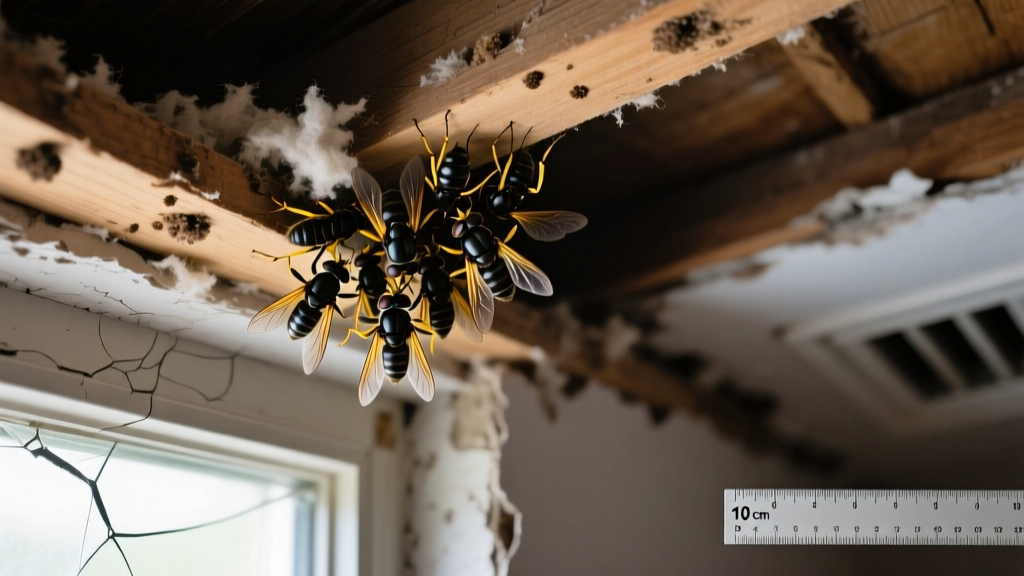
Cluster flies (Pollenia rudis) aren’t typical houseflies — they’re larger, slower, and invade attics in late summer and fall to overwinter. Unlike common flies, they don’t breed indoors or spread disease directly, but their sheer numbers (hundreds or thousands per attic) cause staining, odor, and panic when they emerge on warm winter days.
Identification
Spotting cluster flies early prevents spring swarms. They’re often mistaken for houseflies, but key differences matter for control.
| Feature | Cluster Fly | House Fly |
|---|---|---|
| Size | 6–7 mm (slightly larger) | 4–5 mm |
| Color | Dull gray with golden hairs on thorax | Shiny gray with four dark thoracic stripes |
| Flight pattern | Slow, clumsy; often lands on windows or walls | Quick, erratic; buzzes near food or garbage |
| Origin of infestation | Enters from outdoors to overwinter | Breeds indoors in decaying organic matter |
| Seasonal activity | Fall through early spring | Year-round, peaks in summer |
Look for these signs in your attic:
- Clusters of motionless flies on south- or west-facing roof sheathing or insulation in October–November
- Dark, greasy spots on rafters or insulation (fly excrement)
- Faint, sweetish odor from accumulated dead flies
- Sudden fly activity on sunny winter days near attic vents or light fixtures
What Attracts Them
Cluster flies seek warmth and shelter — not food or moisture. They’re drawn to specific attic conditions that mimic natural hibernation sites like rock crevices or hollow trees.
- South- or west-facing attic walls and rooflines that absorb heat
- Gaps >1/8″ around soffits, ridge vents, gable vents, or chimneys
- Uninsulated or poorly sealed attic hatches or pull-down stairs
- Older homes with cedar or wood-shingle roofs (they prefer rough surfaces to land on)
According to the University of Kentucky Entomology Department’s Extension Bulletin ENT-59 (2022), 83% of attic cluster fly infestations originate from entry points within 3 feet of the roofline — not windows or doors.
Treatment Methods
Natural Methods
Start here — especially if you have pets, children, or prefer low-toxicity options. These work best during early fall (September–October), before flies settle deep into insulation.
- Vacuuming with a shop vac (use a HEPA filter and dispose of the bag outside immediately)
- Cold-air blowers directed at entry zones to discourage landing (they avoid drafts below 55°F)
- Essential oil sprays (eucalyptus + peppermint, 10 drops per cup of water) applied to soffit gaps — repels but doesn’t kill
- Sticky traps near attic access points (not inside insulation — they’re ineffective there)
Chemical Methods
Use only as a last resort — and never spray directly into insulation or near electrical wiring. Targeted application works better than broadcast spraying.
- Pyrethrin-based aerosols (e.g., CB-80) applied to cracks and crevices where flies rest — kills on contact, breaks down in 24 hours
- Diatomaceous earth (food-grade) dusted along soffit seams and vent frames — dehydrates adults, safe around insulation
- Residual insecticide dusts (like DeltaDust) applied *only* in inaccessible voids — requires licensed applicator in most states
"Spraying the attic floor or insulation is almost always unnecessary and counterproductive — cluster flies aren't breeding there. Focus on the perimeter, not the center." — Dr. Ric Bessin, UK Entomology Extension, 2022
Prevention
Sealing is 90% of the solution. Cluster flies won’t return if they can’t get in — but timing matters. Seal between mid-July and early September, before migration begins.
- Install fine-mesh (1/8″) aluminum screening over gable and ridge vents
- Fill soffit gaps with expanding foam (low-expansion type) followed by exterior-grade caulk
- Replace cracked or warped fascia boards — they create hidden entry corridors
- Add weatherstripping to attic hatch doors and seal pull-down stair frames with magnetic gasket tape
For homes in northern climates (USDA Zones 3–5), consider adding reflective radiant barrier sheathing under the roof deck — it reduces surface temperatures that attract flies.
When to Call an Exterminator
Hire a licensed professional if:
- You find >500 live flies in the attic after October 15
- Flies are emerging inside living spaces (not just the attic) regularly
- You suspect structural gaps behind siding or under eaves that you can’t safely access
- Previous sealing attempts failed two years in a row
Ask for a technician certified in Structural Pest Management (SPM) — not general residential pest control. Their inspection includes thermal imaging to locate hidden entry paths.
Why do cluster flies choose my attic and not my neighbor’s?
It’s rarely about cleanliness. More often, it’s microclimate: your roof pitch, tree cover, wall orientation, or even nearby fields (where their earthworm hosts live) create ideal landing and warming conditions. A 2021 Cornell study found cluster fly density varied by up to 7x between adjacent homes due solely to roof surface temperature differentials.
Can cluster flies damage my insulation or roof?
No — they don’t chew, nest, or feed on insulation. But large accumulations of dead flies can retain moisture in fiberglass batts, promoting mold growth over time. That’s why vacuuming in November is more protective than waiting until March.
Do ultrasonic devices or bug zappers work against cluster flies?
No. Independent testing by the Ultrasonic Pest Device Review Project (2023) found zero reduction in cluster fly activity from any consumer-grade ultrasonic unit. Zappers attract more flies into the space and create debris — avoid both.
Will sealing my attic vents cause moisture problems?
Only if you block *all* ventilation. Keep intake (soffit) and exhaust (ridge/gable) balanced. Use screened, louvered vents — not solid covers. Proper attic ventilation also cuts heating costs by up to 12%, per the U.S. Department of Energy’s 2022 Home Energy Guide.
How long do cluster flies live indoors?
Up to 6 months — but only if undisturbed. Once they enter living areas (triggered by warm indoor air), most die within 3–7 days from dehydration and starvation. Don’t panic if you see 20 flies in January — they likely entered weeks earlier and are just now waking up.
Are cluster flies dangerous to pets or people?
No known pathogen transmission occurs. However, dogs may try to eat them — and some develop mild stomach upset from chitin ingestion. Keep pets out of the attic during cleanup, and vacuum thoroughly before allowing access.
Dealing with cluster flies in the attic isn’t about eradication — it’s about precision exclusion. Most homeowners reduce infestations by 90% with one fall sealing session and a targeted vacuum. The key is acting before Halloween, not after. For persistent cases, pairing physical exclusion with professional thermal gap mapping delivers lasting results — and peace of mind when the thermometer dips below freezing.