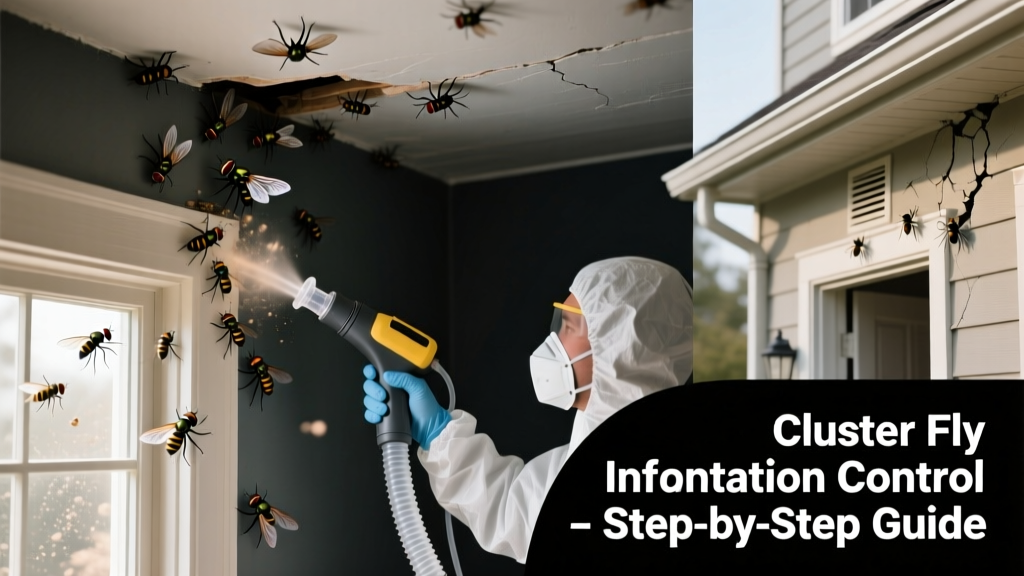
Cluster flies (Pollenia rudis) aren’t like houseflies—they don’t breed indoors or feed on garbage. Instead, they’re parasitic wasp hosts as larvae (targeting earthworms), then seek shelter in homes from late September through November to overwinter. Once inside, they congregate in wall voids, attics, and sun-warmed rooms, emerging on warm winter days to buzz helplessly against windows.
Identification
Spotting cluster flies early prevents large-scale indoor aggregations. Adults are 6–7 mm long, slightly larger than houseflies, with overlapping wings at rest and a distinctive golden-yellow pile (fine hairs) on their thorax. They move sluggishly—especially in cool weather—and often cluster near upper-level windows or attic vents.
| Feature | Cluster Fly | Housefly |
|---|---|---|
| Size | 6–7 mm | 4–5 mm |
| Wing Position at Rest | Overlapping, roof-like | Flat, side-by-side |
| Thorax Hairs | Golden-yellow, dense | Black-gray, sparse |
| Larval Host | Earthworms (outdoors) | Decaying organic matter |
| Indoor Breeding? | No | Yes |
Signs of an infestation include: slow-moving flies on south-facing walls in fall; clusters behind baseboards or in attic insulation; faint musty odor from dead flies in wall voids; and sudden appearances on sunny winter days.
What Attracts Them
Cluster flies don’t seek food or moisture indoors—they seek thermal refuge. They’re drawn to buildings with southern or western exposure, especially those with gaps near soffits, rooflines, attic vents, and window frames. Homes built on clay or compacted soil (where earthworms thrive) see higher pressure. According to the University of Kentucky Entomology Department’s 2022 Fall Pest Survey, 68% of reported cluster fly infestations occurred in homes with unsealed attic access points and missing vent screens.
- South- or west-facing exterior walls with full sun exposure
- Gaps >1/8″ around windows, doors, utility lines, and roofline trim
- Unscreened or damaged attic vents and ridge vents
- Cracks in brick mortar or vinyl siding seams
Treatment Methods
Natural & Mechanical Removal
Vacuuming is the safest first response—use a shop vac with a hose attachment and discard the bag outside immediately. Sticky traps placed near windows or along baseboards catch stragglers. A mixture of water, dish soap, and vinegar in shallow dishes works as a simple trap for active flies (the soap breaks surface tension). Cold temperatures slow them down, making manual removal easier.
Chemical Options
Residual insecticides like pyrethroids (e.g., deltamethrin or cyfluthrin) applied to exterior entry points in late August–early September can reduce adult entry by up to 75%, per the U.S. EPA’s 2023 Residential Pesticide Use Report. Avoid spraying indoors—cluster flies hide deep in walls where sprays won’t reach and may pose inhalation risks. Never fog or use aerosol ‘bug bombs’; they’re ineffective against hidden populations and increase pesticide exposure unnecessarily.
- Apply exterior barrier spray 2–3 ft up and 3 ft out from foundation, focusing on sun-warmed zones
- Use dust formulations (e.g., deltamethrin dust) in wall voids only if access points exist and you’re trained
- Never treat inside finished walls without professional assessment
Prevention
Sealing is 90% of the solution. Cluster flies exploit tiny openings most homeowners overlook. Start with your roofline: install fine-mesh (≤1/8″) vent covers on all attic, gable, and soffit vents. Replace cracked or warped window and door seals—especially on upper floors. Caulk gaps around pipes, wiring, and HVAC ducts entering the attic or basement.
Timing matters: complete sealing work by mid-August. That’s when pre-swarming behavior begins, and adults start testing entry points. Also consider installing UV-light traps in attics—but only after sealing, since lights attract more flies *to* the space if gaps remain.
"Most cluster fly calls we get in January are from treatments done too late—or not paired with exclusion. If you’re still seeing them in March, it’s almost always a structural gap, not a pesticide failure." — Dr. Lena Cho, Urban Entomologist, Cornell Cooperative Extension, 2023
When to Call an Exterminator
Call a licensed pest management professional if: you find >50 live flies daily for three consecutive days; hear buzzing inside walls; notice staining or odors suggesting large die-offs in voids; or have tried sealing + vacuuming for two weeks with no reduction. Professionals can perform thermal imaging to locate hidden clusters and apply targeted dusts into wall cavities using specialized equipment—something DIY kits can’t replicate safely.
Why do cluster flies appear in spring?
They’re not new invaders—they’re the same ones that entered last fall. As outdoor temperatures rise above 50°F, dormant flies become active and try to exit. Many get trapped behind interior walls or insulation and end up in living spaces. This isn’t a new infestation—it’s delayed emergence.
Can cluster flies lay eggs in my home?
No. Their larvae require live earthworms as hosts. You’ll never find maggots or breeding sites indoors. Any eggs found indoors are likely from another fly species—confirm with magnification or consult a local extension office.
Do cluster flies spread disease?
Unlike houseflies or blowflies, cluster flies have minimal contact with waste or decaying matter. The CDC lists no documented cases of human pathogen transmission. Their main risk is allergenic dust from dried bodies and frass in HVAC systems—not infection.
Will cold weather kill them inside my walls?
Not reliably. Cluster flies enter diapause—a hibernation-like state—allowing them to survive months below freezing. Indoor wall voids often stay above 40°F year-round, especially near heat sources like chimneys or recessed lighting. Freezing them requires sustained sub-20°F temps *inside* the void—rare in insulated homes.
Are ultrasonic devices effective?
No. The Federal Trade Commission issued warnings in 2021 about false claims for ultrasonic repellents targeting cluster flies. Independent testing by Ohio State’s Structural Pest Management Program showed zero behavioral change in lab or field trials.
Once sealed and treated, cluster fly pressure drops sharply the following season—if you act before August. For long-term control, pair physical exclusion with targeted exterior treatments and monitor attic vents each July. If you’re also dealing with box elder bugs or Asian lady beetles, use the same sealing strategy—they exploit identical entry routes.