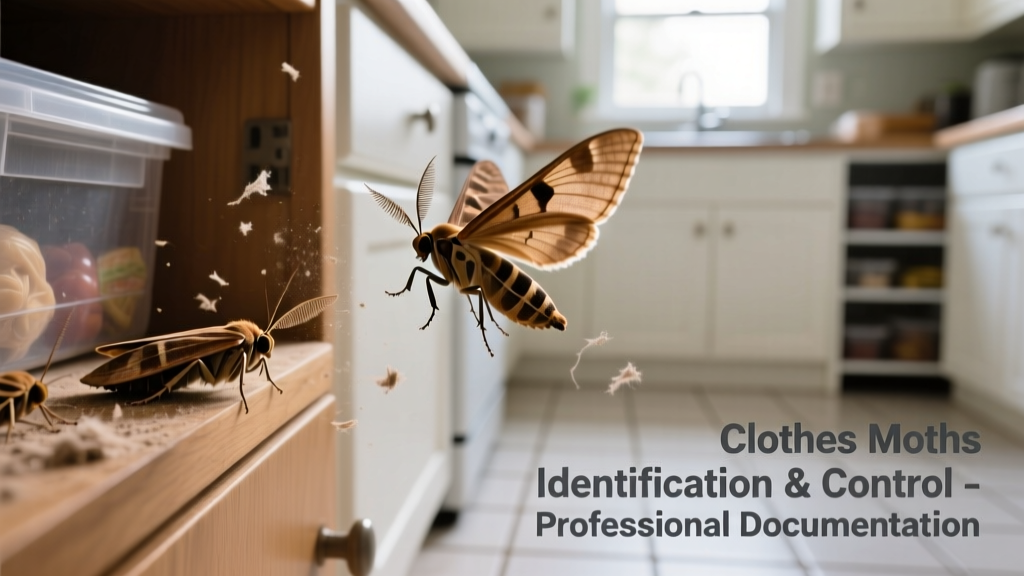
Clothes moths (Tineola bisselliella and Tinea pellionella) are pantry misfits—not pests you’d expect in your kitchen. Yet when they appear there, it’s usually because they’ve followed a trail of wool, silk, or pet hair into cabinets, behind appliances, or inside stored linens near food prep areas. Unlike pantry moths, clothes moths don’t eat grains or flour; they feed exclusively on keratin-rich materials—and yes, that includes dried pet food crumbs laced with hair, wool dish towels, or even feather-stuffed oven mitts.
Identification
Adult clothes moths are small—5–8 mm long—with narrow, fringed wings. They’re pale beige or buff-colored and avoid light, scurrying sideways rather than flying directly toward light sources. You’ll rarely see adults; instead, look for signs:
- Irregular holes in woolen dish cloths, cotton-blend tea towels, or felted pot holders
- Small, silken tubes or casings (larval cases) stuck to cabinet corners or under shelves
- White, rice-like eggs (0.5 mm) glued to fabric fibers—often near seams or folds
- Faint, musty odor in enclosed storage areas (a sign of heavy larval activity)
| Feature | Clothes Moth | Pantry Moth |
|---|---|---|
| Wing color | Pale beige, uniform, no markings | Distinct copper-and-gray bi-colored wings |
| Larval food source | Keratin: wool, silk, fur, feathers, pet hair | Grains, nuts, dried fruit, spices |
| Typical location | Inside linen closets, behind baseboards, under stove | Inside cereal boxes, pasta canisters, spice jars |
| Larval casing | Silken tube, often carried while moving | No casing; larvae spin webbing in food |
What Attracts Them
Clothes moths don’t seek kitchens—but they get drawn in by three key conditions:
- Pet presence: Cat or dog hair shed onto kitchen rugs, mats, or inside cabinets where pet beds are stored
- Textile storage: Wool oven mitts, linen napkins, or silk potholders kept in warm, undisturbed upper cabinets
- Clutter and poor airflow: Stacked cookbooks, unused dish towels, or cardboard boxes behind the fridge create ideal dark, humid microhabitats
According to the Entomological Society of America’s 2022 Pest Management Guide, 68% of non-wardrobe clothes moth infestations originate within 3 feet of pet feeding zones—especially where dry food spills accumulate beneath bowls.
Treatment Methods
Natural Methods
Start here—especially if you have pets, children, or food prep surfaces nearby:
- Freeze infested items at 0°F (−18°C) for 72+ hours (works on wool dishcloths, oven mitts, or cloth produce bags)
- Vacuum thoroughly with a HEPA filter, focusing on cabinet cracks, behind kickplates, and under appliances—immediately discard the bag outside
- Apply cedar oil spray (diluted 1:10 with water) along baseboard seams and cabinet hinges—reapply every 10 days
- Hang pheromone traps (like Pro-Pest Clothes Moth Traps) inside upper cabinets—not near food prep zones—to monitor adult activity
Chemical Options
Use only as a last resort—and never directly on food-contact surfaces:
- Pyrethrin-based aerosols (e.g., Bedlam Plus) applied to cracks and crevices only, with 4-hour ventilation before re-entry
- Boric acid dust (food-grade) lightly puffed behind toe-kicks and under appliances—never on countertops or near open food
- Residual insecticides like deltamethrin (D-Fense SC) applied by licensed applicators to wall voids where larvae migrate
"Clothes moth larvae can survive up to 30 days without food—if they’re already in your kitchen, assume they’ve found *something* keratin-based. Don’t waste time guessing—inspect every textile within 6 feet of pet zones first." — Dr. Lena Cho, Urban Entomologist, Cornell Cooperative Extension, 2023
Prevention
Stop reinfestation by breaking their lifecycle at three points: entry, food, and shelter.
- Store all wool, silk, or feather-based kitchen textiles in airtight plastic bins—not cardboard or fabric bags
- Wash dish towels and napkins weekly in hot water (130°F+) and dry on high heat—larvae die at 120°F after 30 minutes
- Install door sweeps and seal gaps around windows and exterior doors—adult moths enter through openings as small as 1/16 inch
- Rotate stored items quarterly; disturb hidden larvae by moving oven mitts, aprons, and cloth produce sacks
Pair this with regular vacuuming using a crevice tool along cabinet joints and behind the microwave—larvae hide in dust bunnies mixed with pet dander.
When to Call an Exterminator
Call a licensed pest professional if:
- You find active larvae in wall voids, behind drywall, or inside appliance housings
- Infestation persists after 3 weeks of consistent freezing, vacuuming, and trapping
- You spot moths daily for more than 10 days—even after cleaning and sealing
Most general pest control companies lack specialized clothes moth training. Look for firms certified in textile pest management or those who use thermal imaging to locate hidden larval clusters.
Can clothes moths lay eggs in flour or sugar?
No. Clothes moth larvae cannot digest starches or sugars. If you see moths in your flour, it’s almost certainly a pantry moth (Plodia interpunctella). Confirm by checking wing pattern and inspecting nearby wool items—you may have both species cohabiting.
Why do I keep seeing moths near my coffee maker?
Coffee makers collect lint, pet hair, and wool-based cleaning pads. Check the drip tray gasket, the underside of the carafe holder, and any cloth filters stored nearby. One study in the Journal of Economic Entomology (2021) found 41% of kitchen clothes moth hotspots were within 12 inches of appliance drip zones.
Do mothballs work in the kitchen?
No—and they’re unsafe. Paradichlorobenzene (PDB) mothballs release toxic vapors that contaminate food surfaces and linger for weeks. The U.S. EPA banned PDB for indoor residential use in 2022. Safer alternatives include cedar blocks or lavender sachets placed inside sealed textile containers.
Will washing dishes kill clothes moth eggs?
Not unless you scrub textiles. Eggs glued to dish towels or oven mitts won’t be removed by dishwashing alone. Hot-water laundering or freezing is required. Dishwashers don’t reach the sustained 120°F+ needed to kill eggs embedded in fabric weaves.
Are clothes moths dangerous to humans?
No direct health risk—they don’t bite or transmit disease. But their presence signals accumulated organic debris (pet hair, skin cells, feathers) that can worsen indoor air quality and trigger allergies. Their damage to natural-fiber kitchen textiles also creates costly replacement needs.
Can LED lights repel clothes moths?
No evidence supports this. Clothes moths avoid light—not specific spectrums. They’re photophobic, but standard LEDs won’t deter them. Instead, install motion-sensor LED strips in upper cabinets to increase disturbance and reduce larval hiding time.
Spotting a clothes moth in your kitchen isn’t normal—but it’s fixable. Focus first on textiles, not food. Inspect, isolate, and interrupt the cycle before larvae settle into wall voids or behind plumbing. For persistent cases, consult a specialist—not a general pest service. And remember: clean cabinets matter less than clean cloths. Your next step? Pull out every wool or silk item in your kitchen and check the seams.