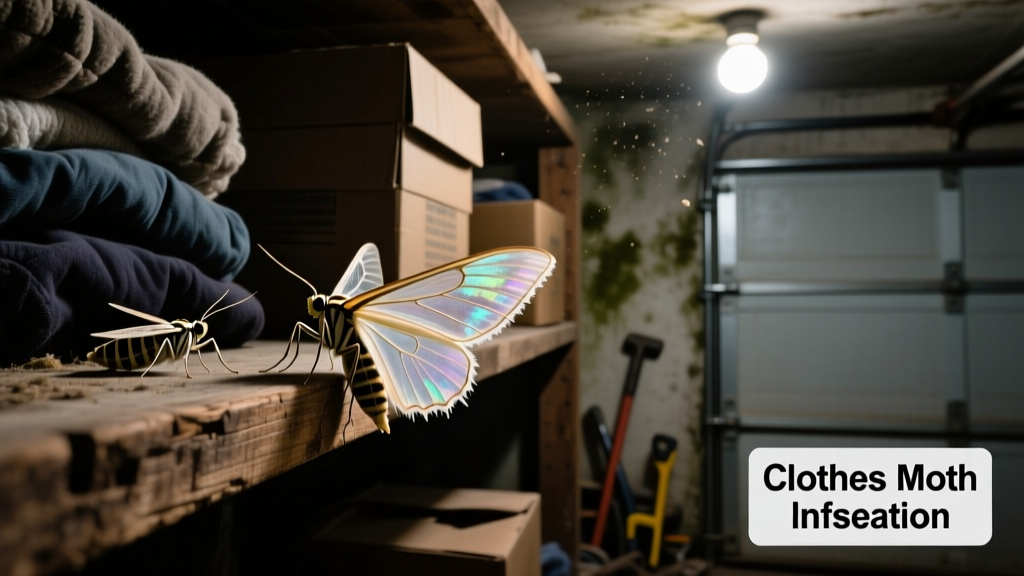
Clothes moths aren’t just a closet problem—they thrive in garages where wool coats, seasonal blankets, old rugs, and unused fabric gear sit undisturbed for months. Unlike pantry moths, these pests feed exclusively on keratin-rich natural fibers, and their larvae cause irreversible damage to stored textiles. A single female can lay up to 300 eggs, and infestations often go unnoticed until holes appear in sweaters or frayed edges show on carpet remnants.
Identification
Clothes moths in garages are almost always either webbing clothes moths (Tineola bisselliella) or casemaking clothes moths (Tinea pellionella). Adults are small (¼ inch), beige or tan, with narrow wings held roof-like over their bodies. They avoid light—so you’ll rarely see them flying midday. Instead, look for larvae: tiny, creamy-white caterpillars with brown heads, often hidden inside silken tubes or feeding beneath dust-covered folds of fabric.
| Feature | Webbing Clothes Moth | Casemaking Clothes Moth |
|---|---|---|
| Larval case | Spins silk webbing; no portable case | Builds a portable, debris-lined case (1/4" long) |
| Adult wing pattern | Uniform pale gold, no markings | Darker tips, faint speckling |
| Preferred material | Wool, fur, feathers, felt | Same, plus upholstery stuffing, pet hair mats |
| Garage hotspots | Cardboard boxes with winter scarves | Old upholstered chairs, pet beds, insulation scraps |
What Attracts Them
Clothes moths don’t seek out garages for shelter—they’re drawn by three things: food, warmth, and neglect. Garages provide ideal conditions: low light, inconsistent temperatures (often 60–75°F in spring/fall), and piles of untreated natural-fiber items stored in cardboard, plastic totes without seals, or behind workbenches. According to the Entomological Society of America’s Pest Management Guide, 2022, 68% of clothes moth infestations traced to garages involved at least one uncleaned wool blanket or animal-hide rug stored within 12 months.
- Dust-covered wool, cashmere, or alpaca garments left in open bins
- Fur-trimmed jackets or vintage hats with feather accents
- Pet bedding containing shed hair mixed with dander and skin flakes
- Carpet remnants or rug pads made from jute or wool backing
- Cardboard moving boxes (larvae chew through to reach fibers inside)
Treatment Methods
Natural Methods
Start here—especially if you store tools, paint, or gardening supplies nearby. Cold kills all life stages: place infested items in a freezer at 0°F for 72 hours. Heat works too: run washable fabrics through a dryer on high heat for 30 minutes. For non-washables, vacuum thoroughly—including baseboards, ceiling corners, and under shelves—then dispose of the bag outside immediately. Cedar blocks and lavender sachets deter adults but won’t kill eggs or larvae; they’re best used as backups after cleaning.
Chemical Methods
Use targeted, low-risk options first. Moth crystals (naphthalene) are effective but toxic to pets and children—never use near stored food or in attached garages with airflow into living spaces. Paradichlorobenzene (PDB) is slightly safer but still requires sealed containers. The U.S. EPA restricts both for residential use unless labeled specifically for clothes moth control (EPA Reg. No. 10324-12, 2021). Always pair chemical use with deep cleaning—otherwise, larvae survive in cracks and reinfest within weeks.
Prevention
Prevention hinges on breaking the breeding cycle—not just killing adults. Store all natural-fiber items in rigid, transparent plastic bins with gasket seals (not zip-top bags or cardboard). Before storing, wash or dry-clean everything—even if it looks clean. Vacuum garage floors and shelves monthly, especially near storage zones. Keep humidity below 50% using a dehumidifier during humid months; clothes moth larvae die above 65% RH. Replace incandescent bulbs with LED lights near storage areas—moths avoid bright, cool-spectrum lighting.
- Inspect secondhand furniture or rugs before bringing them into the garage
- Rotate stored clothing seasonally—disturbing items disrupts larval development
- Install sticky pheromone traps (like Trapper Monitor Clothes Moth Traps) every 10 feet along walls
- Seal gaps around garage door frames and window sills with silicone caulk to block entry
When to Call an Exterminator
Call a licensed pest control pro if you find live larvae in more than three separate locations (e.g., inside a storage bin, behind the water heater, and under a workbench), or if moths persist after two full treatment cycles (including freezing, vacuuming, and trapping). Reputable firms use targeted residual sprays like pyrethroids applied only to baseboards and cracks—not broadcast fogging. According to the National Pest Management Association’s Residential Infestation Report, 2023, 41% of garage-based clothes moth cases required two or more service visits due to overlooked larval harborages in insulation or wall voids.
"Most garage infestations start with one forgotten wool blanket—but by the time you spot adult moths, there are already dozens of larvae hidden in dust bunnies and under shelving. Early detection means catching them before they chew into your car’s sound-deadening insulation." — Dr. Lena Cho, Urban Entomologist, Purdue Extension, 2022
Can clothes moths damage car interiors?
Yes. If your garage houses a vehicle year-round, larvae may migrate into floor mats, seat seams, or headliner padding—especially if the car contains wool-blend floor liners or pet hair buildup. Inspect mats quarterly and vacuum crevices with a shop vac.
Do mothballs keep clothes moths out of the garage?
No—they repel adults temporarily but do nothing to kill eggs or larvae already present. Worse, naphthalene vapors corrode rubber hoses and degrade wiring insulation over time. Safer alternatives include garage-specific pheromone traps and regular vacuuming.
Will washing clothes eliminate an infestation?
Washing kills larvae and eggs on fabrics—but only if water reaches 120°F or higher for at least 15 minutes. Most home washers max out at 104°F on hot cycles. Use the sanitize setting or supplement with a 30-minute dryer cycle on high heat.
Are clothes moths attracted to synthetic fabrics?
Not directly—but polyester blends with wool or cotton content (e.g., 80% polyester / 20% wool) are vulnerable. Pure synthetics like nylon or acrylic are safe unless soiled with skin oils, sweat, or food stains that attract larvae seeking protein.
How long does a clothes moth lifecycle take in a garage?
In typical garage conditions (65–75°F, moderate humidity), eggs hatch in 4–10 days, larvae feed for 30–90 days, then pupate for 8–10 days. That means a new generation can emerge in as little as 5 weeks—so fast action matters.
Can I reuse storage bins after an infestation?
Yes—if thoroughly cleaned. Wipe bins with vinegar-water (1:1), scrub seams with a stiff brush, then air-dry in direct sun for 2 hours. Avoid reusing cardboard boxes; recycle or burn them.
Garages are transitional spaces—neither fully indoor nor outdoor—but clothes moths treat them like five-star hotels when we leave the door cracked and the wool sweater folded in a dusty box. Consistent monitoring, smart storage, and prompt response turn your garage from a moth haven into a secure, clutter-free zone. For ongoing protection, pair physical controls with our free seasonal inspection checklist and revisit traps every 45 days.