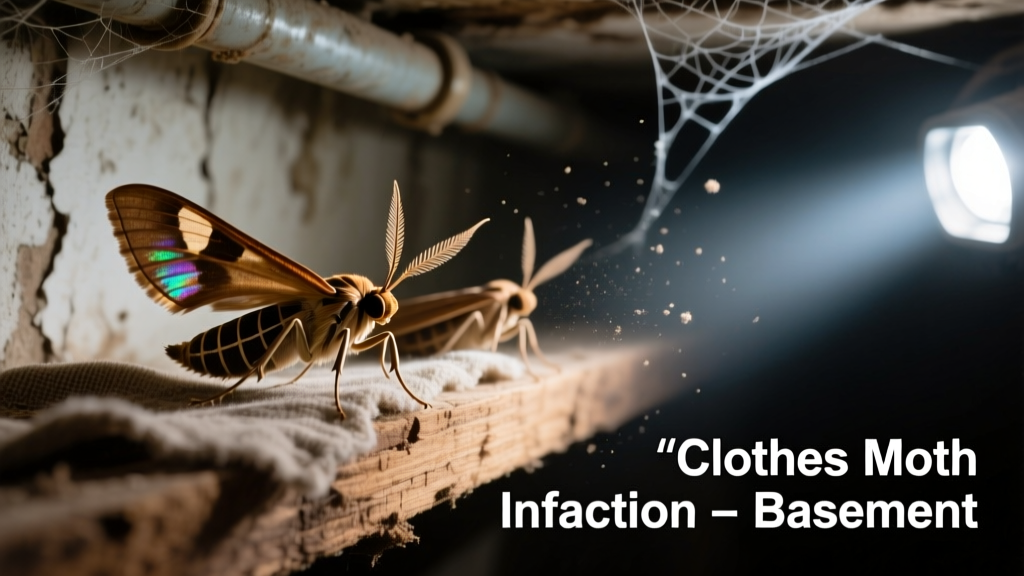
Clothes moths (primarily Tineola bisselliella, the webbing clothes moth) don’t eat fabric for nutrition — their larvae do. In basements, where wool rugs, stored sweaters, old blankets, and upholstered furniture often sit undisturbed in cool, humid corners, these pests find a perfect nursery. Left unchecked, a single female can lay 40–50 eggs, and larval feeding causes irreversible holes, fraying, and musty odor — especially in natural fibers like wool, silk, fur, and feathers.
Identification
Adult clothes moths are small (¼ inch), pale beige or buff-colored, with narrow, fringed wings. They avoid light — you’ll rarely see them flying in open rooms. Instead, look for signs: silken tubes or casings on fabric surfaces, irregular holes in stored items, tiny cream-colored larvae (½ inch long, with brown heads), and shed larval skins near baseboards or under shelves.
| Moth Species | Adult Appearance | Larval Behavior | Typical Basement Targets |
|---|---|---|---|
| Webbing Clothes Moth | Pale gold, wings held roof-like, no spots | Spins silken tubes; feeds hidden inside | Wool rugs, cashmere scarves, taxidermy mounts |
| Casemaking Clothes Moth | Darker head, three dark spots on forewings | Carries portable case of debris & silk | Fur coats, felt padding under furniture, upholstery stuffing |
| Pantry Moth (confusion risk) | Distinctive copper-and-gray wings | Found in grains, nuts, pet food — not fabrics | Cardboard boxes of dry goods, not clothing |
What Attracts Them
Basements attract clothes moths because they combine three key factors: darkness, humidity (40–70% RH), and undisturbed organic material. Moths enter through cracks, vents, or on secondhand items — but they stay because of neglected storage. Damp concrete floors encourage mold growth on fabrics, which larvae consume alongside keratin. According to the Entomological Society of America’s 2022 Pest Management Guide, 68% of basement clothes moth infestations begin within 3 feet of exterior foundation walls where moisture migrates upward.
- Stored winter clothing in cardboard boxes (moths chew through cardboard to reach wool)
- Old upholstered furniture with exposed stuffing or dust bunnies underneath
- Basement laundry hampers holding unwashed wool/silk items for >48 hours
- Animal-based insulation (e.g., sheep’s wool batts) installed behind drywall
Treatment Methods
Natural Methods
Start here — especially if children or pets occupy the space. Freeze infested items at 0°F for 72 hours (not just overnight); this kills all life stages. For non-washable items, seal in airtight plastic bags and place in direct summer sun for 6+ hours — surface temps over 120°F disrupt larval development. Cedar oil sprays (diluted 1:10 with water) applied to shelf edges and box seams deter adults, though they won’t kill eggs. Vacuum thoroughly with a HEPA filter, paying close attention to baseboard crevices and under storage racks — dispose of the bag outside immediately.
Chemical Options
Use only as a last resort and strictly follow label instructions. Paradichlorobenzene (PDB) crystals are effective against larvae but banned in California and restricted elsewhere due to respiratory risks. Pyrethrin-based aerosols (e.g., Bedlam Plus) can be sprayed into cracks and along joists — but never directly on fabrics unless labeled for that use. The U.S. EPA notes that improper PDB use contributes to 12% of reported moth-control-related indoor air complaints annually (EPA Indoor Air Factsheet, 2023).
"Most basement moth problems aren't about killing adults — it's about breaking the 4–6 week lifecycle by removing larval food sources *and* disrupting humidity. If your dehumidifier reads above 55% RH, no treatment will hold." — Dr. Lena Cho, Urban Entomologist, Cornell Cooperative Extension (2023)
Prevention
Prevention is 90% of the battle — and it starts with storage hygiene. Never store clean woolens in plastic bins without lining them with acid-free tissue; instead, use breathable cotton garment bags. Keep basement relative humidity below 50% using a properly sized dehumidifier (aim for 30–45 pints/day capacity for a 1,200 sq ft basement). Inspect every item before storage: launder or dry-clean natural fibers, then freeze for 3 days even if 'clean.' Seal gaps around windows, sump pump covers, and utility penetrations with copper mesh or caulk — adult moths can squeeze through ⅛-inch openings.
- Rotate stored items every 6 weeks to disrupt egg-laying cycles
- Install LED motion-sensor lights in storage zones — adults avoid light exposure
- Replace cardboard boxes with sealed polypropylene totes (look for 'moth-proof' labeling)
- Wipe down shelving monthly with vinegar-water (1:1) to remove keratin-rich dust
When to Call an Exterminator
Call a licensed pest professional if you’ve treated for 3 weeks with no reduction in larval casings, or if you find active infestation in wall voids, HVAC ducts, or behind built-in shelving. Also contact one if moths appear in multiple adjacent rooms (e.g., basement + first-floor closet), suggesting structural harborage. Reputable firms will conduct a moisture audit and inspect for hidden wool-based insulation — a common overlooked source. Avoid companies that only offer blanket fogging; targeted larvicide dusting in wall voids and thermal imaging for heat signatures of clusters are more effective.
Can clothes moths live in concrete walls?
No — but they hide in cracks, expansion joints, and behind baseboards where dust, spider webs, and organic debris accumulate. Larvae feed on that buildup, not the concrete itself. Sealing those gaps with silicone caulk stops migration between units in multi-family buildings.
Do mothballs work in basements?
They repel adults temporarily but won’t penetrate deep into carpet padding or furniture stuffing where larvae live. Worse, naphthalene and PDB residues persist for months and off-gas in poorly ventilated basements — posing health risks per CDC Toxicology Profiles (2021). Safer alternatives include lavender sachets paired with regular vacuuming.
Why do I only see moths in fall?
Basement temperatures stabilize in early fall (60–65°F), triggering pupation. Adults emerge en masse to mate and lay eggs before winter dormancy. That’s why September and October show peak sightings — it’s not new entry, but synchronized emergence from prior summer infestation.
Can washing fix an infestation?
Hot water (130°F+) and detergent kill larvae and eggs on washable items — but only if done *before* moths spread to adjacent materials. Washing alone won’t stop an established population hiding in walls or under flooring. Combine with full-room vacuuming and humidity control.
Are cedar chests really protective?
Only if the wood is raw, unsealed, and frequently opened — volatile oils dissipate after 6–12 months. Refinishing or painting cedar eliminates repellency. For long-term protection, line cedar chests with fresh cedar blocks (replaced yearly) and add silica gel packs to control moisture.
Will sealing my basement stop moths?
Sealing reduces entry, but most infestations start from items brought in — not outdoor entry. Focus sealing efforts on gaps around pipes and windows, then pair with proactive monitoring: hang pheromone traps (clothes moth traps) near storage zones and check weekly. Replace traps every 3 months — they’re your early warning system.
Basements demand a different strategy than closets or attics: moisture management isn’t optional, it’s foundational. Pair physical removal (vacuuming, freezing) with environmental control (dehumidification, light exposure), and monitor with traps — not just once, but quarterly. For deeper issues like wall insulation infestation, refer to our guide on basement pest inspection checklist or explore wool carpet moth damage repair techniques if fibers are already compromised.