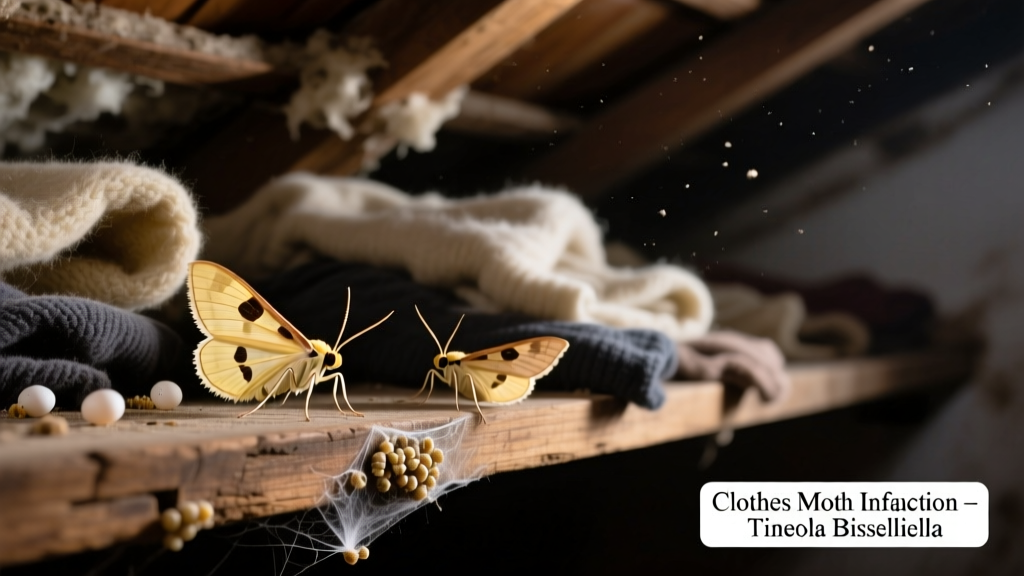
Clothes moths—specifically the webbing clothes moth (Tineola bisselliella) and casemaking clothes moth (Tinea pellionella)—rarely live in attics by accident. They’re drawn there for one reason: undisturbed natural fibers. Unlike pantry moths, these pests don’t eat food—they eat wool, cashmere, feathers, fur, and even dried pet hair or bird nests stored in cardboard boxes. Left unchecked, a single female can lay 40–50 eggs, and larvae may feed for 1–2 years before pupating—causing silent, cumulative damage to heirloom sweaters, rugs, and taxidermy mounts.
Identification
Adult clothes moths are small (¼ inch), beige to buff-colored, and avoid light. You’ll rarely see them flying—they flutter weakly near baseboards or under furniture, not like pantry moths that dart across kitchens. The real evidence is in the larvae: tiny, creamy-white caterpillars with brown heads, often hidden inside silken tubes or feeding on fabric edges. Look for irregular holes, surface grazing, or gritty frass (fecal pellets) resembling ground pepper.
| Feature | Webbing Clothes Moth | Casemaking Clothes Moth |
|---|---|---|
| Adult wing color | Uniform pale gold/beige | Darker head, mottled wings with three dark spots |
| Larval case | No portable case; spins silk webbing over feeding site | Carries a conical, debris-covered case (up to ½ inch) |
| Preferred attic targets | Wool blankets, felt insulation remnants, animal hides | Fur coats, taxidermy mounts, feather pillows |
| Common hiding spots | Under floorboards, behind insulation batts, in cedar chests | In old hatboxes, rolled-up rugs, behind eaves |
What Attracts Them to Your Attic
Attics offer ideal conditions: low traffic, stable temperatures (65–80°F), moderate humidity (40–60%), and decades’ worth of forgotten organic material. Moths don’t fly in from outside—they hitchhike in on secondhand clothing, vintage luggage, or holiday decorations stored in paper bags or cardboard boxes. Rodent nests left after an infestation are also prime larval food sources: dried blood, fur, and nesting material provide protein-rich meals.
- Unwashed wool sweaters folded in plastic bins (moisture traps encourage mold, which larvae graze on)
- Old bird nests tucked into soffits or vents (feathers and keratin attract egg-laying females)
- Cedar-lined storage trunks with cracks or gaps (cedar oil degrades after 6–12 months—no longer repellent)
- Cardboard moving boxes stacked directly on attic flooring (larvae chew through cardboard to reach wool beneath)
Treatment Methods
Natural Methods
Start here if you’ve caught the infestation early (fewer than 3 active cases). Freeze infested items at 0°F for 72 hours—this kills all life stages. For non-washable items like tapestries or taxidermy, use dry-cleaning or professional CO₂ freezing services. Vacuum every square inch of attic flooring, rafters, and insulation seams with a HEPA-filter vacuum; dispose of the bag immediately outside. Then apply food-grade diatomaceous earth (DE) along baseboards and under storage containers—reapply after dusting or humidity spikes.
Chemical Treatments
Use targeted insecticides only when larvae are confirmed in multiple locations. Permethrin-based sprays (e.g., Proven Insecticide Spray) applied to rafters, joists, and box undersides disrupt larval nervous systems—but never spray directly on wool or silk. According to the National Pesticide Information Center’s 2022 safety review, permethrin breaks down in sunlight within 1–2 days, minimizing residual risk. Avoid foggers: they don’t penetrate fabric folds or insulation where larvae hide. Instead, use crack-and-crevice applications with a precision tip.
Prevention
Prevention isn’t about sealing every gap—it’s about removing what moths need to survive. Store woolens in airtight plastic bins (not cardboard or canvas), and launder or dry-clean everything before long-term attic storage. Replace old cedar blocks every 9 months—or better yet, use lavender sachets combined with tight-fitting lids (lavender oil deters adults but doesn’t kill larvae). Install LED motion-sensor lights in attic access points: adult moths avoid bright light, reducing egg-laying activity.
- Inspect holiday decorations annually before storing—especially felt ornaments, wool garlands, and vintage quilts
- Remove all rodent nesting material during spring cleanup—even if no current rodent activity is visible
- Run a dehumidifier in humid climates if attic RH exceeds 55% (larvae develop faster above 60% RH)
- Label storage bins with dates and contents—rotate stock every 18 months to catch issues early
When to Call an Exterminator
Call a licensed pest professional if you find larvae in more than five separate storage units, or if webbing reappears within 10 days of thorough cleaning and freezing. Also call if you suspect moths have spread to living spaces below—their presence in closets or bedrooms signals deeper infestation. According to the National Pest Management Association’s 2023 Clothes Moth Report, 68% of attic infestations requiring professional help involved pre-existing rodent activity or improperly sealed HVAC ducts serving as larval highways.
"In attics, clothes moths aren’t just a textile problem—they’re a symptom of neglected storage hygiene. One uncleaned trunk can seed an entire roof space." — Dr. Lena Cho, Entomologist, University of Massachusetts Amherst, 2022
Can clothes moths damage fiberglass insulation?
No—they cannot digest synthetic fibers. But they’ll feed on organic dust (dead skin, pet dander, pollen) trapped in insulation, and their webbing can clog ventilation pathways. If you see silk strands in insulation, remove and replace affected batts.
Do mothballs work in attics?
Not reliably—and they’re hazardous. Naphthalene or paradichlorobenzene vapors dissipate quickly in ventilated attics, and concentrations needed to repel moths exceed EPA safety thresholds for indoor air. The U.S. EPA classifies naphthalene as a possible human carcinogen (2021 Integrated Risk Information System update).
Will cold winter temperatures kill them?
Only if sustained below 20°F for 5+ days *inside* the attic space. Most insulated attics stay above 32°F year-round—even in Minnesota winters. Don’t rely on seasonal cold.
Can I reuse infested storage boxes?
Yes—if they’re plastic and washable. Scrub with hot water + vinegar, then wipe with 70% isopropyl alcohol. Discard cardboard, paper, or fabric boxes: larvae bore into corrugation and glue seams, making complete eradication impossible.
How long does treatment take to fully eliminate them?
Minimum 90 days. Eggs hatch in 4–10 days, larvae feed 1–28 months depending on temperature and food quality, and pupae last 8–10 days. A full lifecycle check requires monitoring traps for three consecutive months with zero captures.
Are pheromone traps effective in attics?
Yes—for monitoring, not control. Place sticky traps near entry points (attic hatches, soffit vents) and high-risk zones (near wool storage). Replace monthly. If you catch >3 males/week, assume active breeding is occurring nearby. See our moth trap placement guide for attic-specific tips.
Attics don’t have to be moth museums. With consistent inspection, smart storage, and prompt response to early signs, you can protect decades of family textiles—and avoid the frustration of finding a hole in your grandmother’s shawl after it’s been stored for 12 years. Keep your attic dry, bright, and clutter-free: moths hate all three.