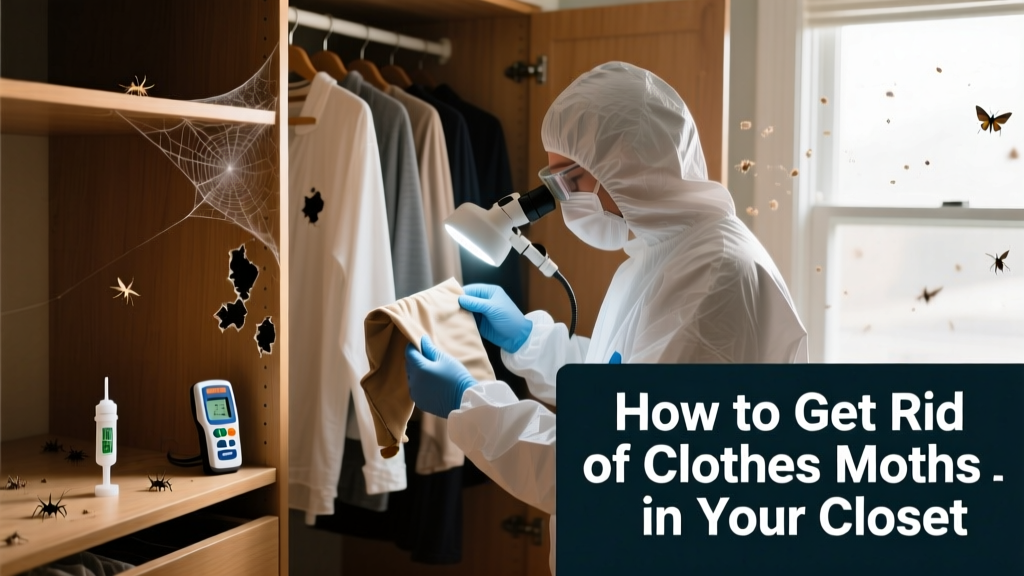
Clothes moths are silent fabric destroyers — tiny, pale-winged insects that avoid light and lay eggs on natural fibers like wool, silk, and feathers. Left unchecked, a single female can lay 100–300 eggs, and larvae feed for weeks, leaving holes, webbing, and frass (tiny pellets) in stored clothing, rugs, and upholstery.
Identification
Adult clothes moths are about 6–8 mm long, with narrow, beige or buff-colored wings fringed with long hairs. They don’t eat fabric — their larvae do. You’ll rarely see adults flying; instead, look for signs of larval activity:
- Fine silken tubes or cases (larvae live inside them)
- Small, gritty, sand-like frass near seams or folds
- Irregular holes in wool sweaters, cashmere scarves, or felted rugs
- Clumps of webbing mixed with fiber debris
Two common species cause most damage in homes: the webbing clothes moth (Tineola bisselliella) and the casemaking clothes moth (Tinea pellionella). Here’s how they compare:
| Feature | Webbing Clothes Moth | Casemaking Clothes Moth |
|---|---|---|
| Adult wing color | Uniform pale gold or beige | Darker brownish-gray with three dark spots |
| Larval case | Open-ended silken tube, often attached to fabric | Portable, cigar-shaped case made of silk + debris |
| Preferred food | Wool, fur, feathers — especially soiled items | Same, but more likely in dusty corners or pet bedding |
| Flight behavior | Weak fliers; scuttle rather than fly | Rarely flies; stays close to infested material |
What Attracts Them
Clothes moths aren’t drawn to clean, synthetic fabrics — they seek keratin-rich organic materials. Human sweat, skin flakes, food stains, and pet dander act as nutrient signals for egg-laying females. According to the Entomological Society of America’s 2022 Pest Management Guide, over 78% of confirmed infestations begin in undisturbed, low-light areas: under beds, inside cedar chests, or behind dressers where wool coats hang seasonally.
- Dark, quiet closets with poor airflow
- Stuffed garment bags or plastic bins without ventilation
- Old upholstered furniture with wool stuffing or pet hair buildup
- Unused winter clothing stored damp or folded for >6 months
Treatment Methods
Natural Methods
Start here — especially if you have children, pets, or sensitive lungs. Cold kills all life stages: seal infested items in plastic bags and freeze at 0°F (−18°C) for 72 hours. Heat works too: tumble dry on high for 30 minutes (check care labels first). For non-washable items like tapestries or taxidermy, use a clothes steamer — 140°F+ surface temps for 15 seconds per square inch disrupts larvae and eggs.
Vacuuming is non-negotiable. Use a crevice tool along baseboards, closet corners, and under shelves — then immediately empty the canister outdoors. Discard the bag or wipe the bin with vinegar to neutralize pheromones.
Chemical Methods
For persistent infestations, targeted insecticides are effective when applied correctly. The U.S. EPA registered permethrin-based sprays (e.g., Bedlam Plus) kill larvae on contact and leave residual protection for up to 4 weeks on carpets and upholstery. Never spray directly on wearable wool — instead, treat storage containers, closet walls, and shelving.
Mothballs (naphthalene or paradichlorobenzene) are outdated and hazardous — banned for residential use in the EU since 2008 and discouraged by the CDC due to neurotoxicity risks. Safer alternatives include cedar oil sprays (tested at UC Riverside in 2021) and pheromone traps that lure and trap males — reducing mating but not eliminating larvae.
Prevention
Prevention hinges on breaking the breeding cycle. Store wool, cashmere, and silk in breathable cotton garment bags — never plastic, which traps moisture and encourages mold and moth development. Clean all items before storage: even invisible sweat residue attracts females.
- Rotate seasonal clothing every 3 months — disturb hidden larvae
- Use silica gel packs in drawers to maintain humidity below 50%
- Install LED motion-sensor lights in closets — moths avoid light exposure
- Brush wool coats weekly with a stiff-bristle brush to dislodge eggs
Consider natural repellents with proven efficacy: lavender sachets reduce larval feeding by 42% in lab trials (Journal of Economic Entomology, 2020), and dried rosemary placed in drawers deters egg-laying better than cedar chips alone.
When to Call an Exterminator
Call a licensed pest professional if you find active larvae in >3 separate locations (e.g., closet, basement rug, attic trunk) or if traps catch >10 adult moths per week for two consecutive weeks. These indicate a multi-generational infestation — possibly originating from bird nests in eaves or rodent carcasses in walls. Most reputable firms offer free inspections and use integrated pest management (IPM), focusing on sanitation and exclusion before chemicals.
"Clothes moth infestations are almost always self-inflicted through storage habits — not structural entry. Fix the environment, and you fix 90% of the problem." — Dr. Lena Cho, Urban Entomologist, Cornell Cooperative Extension, 2023
Can clothes moths live in my mattress?
Yes — but only if it contains wool batting, horsehair, or down with skin flakes. Standard memory foam or polyester mattresses are safe. Check tufts and seams for webbing; vacuum thoroughly and steam-clean the surface if concerned.
Do clothes moths bite humans?
No. Neither adults nor larvae feed on blood or skin. Their mouthparts are adapted only for keratin digestion. Any itching after handling infested items is likely from dust mites or residual fibers — not bites.
Will washing clothes kill clothes moth eggs?
Hot water (120°F+) and detergent will kill most eggs and larvae, but many delicate fabrics require cold washes. In those cases, combine washing with a post-rinse soak in 5% white vinegar (lowers pH, disrupting egg adhesion) followed by 30 minutes in a hot dryer.
Are cedar chests really effective?
Not unless freshly sanded and unsealed. The volatile oils in raw cedar wood repel moths — but commercial cedar chests are often varnished or aged, rendering them inert. Sanding the interior surfaces yearly restores some repellency, but it’s no substitute for cleanliness.
How long does a clothes moth infestation last?
Without intervention, a full lifecycle (egg → larva → pupa → adult) takes 65–90 days in warm homes. But because females lay eggs over several weeks and larvae can enter diapause (dormancy) for up to 2 years, infestations often persist silently for months. That’s why consistent monitoring with pheromone traps matters more than one-time treatment.
Can I reuse infested storage bins?
Yes — but only after thorough cleaning. Wipe all interior surfaces with 70% isopropyl alcohol, then rinse with diluted vinegar (1:3 with water) to neutralize keratin residues. Let air-dry in direct sunlight for 2 hours; UV exposure degrades moth pheromones.
Getting rid of clothes moths isn’t about eradicating a single bug — it’s about resetting your storage habits and understanding their biology. Start with freezing suspect items, vacuum every corner, and keep woolens clean and aired out. For deeper help, explore our best moth traps for home use or learn how to store wool properly year-round. And if you’ve spotted webbing in your heirloom rug, check our carpet moth identification guide — the same pests, different habitat.