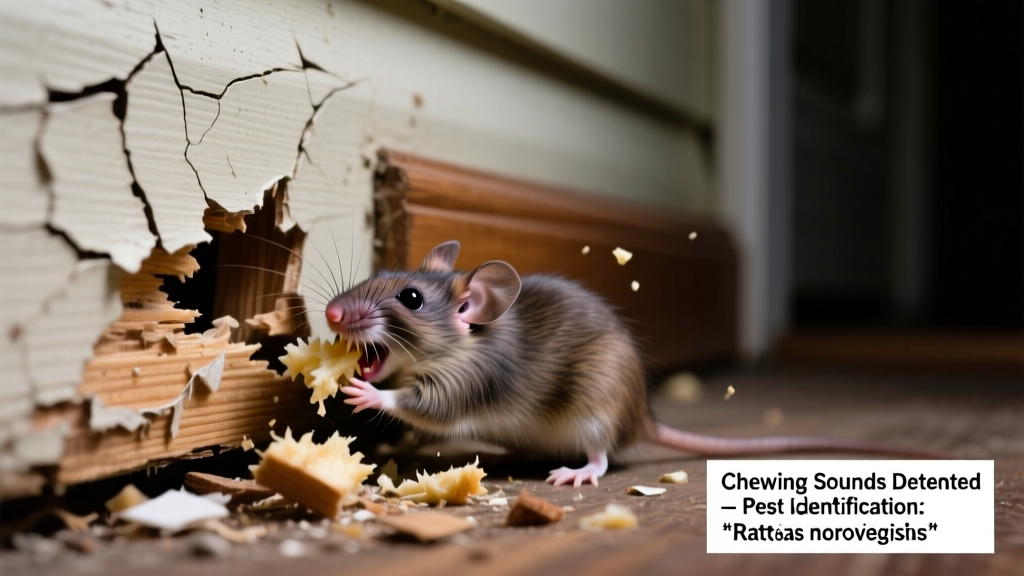
Chewing sounds inside walls—especially at night—are rarely harmless. They signal active pests gnawing on wood, insulation, wiring, or even drywall. Left unchecked, these intruders can cause structural damage, fire hazards from chewed electrical lines, or costly infestations that spread rapidly.
Identification
Three pests commonly produce chewing noises in walls: mice, rats, carpenter ants, and sometimes drywood termites. Each leaves distinct clues beyond sound—size, timing, debris, and behavior help narrow it down.
| Pest | Sound Profile | Droppings | Entry Clues |
|---|---|---|---|
| House mouse | Light, rapid scratching; often at dusk/dawn | 3–4 mm, rice-shaped, scattered near baseboards | Holes <1/4" wide; greasy smudge marks along walls |
| Norway rat | Deeper, slower gnawing; may hear thumping or scurrying | 1/2" long, blunt-ended, clustered near nests | Holes >1/2" wide; burrows near foundation; gnawed plastic or pipes |
| Carpenter ant | Faint rustling or papery crunching; nocturnal but quieter than rodents | No droppings—but sawdust-like frass (coarse, fibrous) | Smooth, clean galleries in damp wood; frass piles near vents or outlets |
| Drywood termite | Very faint, almost imperceptible tapping (soldiers banging heads) | Hard, six-sided fecal pellets ("kick-out holes" near surface) | Tiny, round exit holes (1–2 mm); no mud tubes; found in attic or upper floors |
Visual & Behavioral Clues
- Mice leave urine trails detectable with a blacklight (glows yellow-green)
- Rats often chew through cinderblock or concrete foundations—not just wood
- Carpenter ants avoid moist soil; if you find them indoors, there’s likely a moisture problem nearby
- Drywood termites don’t need ground contact—unlike subterranean termites, they live entirely in the wood they infest
What Attracts Them
These pests don’t enter randomly. They respond to consistent environmental cues—and most are drawn to the same three conditions: food access, shelter, and moisture.
- Cracked foundations, gaps around utility lines, or damaged soffits give easy entry
- Unsealed pantry items, pet food left out overnight, or bird feeders within 30 feet attract rodents
- Leaky pipes, poor attic ventilation, or roof leaks create damp wood ideal for carpenter ants and termites
- Old insulation (especially fiberglass without vapor barrier) provides nesting material for mice and rats
Treatment Methods
Natural & Mechanical Options
Start here—especially if you suspect mice or light ant activity. These methods reduce risk to pets, kids, and beneficial insects.
- Steel wool + caulk: Pack into holes >1/8" wide—mice can’t chew through steel wool, and caulk seals it permanently
- Peppermint oil spray (10 drops per oz water): Apply along baseboards and entry points—repels mice but requires reapplication every 3–4 days
- Vacuum frass piles daily (with HEPA filter) to disrupt ant pheromone trails
- Freeze suspected termite-infested wood (48 hrs at 0°F) kills drywood colonies—only effective for small, accessible pieces
Chemical & Professional-Grade Tools
Use only when monitoring confirms ongoing activity—and always follow label instructions precisely.
- First-generation anticoagulant rodenticides (e.g., warfarin) require multiple feedings; safer for non-target animals than second-gen options like bromadiolone
- Borate-based dusts (e.g., Tim-Bor) applied directly into wall voids suppress carpenter ant galleries and prevent reinfestation
- Fipronil gel bait stations placed near suspected trails achieve >90% colony elimination in 7–10 days (University of Florida IFAS Extension, 2022)
- For drywood termites: heat treatment (120°F core wood temp for 35+ minutes) is EPA-registered and avoids fumigation chemicals
Prevention
Sealing and monitoring are more effective than reactive treatments. Focus on durability—not just coverage.
- Install door sweeps with aluminum or stainless-steel bristles (not rubber)—rats chew through soft sweeps in under 48 hours
- Trim tree branches at least 6 feet from roofline—ants and rodents use them as bridges
- Use metal mesh (1/4" hardware cloth) behind soffit vents—standard fiberglass screening fails against gnawing
- Install dehumidifiers in crawlspaces and attics where relative humidity exceeds 60%—carpenter ants thrive above 55%
When to Call an Exterminator
Call immediately if you see any of these red flags:
- Multiple entry points (>3 holes larger than 1/4") in one wall section
- Frass piles larger than a teaspoon in one location—indicates active carpenter ant colony
- More than 25 termite pellets in a single 24-hour period (use white paper under suspected kick-out holes to count)
- Electrical buzzing or flickering lights near walls—rodents may have chewed live wires
"A single pregnant mouse can produce up to 60 offspring per year—and their gnawing weakens structural integrity faster than you’d expect. Early detection isn’t optional—it’s structural insurance." — Dr. Elena Ruiz, Urban Rodent Ecologist, National Pest Management Association, 2023
Why do I hear chewing only at night?
Mice and rats are nocturnal and avoid daylight to evade predators. Carpenter ants and drywood termites are also most active after sunset—but their sounds are subtler and less rhythmic.
Can insulation noise be mistaken for pest chewing?
Yes—especially fiberglass settling, HVAC duct expansion, or thermal contraction in older homes. Tap gently on the wall: real chewing stops or changes pattern; structural noise continues uniformly. Also check for droppings or frass—insulation doesn’t leave either.
Will ultrasonic repellents work?
No. The Federal Trade Commission issued warnings in 2021 about fraudulent claims. Independent testing by the University of Nebraska-Lincoln found zero reduction in rodent activity across 12 weeks of ultrasonic device use.
How fast can a mouse chew through drywall?
A hungry adult mouse can breach 1/2" drywall in under 2 hours using its incisors, which grow 5 inches per year and must be worn down constantly (National Wildlife Research Center, 2020). That’s why early sealing is critical.
Are carpenter ants dangerous to humans?
They don’t bite unless provoked—and their bites are rarely harmful. But their presence signals advanced wood decay. According to the Insurance Institute for Business & Home Safety's 2023 report, 68% of homes with carpenter ant infestations had undetected moisture damage behind walls.
Do termites make noise I can actually hear?
Rarely—but soldier drywood termites bang their heads against tunnel walls as an alarm signal. You’ll only hear it in absolute silence, often with your ear pressed to the wall. More reliable signs are kick-out holes and pellet piles—learn how to spot drywood termite damage.
If you’ve confirmed pest activity, act within 72 hours. Delaying increases nest size, structural risk, and treatment cost. For persistent issues, download our free rodent-proofing checklist or review our step-by-step carpenter ant inspection guide. Sound is your first warning—don’t wait for visible damage to take it seriously.