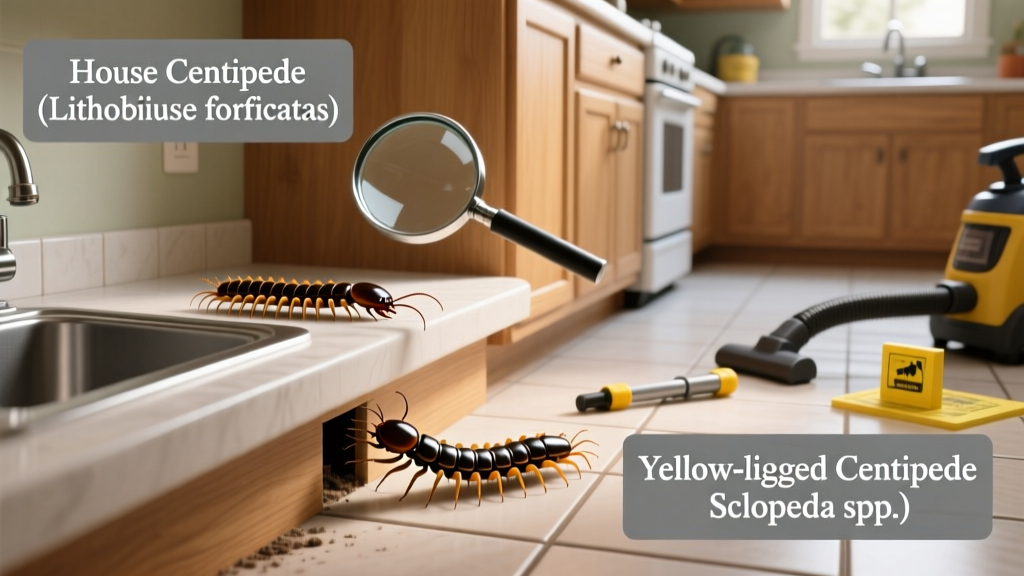
Centipedes in the kitchen aren’t just unsettling—they’re a red flag for moisture issues and hidden entry points. While harmless to humans (they don’t bite unless provoked and rarely break skin), their presence signals conditions that also attract cockroaches, silverfish, and mold. Most kitchen sightings involve the common house centipede (Scutigera coleoptrata), a fast-moving, 15-legged arthropod that hunts pests—but you don’t want it hunting near your coffee maker.
Identification
House centipedes are tan to yellowish-gray with three dark longitudinal stripes down the back. Adults reach 1–1.5 inches long, have 15 pairs of long, banded legs (not 100—despite the name), and antennae longer than their body. They move in rapid, jerky bursts—often mistaken for spiders or silverfish at first glance.
Key signs include:
- Sighting under sinks, behind refrigerators, or near baseboards after dusk
- Shed exoskeletons (translucent, segmented, ~¾ inch long) near damp corners
- Small, pale eggs in clusters inside wall voids or cabinet backs (rarely seen without inspection)
| Pest | Leg Count | Speed & Movement | Preferred Kitchen Zone | Primary Clue |
|---|---|---|---|---|
| House centipede | 30 legs (15 pairs) | Erratic, darting, stops/starts | Under sink, pantry floor, behind appliances | Long antennae + striped back + no webbing |
| Silverfish | 6 legs | Smooth, wiggling glide | Inside cereal boxes, near flour containers | Teardrop shape + silvery scales + no wings |
| Earwig | 6 legs | Slow crawl; may fly weakly | Cracks in tile grout, under dish racks | Forceps-like pincers at rear |
What Attracts Them
Centipedes don’t seek food—they hunt other pests. So their kitchen presence almost always means prey is already there: cockroach nymphs, ants, spiders, or drain flies. But they need three things to survive indoors: moisture, shelter, and access.
- Leaky faucet drip rates over 1 drip per second raise localized humidity above 60%—ideal for centipedes (U.S. EPA WaterSense, 2022)
- Crumbs and grease buildup attract their prey—and indirectly, centipedes
- Gaps >1/16 inch around pipes, windows, and baseboards let them enter from basements or crawlspaces
- Cardboard boxes stored on concrete floors absorb ground moisture, creating microhabitats
Treatment Methods
Natural Methods
Start here—especially if you have kids or pets. Diatomaceous earth (food-grade) applied as a thin line along baseboards and under cabinets dehydrates centipedes on contact. It’s non-toxic but loses effectiveness when wet, so reapply after cleaning or leaks.
Vinegar-water spray (1:1) deters centipedes via scent disruption and lowers surface pH—making surfaces less hospitable. Spray along cabinet toe-kicks and behind the stove weekly. Vacuuming with a crevice tool removes live centipedes *and* their prey; dispose of the vacuum bag immediately outside.
Chemical Options
Residual insecticide sprays containing bifenthrin or lambda-cyhalothrin can be effective when applied precisely to harborages—not broad-surface spraying. According to the National Pesticide Information Center (2023), perimeter treatments reduce indoor centipede activity by up to 70% when combined with moisture control.
Never spray near food prep areas, open shelving, or inside cabinets without removing all items first. Always follow label instructions: many products require 24-hour ventilation before re-entry. Avoid foggers—they scatter centipedes deeper into walls without eliminating nests.
Prevention
Centipedes won’t stay where their prey disappears and moisture drops. Focus on three layers: eliminate prey, dry the space, and seal entry.
- Fix all leaks within 48 hours—even minor ones under the sink
- Install a hygrometer in the kitchen; maintain RH below 50% using exhaust fans or a portable dehumidifier (kitchens average 55–65% RH during cooking, per ASHRAE Handbook 2021)
- Store dry goods in hard-sided, lidded containers—not paper or thin plastic
- Use silicone caulk to seal pipe penetrations and gaps behind kickboards
"Centipedes are the canary in the coal mine for moisture and secondary infestations. If you’re seeing more than one per week, inspect for cockroach activity behind the dishwasher and under the stove—9 out of 10 cases link directly to those zones." — Sarah Lin, Staff Entomologist, Pest Control Tech Magazine, 2022
When to Call an Exterminator
Call a licensed professional if you see centipedes daily for over 10 days—or if you find more than five in a single night. That volume suggests a breeding population in adjacent walls or subflooring, not just accidental entry.
Also call if DIY efforts fail after three weeks of consistent moisture control and sealing. A pro will conduct thermal imaging to locate hidden damp zones and apply targeted dusts (like DeltaDust) into wall voids where centipedes nest.
Why do centipedes appear more in summer?
Outdoor soil temperatures rise, pushing centipedes toward cooler, moister interiors. Kitchens with AC units often become thermal sinks—especially if basement or crawlspace humidity exceeds 70%. This seasonal shift peaks June–August, per the National Pest Management Association’s 2023 Field Survey.
Can centipedes climb cabinets or walls?
Yes—easily. Their leg structure lets them scale smooth vertical surfaces like tile, stainless steel, and painted drywall. That’s why you’ll spot them on pantry doors or fridge sides. Unlike spiders, they don’t rely on silk—they use microscopic hooks on each leg tip.
Do centipedes lay eggs in kitchen cabinets?
Rarely—but possible in undisturbed, humid voids. Females lay 15–60 eggs in soil or rotting wood outdoors. Indoors, they’ll only oviposit in consistently damp, dark cavities: behind loose baseboards, inside hollow-core cabinet doors with water damage, or under warped vinyl flooring near the sink.
Are centipedes dangerous to pets?
No. Though they possess venom glands used to paralyze prey, their forcipules (modified front legs) are too weak to penetrate dog or cat skin. The ASPCA reports zero verified cases of centipede envenomation in household pets since 2010.
Will bleach kill centipedes?
Bleach may kill on direct contact, but it’s ineffective as a repellent and damages grout, metal fixtures, and septic systems if poured down drains. More importantly, bleach doesn’t address moisture or prey—so new centipedes return within days. Use drain gel treatments instead for organic buildup that feeds their prey.
How long do kitchen centipedes live indoors?
Up to 3 years in ideal conditions—but most die within weeks without consistent moisture and prey. Their lifespan drops to under 10 days if relative humidity falls below 40% and cockroach activity is eliminated. That’s why cockroach control is the fastest path to centipede reduction.
Centipedes in the kitchen aren’t about extermination—they’re about recalibrating your environment. Fix the leak, starve the bugs they eat, and seal the cracks. You’ll stop seeing them not because you killed them all, but because your kitchen no longer feels like home to them—or their dinner.