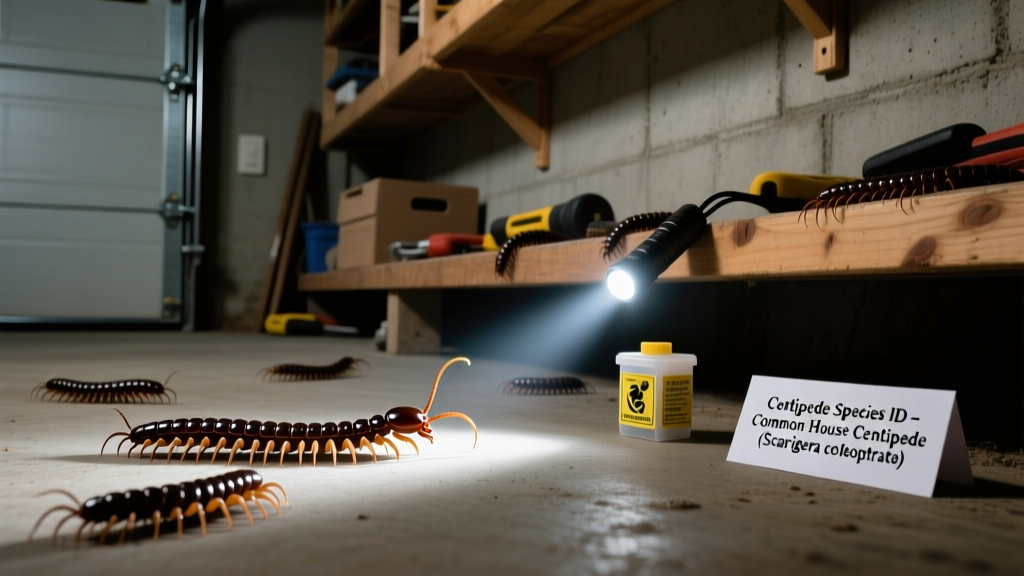
Centipedes aren’t insects—they’re arthropods with dozens of legs, venomous jaws, and a strong preference for damp, cluttered garages. While they don’t damage structures or spread disease, their sudden appearances (especially at night near floor drains or stored boxes) trigger alarm—and they’ll readily bite if handled.
Identification
Garage centipedes are almost always house centipedes (Scutigera coleoptrata) or soil-dwelling species like Lithobius spp. that wander in from foundations. They’re fast, flattened, and range from 1–1.5 inches long. Unlike millipedes, they have one pair of legs per body segment—and those legs extend outward, giving them a spidery, skittering gait.
| Feature | Centipede | Millipede | Silverfish |
|---|---|---|---|
| Legs (adult) | 30–354 (odd number of pairs) | 60–400 (even pairs) | 6 |
| Movement | Fast, erratic, darting | Slow, wave-like | Wriggling, fish-like |
| Habitat clue | Under cardboard, near sump pumps | In mulch piles or damp concrete cracks | Inside cardboard boxes, near glue or paper |
| Bite risk | Yes—painful, localized swelling | No | No |
Look for shed exoskeletons near baseboards, tiny pinprick holes in drywall (entry points), or live specimens darting under parked cars at dusk. A single sighting often means several more are hiding in wall voids or beneath concrete slabs.
What Attracts Them
Centipedes follow food—not crumbs, but other pests. They hunt spiders, silverfish, cockroach nymphs, and carpet beetle larvae. So if you’ve got centipedes, you likely have an underlying pest population feeding them.
- Dampness: Relative humidity above 60% (common near garage floor drains, HVAC condensate lines, or cracked slab edges)
- Clutter: Cardboard boxes, old tires, stacked firewood, and unused tools create humid microhabitats and shelter
- Entry points: Gaps >1/16″ under garage doors, unsealed utility penetrations, and weep holes in cinderblock walls
- Light-attracted prey: Outdoor lights near garage doors draw moths and flies—then centipedes follow the buffet
According to the National Pest Management Association’s 2022 Field Survey, 68% of garage centipede infestations were linked to unaddressed moisture issues within 3 feet of the foundation.
Treatment Methods
Natural Methods
Start here—especially if kids or pets use the garage. Diatomaceous earth (food-grade) works best when applied as a thin, dry band along baseboards and under storage shelves. It dehydrates centipedes on contact but loses efficacy if dampened. Cedar oil spray (0.5% solution) disrupts their nervous system and repels without toxicity; reapply every 7–10 days after rain or washing.
- Sticky traps placed near floor drains and behind freezers catch active adults (check daily)
- Vacuuming with a shop vac + immediate disposal of the canister contents removes eggs and adults
- Reducing spider populations with spider control methods cuts off their primary food source
Chemical Methods
Reserve insecticides for persistent hotspots. Bifenthrin (0.02% concentration) applied as a perimeter barrier 2 ft up and 3 ft out from garage walls provides 6–8 weeks of residual control. Avoid spraying near electrical panels or vehicle exhaust paths. For wall voids, use a dust formulation of deltamethrin—never aerosol sprays, which disperse ineffectively in open garages.
"Centipedes avoid treated surfaces for up to 90 days—but only if you eliminate moisture first. Spraying a damp corner is like locking the door while leaving the window wide open." — Dr. Lena Torres, Urban Entomology Extension, UC Riverside, 2023
Prevention
Long-term success hinges on making your garage inhospitable—not just killing what’s there. Seal gaps with copper mesh and silicone caulk (not expandable foam, which centipedes chew through). Install a dehumidifier set to 50% RH if humidity stays above 60% for >48 hours straight. Elevate stored items on plastic pallets—not cardboard or wood—to break contact with cool, damp concrete.
- Inspect and replace worn garage door bottom seals annually
- Redirect downspouts at least 5 ft from foundation
- Clean gutters quarterly to prevent overflow onto garage walls
- Switch outdoor lights to yellow sodium vapor bulbs—they attract 70% fewer insects than LED white light (U.S. Department of Energy, 2021)
Pair these steps with regular vacuuming of corners and behind appliances. For ongoing monitoring, place 3–4 sticky traps in low-traffic zones and rotate locations monthly.
When to Call an Exterminator
Call a licensed pest pro if you see more than 5 centipedes in one week—or if they’re appearing inside the house via garage-connected interior doors. Also call if you find evidence of structural moisture: efflorescence on concrete, musty odors near walls, or blistering paint on garage-side drywall. These indicate conditions that support not just centipedes, but termites and carpenter ants too.
Why do centipedes gather near my garage door?
They’re exploiting the thermal and moisture gradient—the gap under the door is cooler and damper than the rest of the garage floor, especially in summer. That same gap also lets in springtails and sowbugs, which centipedes eat. Replace the door seal and add a threshold sweep rated for 1/8″ clearance.
Can centipedes climb garage walls?
Yes—especially smooth concrete or painted drywall. Their leg hooks grip surprisingly well. That’s why they’re often seen high on walls near ceiling joists or ventilation grilles. Vertical treatments should extend 3 ft up from baseboards during chemical applications.
Do centipedes lay eggs in garages?
Rarely—but they will if humidity exceeds 70% and organic debris (like moldy cardboard or leaf litter) is present. Females deposit 15–60 eggs in soil or decaying matter. You’ll spot clusters of translucent, pearl-like eggs only if you lift soaked insulation or peel back rotted plywood subflooring.
Are garage centipedes dangerous to pets?
Not typically. Dogs and cats rarely get bitten unless they corner or paw at one. If bitten, symptoms are mild: localized redness and brief stinging. However, small rodents (like pet hamsters kept in garages) are vulnerable prey—centipedes may attack them.
Will sealing my garage windows stop centipedes?
Only if you seal *all* gaps—including where window frames meet brick or stucco, and around operable vents. Centipedes fit through openings as narrow as 0.02 inches. Use non-expanding polyurethane foam for larger voids, then cover with acrylic caulk for a seamless, chew-resistant finish.
How long does it take to eliminate a centipede problem?
With consistent moisture control and sanitation, activity drops by 80% in 10–14 days. Full resolution—including egg hatch cycles—takes 3–4 weeks. If numbers rebound after 3 weeks, re-inspect for hidden moisture sources like leaking water heater pan drains or failed sump pump check valves.
Centipedes in your garage aren’t a sign of neglect—they’re a signal that moisture and secondary pests are out of balance. Fix the environment, not just the bug. And remember: if you’re seeing them regularly, something else is already living in your walls. Address that first, and the centipedes will follow suit.