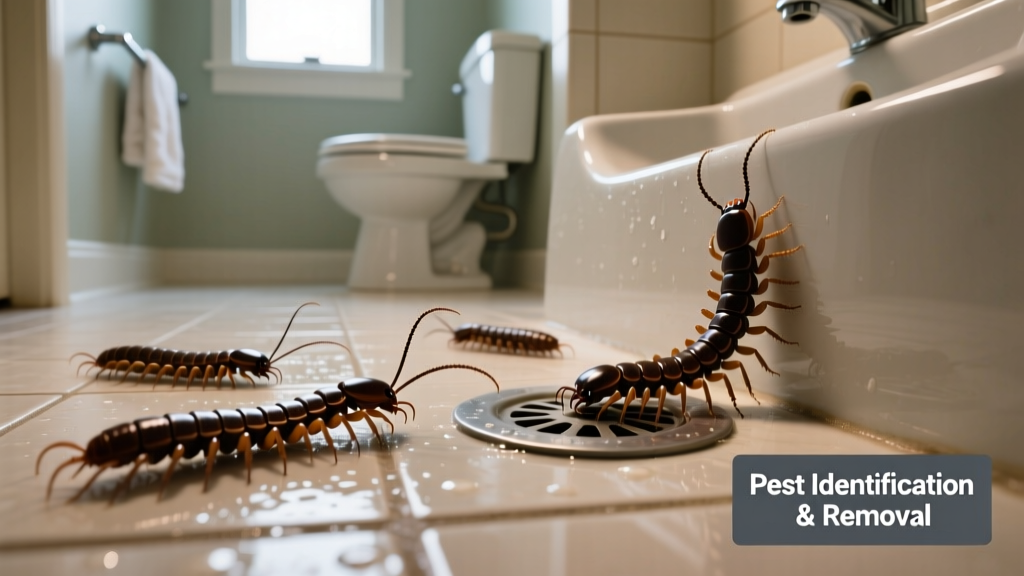
Centipedes—long, multi-legged arthropods with fast, darting movements—are common bathroom invaders because they seek moisture, warmth, and prey like spiders and silverfish. While they don’t bite humans often and aren’t disease vectors, their sudden appearance on walls or floors triggers alarm—and signals underlying moisture or pest issues.
Identification
Household centipedes (most commonly Scutigera coleoptrata, the house centipede) are 1–1.5 inches long, with 15 pairs of long, banded legs that ripple as they move. They’re tan to yellowish-gray, with three dark longitudinal stripes down the back and antennae nearly as long as their body. Unlike millipedes, they’re fast, predatory, and avoid light.
| Feature | House Centipede | Millipede | Spider |
|---|---|---|---|
| Legs (adult) | 15 pairs (30 legs) | Up to 400 legs (in segments) | 4 pairs (8 legs) |
| Movement | Quick, skittering | Slow, rolling gait | Variable; often pauses mid-step |
| Habitat preference | Damp, hidden crevices near drains or baseboards | Decaying organic matter (rarely indoors) | Corners, ceilings, window frames |
| Bite risk | Low; only if handled (mild sting) | None | Most harmless; few medically significant |
Signs include spotting one at night near tubs or sinks, finding shed exoskeletons behind toilets, or noticing small, fast shadows along grout lines.
What Attracts Them
Bathrooms offer three essentials for centipedes: moisture, shelter, and food. Leaky faucets, poor ventilation, and standing water under sinks create ideal humidity (they require >70% RH to survive). Cracks in tile grout, gaps around pipes, and openings behind baseboards serve as entry points and harborage. Most critically, they follow prey—so a centipede sighting usually means you also have silverfish, cockroach nymphs, or spiders present.
- Relative humidity above 70% (measured with a hygrometer)
- Unsealed gaps around plumbing, vents, or door thresholds
- Cluttered cabinets or piles of towels that retain moisture
- Undetected leaks under vanities or behind shower walls
Treatment Methods
Natural Methods
Start non-chemical: vacuum adults with a crevice tool (dispose bag immediately), wipe down surfaces with diluted vinegar (1:1 with water) to disrupt scent trails, and apply food-grade diatomaceous earth (DE) in dry, undisturbed cracks—DE dehydrates centipedes on contact but loses efficacy if damp. Cedar oil spray (0.5% solution) applied along baseboards repels without toxicity to pets or kids.
Chemical Options
If infestation persists, targeted insecticides work best. Use residual pyrethroid sprays (e.g., bifenthrin 0.05%) only in cracks and voids—not open surfaces. Avoid foggers; they disperse ineffectively in bathrooms and degrade quickly in humidity. According to the National Pesticide Information Center’s 2022 review, perimeter sprays reduce centipede activity by 68% within 72 hours when applied correctly—but overuse increases resistance and harms beneficial predators.
"Centipedes are symptom, not cause. If you're seeing more than 2–3 per week, inspect for moisture damage and secondary pests first." — Dr. Lena Torres, Urban Entomologist, Purdue Extension, 2023
Prevention
Sustained control hinges on environmental correction. Install an exhaust fan rated for at least 50 CFM and run it 20 minutes after each shower. Fix all leaks—even minor drip rates add up: the U.S. EPA estimates that a single dripping faucet wastes 3,000 gallons annually. Seal gaps with silicone caulk (not acrylic) around pipes and baseboards. Store towels and bath mats off the floor, and replace worn grout with mold-resistant epoxy-based sealant.
- Run bathroom fan during and 20 minutes after every shower
- Check under sinks monthly for condensation or soft drywall
- Use a dehumidifier if humidity stays above 60% (even briefly)
- Keep drain traps filled with water to block sewer entry
When to Call an Exterminator
Call a licensed pest professional if you see centipedes daily for over two weeks, find them in multiple rooms (not just the bathroom), or discover evidence of structural moisture—like bubbling paint, warped subflooring, or musty odors behind walls. Reputable providers will conduct moisture mapping and inspect for hidden plumbing leaks before applying any treatment. Avoid companies that push blanket sprays or quarterly contracts without inspection.
Why do centipedes appear only at night?
They’re nocturnal and photophobic—light triggers avoidance behavior. Their compound eyes detect even low-level ambient light, so they emerge after lights go out and retreat before dawn. Turning on lights mid-bathroom visit often startles them into freezing or bolting into drains.
Can centipedes come up through drains?
Yes—but rarely from city sewers. More often, they enter via cleanout access points, broken P-traps, or dry drain traps. A properly sealed trap with standing water blocks entry. Test yours: pour ½ cup water down the drain—if it disappears in under 30 seconds, the trap is compromised.
Are centipedes dangerous to pets?
No documented cases of harm to dogs or cats exist. Centipedes avoid confrontation and lack venom potent enough to affect mammals. However, if your pet chases and mouths one, mild oral irritation may occur—rinse mouth with water and monitor. Keep pets away from chemical treatments, not the centipedes themselves.
Do ultrasonic repellents work?
No. Independent testing by the University of Nebraska-Lincoln’s Entomology Department (2021) found zero reduction in centipede activity using six commercially available ultrasonic devices across 12 humidified test bathrooms over 28 days.
How long do bathroom centipedes live indoors?
Up to 6 years—the longest lifespan of any common household arthropod. That’s why eliminating their food sources (other pests) matters more than killing individuals. A single adult can consume 15+ insects weekly, making them both nuisance and accidental ally.
Will sealing my bathroom windows stop them?
Not alone. Centipedes rarely fly or climb smooth glass—they enter through foundation cracks, pipe chases, or gaps under doors. Focus on sealing the bottom 6 inches of exterior-facing walls and installing door sweeps with ≤⅛" gap. Aluminum threshold seals last longer than rubber in humid conditions.
Centipedes in your bathroom are less about invasion and more about invitation. Fix the moisture, deny the shelter, and disrupt the food chain—and you’ll rarely see one again. For related help, see our guides on silverfish in bathroom and leaky faucet repair, both key contributors to this issue.