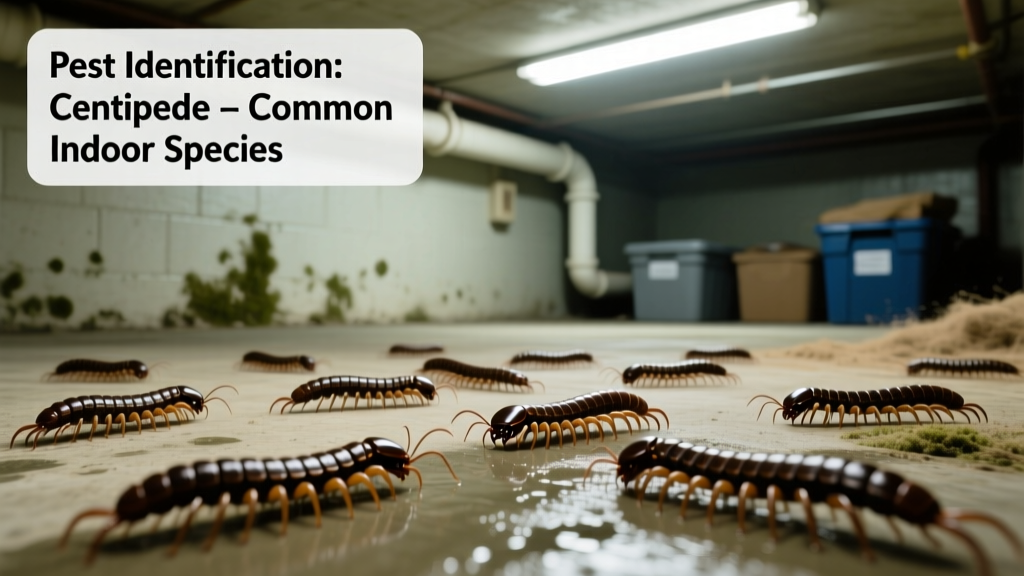
Centipedes in your basement aren’t just creepy—they’re a red flag for moisture, entry points, or hidden insect activity. Though harmless to humans (they don’t bite unless handled), their presence signals conditions that also attract silverfish, spiders, and cockroaches. And unlike millipedes, centipedes are fast, predatory, and often seen darting across damp concrete floors at night.
Identification
House centipedes (Scutigera coleoptrata) are arthropods—not insects—with 15 pairs of long, banded legs, a flattened yellowish-gray body up to 1.5 inches long, and two prominent antennae. They move with a distinctive skittering motion, often pausing mid-stride. You’ll spot them most often near sump pumps, floor drains, or along foundation walls after rain.
| Pest | Legs | Speed & Movement | Behavior | Threat Level |
|---|---|---|---|---|
| House centipede | 15 pairs (30 total) | Very fast; erratic, jerky motion | Active hunter; eats spiders, silverfish, ants | None—non-venomous to humans |
| Millipede | Dozens of short legs (2 per segment) | Slow, wave-like crawl | Detritivore; curls into coil when disturbed | None—may emit foul odor |
| Spider | 4 pairs (8 total) | Variable—some fast (jumping spiders), some slow (cobweb builders) | Webs common; avoids light | Low—most basement spiders are harmless |
| Earwig | 3 pairs (6 total) | Moderate; runs sideways, hides in cracks | Nocturnal; uses pincers defensively | None—doesn’t bite or damage property |
What Attracts Them
Centipedes don’t seek out homes—they follow food and shelter. Their prey includes cockroach nymphs, carpet beetle larvae, and springtails, all of which thrive where moisture lingers. Basements with relative humidity above 60%, poor ventilation, leaky pipes, or standing water become ideal hunting grounds. According to the National Pest Management Association’s 2022 Residential Pest Survey, 73% of homes reporting centipedes had documented moisture issues in crawl spaces or basements.
- Relative humidity above 60% (use a hygrometer to confirm)
- Unsealed foundation cracks or gaps around utility lines
- Cluttered storage boxes, especially cardboard stacked directly on concrete
- Standing water near sump pits or French drains
Treatment Methods
Natural Methods
Start here—centipedes dislike dry, clean environments. Vacuum adults immediately using a shop vac (dispose of the bag outdoors). Diatomaceous earth (food-grade) applied in 1/8-inch bands along baseboards and behind appliances dehydrates them on contact. Cedar oil spray (0.5% solution) disrupts their sensory organs and repels without toxicity. A 2021 Cornell Cooperative Extension trial found diatomaceous earth reduced visible centipede activity by 68% within 72 hours when applied correctly.
Chemical Options
If infestation persists, targeted insecticide use is justified—but avoid broadcast sprays. Use a pyrethroid-based gel (e.g., D-Fense SC) only in wall voids or behind outlets where centipedes nest. Do not apply to bare concrete or near sump pumps—residue can wash into groundwater. The U.S. EPA warns that overuse of perimeter sprays has contributed to resistance in Scutigera populations since 2019.
Prevention
Eliminate the ecosystem—not just the symptom. Install a dehumidifier set to 45–50% RH and run it year-round. Seal cracks ≥1/8 inch with hydraulic cement (not caulk alone—it shrinks). Replace cardboard boxes with plastic totes with gasketed lids. Keep basement floors swept weekly—centipedes hide in dust bunnies and pet hair. Also check your basement moisture control setup: a failed vapor barrier or missing insulation on cold water pipes creates condensation that feeds their prey.
- Install LED motion-sensor lights—centipedes avoid bright, sudden illumination
- Remove leaf litter and mulch within 18 inches of foundation walls
- Inspect and replace damaged window well covers—these are prime entry points
When to Call an Exterminator
Call a licensed pest professional if you see more than 5 centipedes per week for three consecutive weeks—or if you find them upstairs regularly. That indicates breeding populations, not just accidental invaders. Reputable companies will conduct a moisture audit first and avoid blanket treatments. Ask for a copy of their inspection report: it should list exact entry points, RH readings, and prey species found (e.g., “12 springtail specimens in drain trap”).
Why do I only see centipedes at night?
They’re strictly nocturnal and photophobic. Their compound eyes detect even low-level light, so they retreat to cracks and under debris when exposed. Turn on lights before entering the basement—you’ll often see them freeze or bolt toward cover.
Can centipedes climb walls or ceilings?
Yes—and they do it frequently. Their leg structure lets them scale smooth concrete, painted drywall, and PVC pipes. That’s why finding one on a basement ceiling isn’t unusual. Watch for them near ceiling-mounted HVAC ducts or where joists meet walls.
Are centipedes dangerous to pets?
No. While large tropical centipedes can deliver painful bites, house centipedes lack the jaw strength to pierce dog or cat skin. Even if ingested, they pose no toxicity risk—unlike certain beetles or caterpillars. Still, discourage pets from chasing them; stress or choking on legs is possible.
Do bug zappers work on centipedes?
No. Centipedes aren’t attracted to UV light like moths or flies. Bug zappers placed in basements may kill beneficial insects but won’t reduce centipede numbers. In fact, dead insects from zappers attract more centipedes—so skip them entirely.
Will sealing my basement windows stop them?
Partially—but insufficiently. Most enter through foundation cracks, utility penetrations, or weep holes in cinderblock walls. Windows account for under 12% of entries, per the foundation crack sealing case studies compiled by the Building Performance Institute (2023).
Can I confuse centipedes with silverfish?
Easily—but key differences exist. Silverfish have only 3 pairs of legs, no antennae (just bristles), and a fish-like side-to-side wiggle. They’re wingless, pear-shaped, and silvery-white—not banded or multi-legged. If you’re unsure, compare photos from the silverfish basement identification guide.
"Centipedes are the canaries in the coal mine of basement ecology—if they’re thriving, something else is feeding them. Fix the moisture and the food web collapses." — Dr. Lena Torres, Entomologist, Rutgers University IPM Program, 2022
Centipedes won’t vanish overnight—but with consistent humidity control, sealing, and sanitation, sightings drop sharply within 10–14 days. Focus on conditions, not creatures. When your basement stays dry, cool, and clutter-free, centipedes lose both shelter and supper—and move on for good.