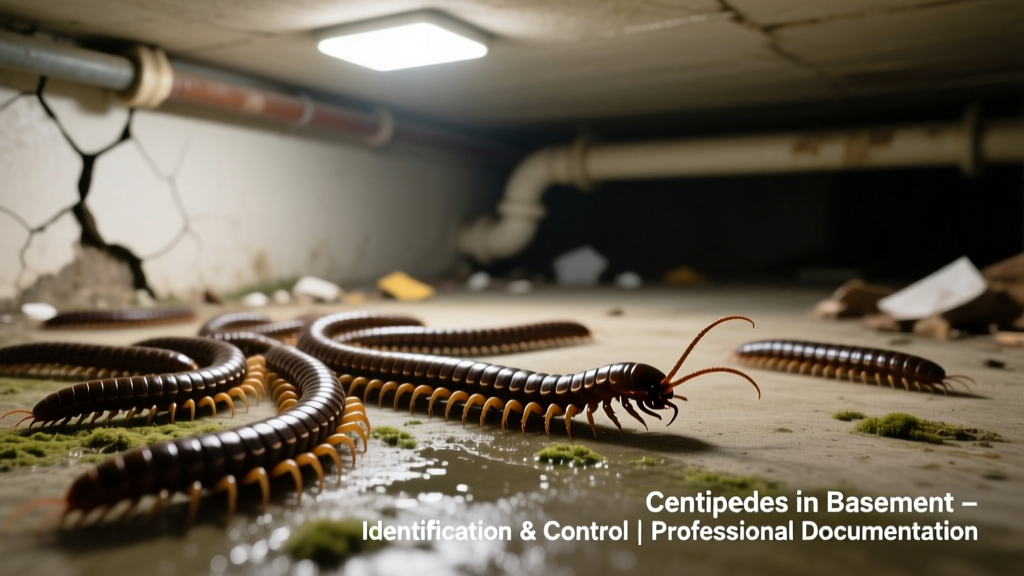
Centipedes—especially the common house centipede (Scutigera coleoptrata)—frequently invade basements because of cool, damp conditions and abundant prey like spiders, silverfish, and cockroach nymphs. While harmless to humans (they rarely bite and their venom isn’t medically significant), their sudden, darting movement triggers strong aversion—and their presence signals underlying moisture or pest issues.
Identification
House centipedes are tan to grayish-yellow with 15 pairs of long, banded legs (not 100, despite the name). Adults reach 1–1.5 inches and move in rapid, wave-like motion. Unlike millipedes, they’re fast, predatory, and have prominent antennae and claw-like forcipules near the head.
Key signs in your basement include sightings at night (they’re nocturnal), shed exoskeletons near foundation cracks or sump pits, and clusters near drains or dehumidifier drip pans.
| Feature | House Centipede | Millipede | Spider |
|---|---|---|---|
| Leg count (adult) | 30 (15 pairs) | 60–400 (many pairs) | 8 |
| Movement speed | Very fast, skittering | Slow, deliberate | Variable, often quick |
| Preferred habitat | Damp walls, pipes, cluttered corners | Soil, mulch, under stones | Ceiling corners, window frames |
| Threat to humans | Negligible (bite rare, mild sting) | None | Most harmless; few species medically relevant |
What Attracts Them
Centipedes don’t seek out humans—they follow food and shelter. Basements offer three critical attractants: moisture, darkness, and prey. Relative humidity above 60% supports their survival; standing water near sump pumps, leaky pipes, or poor exterior grading creates ideal microhabitats. Cluttered storage boxes, old cardboard, and piles of firewood provide cover and nesting zones.
- Leaky basement windows or cracked foundation walls (entry points)
- Unvented clothes dryers exhausting into basement space
- Overgrown shrubbery within 18 inches of foundation (holds moisture and bridges entry)
- Undecked crawl spaces with exposed dirt floors
Treatment Methods
Natural Methods
Start with desiccants and physical removal. Food-grade diatomaceous earth (DE) applied in a thin line along baseboards and behind appliances damages centipede exoskeletons on contact. Vacuuming with a shop vac removes live specimens and eggs—immediately dispose of the bag outdoors. Sticky traps placed near floor drains and utility closets catch adults without chemicals.
Essential oil sprays (10 drops peppermint + 1 cup water) deter centipedes but require reapplication every 3–4 days. According to the University of Kentucky Entomology Department’s 2022 pest management bulletin, peppermint oil disrupts centipede sensory receptors—but it’s not a standalone solution.
Chemical Options
For persistent infestations, use EPA-registered insecticides labeled for indoor centipede control. Bifenthrin (0.02% concentration) applied as a perimeter spray along foundation walls and interior baseboards delivers residual activity for up to 90 days. Avoid broad-spectrum pyrethroids indoors unless targeting specific harborage zones—overuse can kill centipedes’ natural predators (like ground beetles), worsening secondary pest outbreaks.
- Always read the label: “For crack-and-crevice application only” means do NOT broadcast-spray floors
- Never apply near sump pump intakes or floor drains—chemical runoff contaminates groundwater
- Wear N95 mask and gloves when handling concentrated formulations
Prevention
Sustained prevention hinges on moisture control and exclusion. Install a dehumidifier set to 45–50% RH and empty it daily—or upgrade to a continuously drained unit. Seal gaps >1/8 inch around pipes, windows, and doorframes with silicone caulk or copper mesh (rodents can’t chew through it). Redirect downspouts at least 5 feet from the foundation, and install French drains if soil slopes toward the house.
Store seasonal items in sealed plastic totes—not cardboard—and elevate them 6 inches off concrete floors using pallets or metal shelving. Replace organic mulch (bark, wood chips) with gravel or stone within 24 inches of the foundation.
"Centipedes are nature’s pest patrol—but when they move indoors, it’s always a symptom, never the disease." — Dr. Elena Ruiz, Urban Entomologist, Purdue Extension, 2023
When to Call an Exterminator
Call a licensed professional if you see more than 5 centipedes per week for three consecutive weeks—or if you’ve addressed moisture and clutter but sightings persist. Reputable firms conduct moisture mapping and thermal imaging to locate hidden entry paths and breeding zones. They’ll also inspect for concurrent infestations: silverfish, spiders, or earwigs often co-occur and indicate similar conditions.
Why do I only see centipedes at night?
They’re strictly nocturnal and photophobic. Their compound eyes detect light changes—not images—so even dim LED nightlights suppress activity. Use motion-sensor lights sparingly; better to reduce hiding spots than chase them with light.
Can centipedes climb walls and ceilings?
Yes—house centipedes have adhesive pads on leg tips and can scale smooth concrete, painted drywall, and PVC pipe. That’s why they appear suddenly on basement walls or furnace ductwork. This ability also makes sealing vertical gaps essential.
Do centipedes lay eggs in my basement?
Rarely. Females deposit 15–60 eggs in moist soil or rotting wood—usually outside. But if your basement has a dirt floor, exposed insulation with mold, or decaying timber framing, egg-laying becomes possible. Look for tiny, pearl-white ovoids (0.5 mm) in damp crevices.
Will killing one centipede attract more?
No. Centipedes are solitary and non-colonial. They don’t release aggregation pheromones. However, crushing one may leave behind scent cues that briefly attract scavengers—so vacuum instead.
Are basement centipedes different from outdoor ones?
Most basement invaders are the non-native Scutigera coleoptrata, adapted to human structures. Native soil-dwelling centipedes (e.g., Lithobius spp.) rarely enter homes—they prefer forest litter and die quickly in low-humidity interiors.
Can I use bleach to repel them?
No. Bleach doesn’t repel centipedes and corrodes concrete, grout, and metal pipes. Its fumes irritate human airways and degrade HVAC filters. Stick to targeted DE, dehumidification, and exclusion.
Centipedes in your basement aren’t just creepy—they’re a clear signal that moisture and microhabitats need correction. Fix those first, and the centipedes won’t just disappear—they’ll have no reason to return. For deeper moisture diagnostics, review our guide on basement moisture problems and foundation crack sealing.