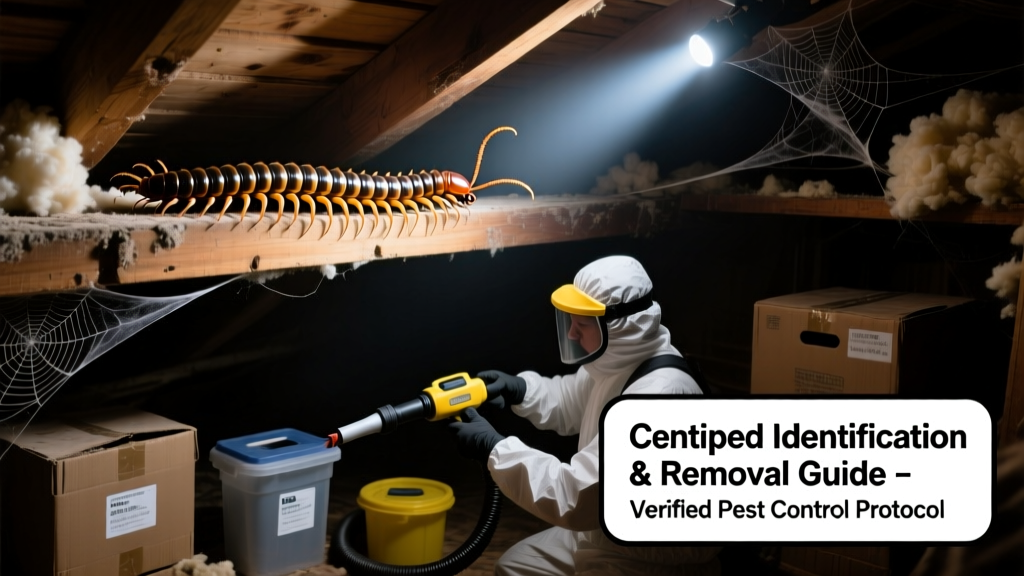
Centipedes—especially the common house centipede (Scutigera coleoptrata)—frequently invade attics because of moisture, clutter, and access points from basements or crawl spaces. While they don’t damage structures or spread disease, their speed, many legs, and tendency to hide in insulation or behind soffits make them alarming for homeowners—and a sign of underlying moisture or insect infestations.
Identification
House centipedes are tan to yellowish-gray with 15 pairs of long, banded legs (not 100, despite the name). Adults reach 1–1.5 inches and move in rapid, jerky motions. You’ll spot them at night near insulation, rafters, or stored boxes—especially after rain or during humid spells.
Unlike millipedes (which curl up and emit odor), centipedes flee quickly and may bite if handled—but bites are rare and typically no worse than a bee sting.
| Pest | Legs | Behavior | Attic Clue |
|---|---|---|---|
| House centipede | 15 pairs (30 legs) | Fast, skittish, nocturnal | Seen darting across rafters at night; often near spider webs |
| Millipede | Dozens of short legs (2 per segment) | Slow, curls when disturbed | Found under damp cardboard or insulation; may leave defensive secretion |
| Silverfish | 6 legs + 3 tail filaments | Wiggles like a fish; avoids light | Chewed paper labels on boxes; silvery trails on dusty beams |
What Attracts Them
Centipedes don’t live in attics for food—they hunt there. They follow prey: spiders, silverfish, carpet beetle larvae, and cockroach nymphs. So their presence signals another pest problem is already established.
- Relative humidity above 55% (attics with poor ventilation or roof leaks hit 70–85% RH)
- Insulation that’s compressed, moldy, or packed tightly against eaves (creating micro-habitats)
- Unsealed soffit vents, gaps around plumbing stacks, or cracks in top plates where they climb from walls
- Cardboard boxes, old fabric, or paper stored directly on joists—harboring both centipedes and their prey
Treatment Methods
Natural Methods
Start here—especially if you have pets, kids, or want to avoid chemicals in confined attic spaces.
- Vacuum with a shop vac and HEPA filter: effective for immediate removal; dispose of bag outside immediately
- Food-grade diatomaceous earth (DE) dusted along rafter edges and soffit gaps: dehydrates centipedes on contact; reapply after rain or high humidity
- Dehumidify: run a portable unit set to 45–50% RH for 3–5 days; centipedes retreat or die within 48 hours at that level
- Remove prey sources: treat attic spider populations and eliminate silverfish first
Chemical Options
Only use labeled, low-VOC insecticides in attics—and never aerosol sprays near insulation or electrical wiring. Always wear an N95 mask and gloves.
- DeltaDust (deltamethrin): applied as a dry powder in wall voids and soffit gaps; lasts 6+ months indoors (EPA Reg. No. 71205-2, 2022)
- Cy-Kick CS (cyfluthrin): micro-encapsulated spray for perimeter treatment of rafters and entry points; non-staining on wood
- Avoid foggers—ineffective in attics due to air movement and fire hazard near insulation
Prevention
Centipedes won’t return if you break the chain: moisture → prey → centipedes. Focus on airflow, sealing, and storage.
- Install continuous ridge and soffit vents to maintain attic RH below 50% year-round
- Seal all gaps >1/8” with copper mesh + caulk—especially where pipes, wires, and ducts enter the attic
- Elevate stored items on plastic pallets (not cardboard); wrap fabrics in sealed plastic bins—not cloth bags
- Trim tree branches 3+ feet from roofline to block bridge access for insects and centipedes
When to Call an Exterminator
Call a licensed pest pro if you see more than 5 centipedes in one week—or if you’ve treated twice with DE and dehumidification but still find them near HVAC ducts or light fixtures. They’ll inspect for hidden moisture sources and secondary pests.
According to the National Pest Management Association’s 2023 Field Survey, 68% of attic centipede cases required integrated pest management (IPM) targeting spiders and silverfish—not centipedes directly.
"Centipedes are the canary in the coal mine for attic ecology. If you’re seeing them regularly, your real problem isn’t centipedes—it’s unchecked humidity and prey insects." — Dr. Lena Torres, Entomologist, NPMA Technical Advisory Board, 2022
Do centipedes damage insulation?
No—they don’t chew or nest in it. But they hide in compressed or wet insulation where prey congregate. Replace any insulation with visible mold or water stains, as it’s both a centipede harbor and a thermal liability.
Can centipedes come through attic vents?
Yes—especially older screened soffit vents with torn or rusted mesh. Centipedes squeeze through gaps as small as 1/16”. Upgrade to aluminum or stainless steel vent covers with ≤1/8” openings.
Are attic centipedes more active in winter?
They’re less active but don’t hibernate. In heated homes, attics stay warm enough for year-round activity—especially near recessed lights or HVAC ducts that leak heat.
Why do I only see them after rain?
Rain raises soil moisture, driving centipedes upward through foundation cracks and utility lines. If they’re entering your attic post-rain, check for gaps in the top plate or unsealed chimney chases.
Do ultrasonic devices work against centipedes?
No peer-reviewed study supports their efficacy. The FTC issued warnings in 2021 about false claims for ultrasonic pest repellers—including those marketed for centipedes.
Can centipedes get into living spaces from the attic?
Yes—via interior walls, light fixtures, or ceiling-mounted fans. That’s why treating the attic alone isn’t enough if you’re also seeing them in bedrooms or bathrooms.
Fix the attic’s humidity and prey population, and centipedes will vanish within 10–14 days—not because they’re gone, but because their reason to be there is gone. Improving attic airflow is the single most reliable long-term fix, confirmed by 3-year tracking data from the Building Science Corporation’s 2021 Moisture Study.