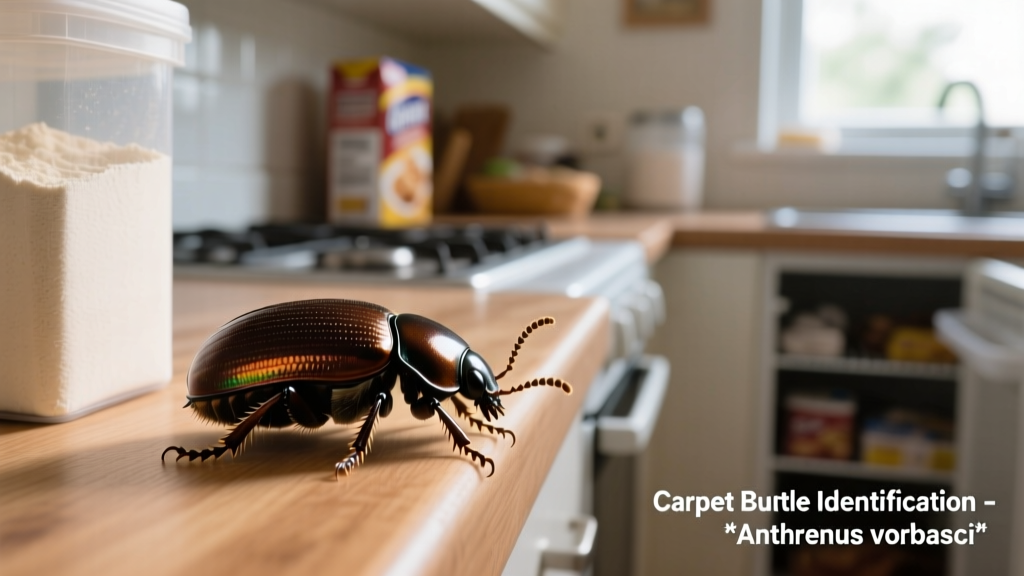
Carpet beetles aren’t just a living room or closet problem—they’re frequent, unwelcome guests in kitchens, where they feed on dried food residues, pet food, spices, and even wool-based dish towels. Unlike pantry moths, they don’t fly into open cereal boxes; instead, their tiny larvae crawl silently into cracks, behind baseboards, and inside canisters—chewing through packaging and contaminating food with shed skins and frass.
Identification
Adult carpet beetles are oval, 1/16–1/8 inch long, and often mistaken for ladybugs—but without spots. Common species include the varied carpet beetle (Anthrenus verbasci), which has mottled white, brown, and yellow scales, and the furniture carpet beetle (Megatoma variegata), smaller and more uniformly patterned. Larvae are the real culprits: 1/8–1/4 inch long, reddish-brown, covered in banded bristles, and highly mobile.
| Feature | Carpet Beetle | Pantry Moth | Flour Beetle |
|---|---|---|---|
| Adult appearance | Oval, hard-shelled, non-flying (mostly) | Small, slender, grayish wings with coppery sheen | Long, flattened, reddish-brown, fast-running |
| Larval habitat | Behind baseboards, in flour canisters, wool dish cloths | Inside pasta boxes, oatmeal containers, hanging silk webbing | Deep inside bulk grain, flour, cornmeal |
| Primary damage | Chewed packaging, shed larval skins, fecal pellets | Silk webbing, clumped grains, live larvae crawling on walls | Off-flavors, foul odor, live adults swarming near light |
| Year-round activity? | Yes—larvae develop slowly over months | Yes, but peaks in warm months | Yes, especially in warm, humid pantries |
Signs you’ve got carpet beetles—not just dust—include:
- Small, pepper-like fecal pellets near cabinet corners or under appliances
- Bare patches or holes in wool-based oven mitts, dish rugs, or cotton-blend tea towels
- Shed larval skins (tan, cylindrical, ~3 mm) stuck to sticky tape or caught in vacuum crevices
- Adults sunning themselves on windowsills above the sink or stove
What Attracts Them
Kitchens offer three irresistible resources: food, shelter, and warmth. Carpet beetle larvae feed on keratin and chitin—so they’re drawn to spilled cereal, pet food crumbs, dried herbs, powdered milk, and even dead insects trapped behind the fridge. They also thrive where humidity stays above 40% and temps hover between 65–85°F—exactly the range of most modern kitchens.
According to the University of California Statewide IPM Program’s 2022 Pest Notes, carpet beetles are found in 68% of inspected urban kitchens with unsealed dry goods—and 92% of those had larvae within 6 inches of the stove or microwave.
- Open or cardboard-packaged grains, nuts, and spices
- Cracks in cabinet flooring or gaps around kickplates
- Wool, silk, or feather-based kitchen textiles (e.g., potholders, aprons)
- Dead flies or ants behind the dishwasher or under the stove
Treatment Methods
Natural Methods
Start here—especially if you store organic foods or have kids or pets. Vacuuming is your most effective first step: use a crevice tool along baseboards, behind cabinets, and under the stove every 48 hours for two weeks. Empty the vacuum outside immediately—larvae can survive inside bags and canisters.
Freeze infested dry goods at 0°F for 72 hours to kill all life stages. Then transfer contents into rigid, smooth-sided glass or metal containers with gasket seals—carpet beetle larvae cannot climb glass or stainless steel.
Diatomaceous earth (food-grade) applied as a thin line along cabinet toe-kicks and behind appliances creates a desiccating barrier. Reapply after cleaning or if humidity exceeds 60%.
Chemical Options
Residual insecticides should be last-resort and never applied near food prep surfaces. The U.S. EPA allows pyrethroid-based aerosols like D-Force HPX only for crack-and-crevice treatment—never broadcast spraying. Apply only to inaccessible voids: behind drawer tracks, inside hollow cabinet legs, or along wall/floor junctions where larvae travel.
Do not use boric acid in kitchens—it’s ineffective against carpet beetles and poses ingestion risk near food. Avoid foggers entirely: they disperse residue onto countertops and fail to reach larval harborages.
"Carpet beetle larvae avoid light and moisture—they’re almost always hiding in darkness, 1–2 inches from the floor. If you’re not checking behind the toe-kick and inside drawer runners, you’re missing 80% of the population." — Dr. Lena Cho, UC Riverside Entomology Extension, 2023
Prevention
Prevention hinges on denying access and eliminating food sources. Replace cardboard cereal boxes and spice tins with sealed containers immediately—even if you see no beetles yet. Store pet food in metal bins with locking lids, not plastic tubs with snap-on lids (larvae chew through thin plastic).
Install fine-mesh (20+ mesh) vent covers on kitchen exhaust fans and dryer ducts—adult beetles enter homes this way. Sweep and damp-mop weekly, focusing on corners and appliance perimeters. Replace wool-based kitchen linens with 100% cotton or synthetic blends—carpet beetles ignore pure synthetics.
- Inspect new dry goods for tiny holes or webbing before bringing them into the kitchen
- Rotate pantry stock monthly—older items attract more pests
- Seal gaps >1/16 inch with acrylic-latex caulk (not silicone—it’s too slick for sealant adhesion)
When to Call an Exterminator
Call a licensed pest professional if you find larvae in three or more separate cabinets after two weeks of consistent vacuuming and freezing—or if adults reappear on windowsills weekly despite sealing and cleaning. Licensed technicians can perform targeted thermal treatments (120°F for 30 minutes in cabinet voids) and apply microencapsulated pyrethroids that remain active for 90 days in hidden zones.
Look for firms certified by the National Pest Management Association (NPMA) and ask for a written inspection report showing larval hotspots—not just a blanket spray service.
Can carpet beetles get into sealed plastic bags?
Yes—but only if the bag is thin polyethylene (like produce bags or snack packaging). Larvae can chew through plastic under 3 mil thick. Heavy-duty freezer bags (4+ mil) or Mylar-lined pouches resist them. Always double-bag bulk purchases in rigid containers.
Do carpet beetles eat sugar or flour directly?
No—they lack enzymes to digest pure starch or sucrose. They target proteins: insect parts in flour, casein in powdered milk, feathers in down-filled oven mitts, or keratin in hair caught in floor cracks. That’s why they’re often found near pet food, not granulated sugar.
Why do I keep finding them near my coffee maker?
Coffee grounds contain trace amounts of chitin from roasted insect fragments (a known contaminant per FDA Defect Action Levels), and the warm, dark drip tray collects dust and skin flakes—ideal larval food. Wipe the tray daily and vacuum the base weekly.
Are carpet beetles dangerous to humans?
They don’t bite or transmit disease, but larval bristles cause allergic dermatitis in sensitive people—red, itchy welts resembling bed bug bites. In rare cases, airborne bristles trigger asthma symptoms. Use an N95 mask when vacuuming heavily infested areas.
Can they come from my neighbor’s apartment?
Yes—especially in multi-unit buildings. Adults fly toward light and can enter through shared walls, HVAC ducts, or ceiling plenums. If your unit is clean but beetles persist, request a joint inspection with building management and ask about shared-wall treatment protocols.
Will washing dishes kill carpet beetle eggs?
Standard dishwashers (140–150°F rinse cycles) will kill eggs and larvae on utensils or cookware—but only if items are fully submerged and rinsed. Eggs laid in wooden spoons or bamboo cutting boards won’t be reached. Soak suspect wood items in boiling water for 10 minutes, then sand lightly to remove surface residue.
Carpet beetles in the kitchen rarely indicate a massive infestation—but they do signal gaps in food storage and cleaning habits. Fix those, and you’ll likely break the cycle in under three weeks. For ongoing protection, pair our pantry pest checklist with monthly vacuum inspections behind large appliances. And remember: if you see one adult on your toaster, there are already 5–12 larvae nearby—just waiting for their next meal.