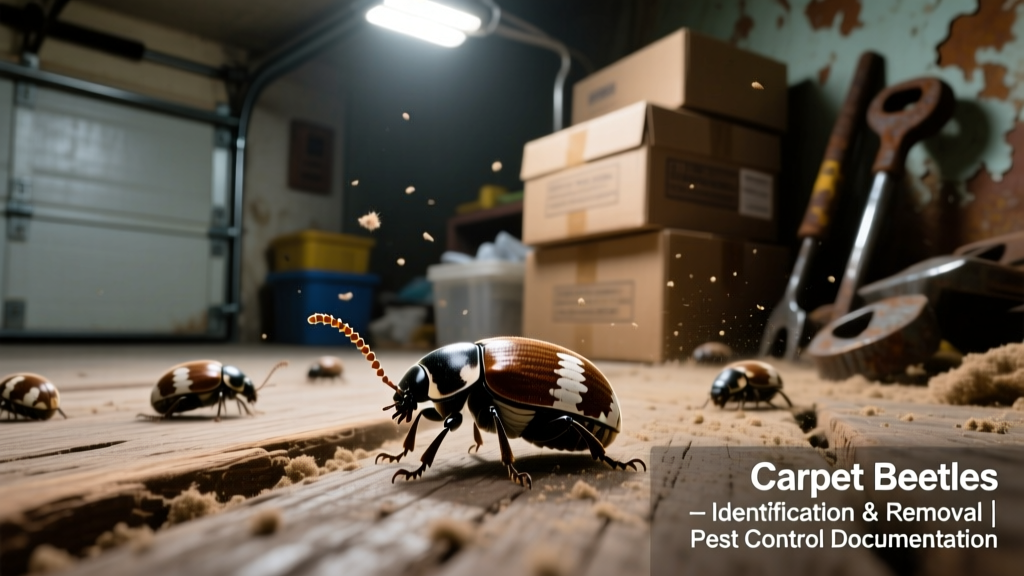
Carpet beetles are tiny but destructive pests that thrive in undisturbed, dusty corners — making garages prime real estate. Unlike moths, they don’t fly much, but their larvae chew through natural fibers like wool, leather, and pet hair, silently damaging rugs, stored clothing, and even insulation over time.
Identification
Adult carpet beetles are oval-shaped, 1/16 to 1/8 inch long, and often mottled with brown, white, and orange scales — resembling miniature ladybugs. Larvae are the real problem: 1/8-inch, hairy, reddish-brown, and shaped like tiny commas. They avoid light and burrow deep into clutter, behind baseboards, or inside cardboard boxes.
Key signs in your garage include:
- Shed larval skins near stored items (look like translucent, curled husks)
- Tiny holes or bare patches in wool rugs, car seat covers, or old blankets
- Clusters of adults on windowsills or near light fixtures (they’re attracted to UV light)
- Faint, musty odor from accumulated frass (larval droppings) in storage bins
| Pest | Size | Key Visual Clue | Typical Location |
|---|---|---|---|
| Varied carpet beetle (Anthrenus verbasci) | 1.5–2.5 mm | Mottled pattern of white, brown, and yellow scales | Under stored rugs, inside toolboxes, behind shelves |
| Larder beetle (Dermestes lardarius) | 3–6 mm | Single broad pale stripe down wing covers | Near dried pet food, rodent carcasses, or grease traps |
| Drugstore beetle (Stegobium paniceum) | 2–3 mm | Uniform reddish-brown; antennae end in 3-segmented club | In birdseed, flour bags, or old paint cans with dried residue |
What Attracts Them
Garages offer three ideal conditions: food, shelter, and neglect. Carpet beetle larvae feed on keratin — so anything containing animal protein draws them in. That includes dust bunnies rich in pet dander, old leather jackets, wool blankets, taxidermy mounts, dried insect collections, and even dead rodents trapped in wall voids.
They also exploit common garage oversights:
- Cardboard boxes left unsealed for months (larvae crawl in and feed on glue + paper fibers)
- Unused holiday decorations wrapped in wool or felt
- Insulation batts made with recycled denim or cotton (keratin-free, but still harbor dust/dander)
- Gaps around garage doors and utility lines — entry points for adults flying in from outdoors
Treatment Methods
Natural Methods
Vacuuming is your most effective first step — use a crevice tool on baseboards, shelf undersides, and behind stored items. Dispose of the vacuum bag or canister contents immediately outside in a sealed trash bag. Steam cleaning (180°F+) kills eggs and larvae on rugs and upholstery. Freezing infested small items (e.g., gloves, hats) at 0°F for 72 hours halts development.
For ongoing deterrence, place cedar blocks or lavender sachets near storage bins — not as kill agents, but as mild repellents that disrupt larval navigation. Diatomaceous earth (food-grade) applied as a thin line along garage floor edges and under shelves dehydrates larvae on contact.
Chemical Options
Pyrethrin-based aerosols (like Bedlam Plus) work well for spot-treating cracks and crevices where larvae hide — but only after thorough vacuuming. Avoid broad-spectrum sprays on concrete floors; they degrade quickly and offer minimal residual control. According to the National Pesticide Information Center’s 2022 review, carbaryl (Sevin Dust) is labeled for carpet beetles in non-food areas and remains effective for up to 3 weeks when kept dry.
"Most garage infestations trace back to one overlooked source — a single mouse nest in the attic above or an old bird’s nest in the eaves. Always inspect vertical pathways before treating horizontally." — Dr. Lena Cho, Entomologist, UC Riverside IPM Program, 2023
Prevention
Prevent recurrence by breaking the life cycle: adult beetles lay eggs in spring and early summer, and larvae take 2–12 months to mature depending on temperature and food quality. In heated garages, multiple generations per year are possible.
Start with these steps:
- Inspect and discard all damaged natural-fiber items — don’t try to salvage moth-eaten rugs or wool coats
- Store seasonal items in hard-sided plastic totes with gasket seals (not plastic bags — larvae chew through)
- Seal gaps >1/8 inch around garage door frames, pipe penetrations, and window trim with silicone caulk
- Run a dehumidifier if relative humidity exceeds 55% — larvae develop slower below 45% RH
Also consider installing fine-mesh (20+ mesh) vent covers on soffits and gable vents — adults can’t squeeze through.
When to Call an Exterminator
Call a licensed pest management professional if you find larvae in more than three separate locations (e.g., behind shelving, inside a tool chest, and under a workbench), or if adults continue appearing weekly after two rounds of vacuuming and targeted treatment. Persistent infestations often indicate breeding sources outside the garage — like roof voids, wall cavities, or adjacent attics.
Look for companies certified by the National Pest Management Association (NPMA) and ask for a written inspection report identifying probable entry points and hidden harborage zones. Avoid firms offering “one-time fogging” — it won’t reach larvae embedded in carpet padding or insulation.
Can carpet beetles damage my car interior?
Yes — especially older vehicles with wool headliners, leather seats, or cloth floor mats. Larvae feed on dust, skin flakes, and fabric adhesives. Check under floor mats and along sun visor hinges. Vacuum monthly and wipe surfaces with diluted vinegar to remove attractants.
Do carpet beetles bite humans?
No — they lack mouthparts capable of piercing skin. However, larval hairs can cause allergic dermatitis in sensitive people, presenting as itchy, red welts (often mistaken for bites). This is especially common after handling infested items without gloves.
Will washing clothes kill carpet beetles?
Hot water (130°F+) and high-heat drying (>120°F for 30 minutes) will kill all life stages. Cold washes and air-drying won’t. For wool or delicate items, dry cleaning is safer and equally effective.
Are carpet beetles attracted to LED lights?
Less so than incandescent or fluorescent bulbs — but they’ll still gather near any light source at night. Switch to yellow sodium-vapor or amber LED bulbs (5000K or lower color temperature) near garage entrances to reduce attraction.
Can I use mothballs in the garage?
No. Paradichlorobenzene (PDB) mothballs are ineffective against carpet beetles and pose serious health risks in enclosed spaces. The U.S. EPA warns that prolonged exposure can cause neurological symptoms and is linked to increased asthma risk in children (EPA Safer Choice Program, 2021). Use cedar or freezing instead.
How long does a carpet beetle infestation last?
With consistent intervention, active infestations resolve in 2–4 months. But eggs laid in late summer may overwinter and hatch in spring — so monitor March–June for new adults. Continue vacuuming monthly for six months post-treatment to catch emerging beetles.
Garage carpet beetles rarely spread to living areas — unless you bring infested items inside or have shared HVAC ductwork. Keep storage intentional, inspect before rotating seasonal gear, and remember: the best treatment is always what you do before the first larva hatches. For related issues, see our guides on rodent-proofing garage doors and silverfish in garage.