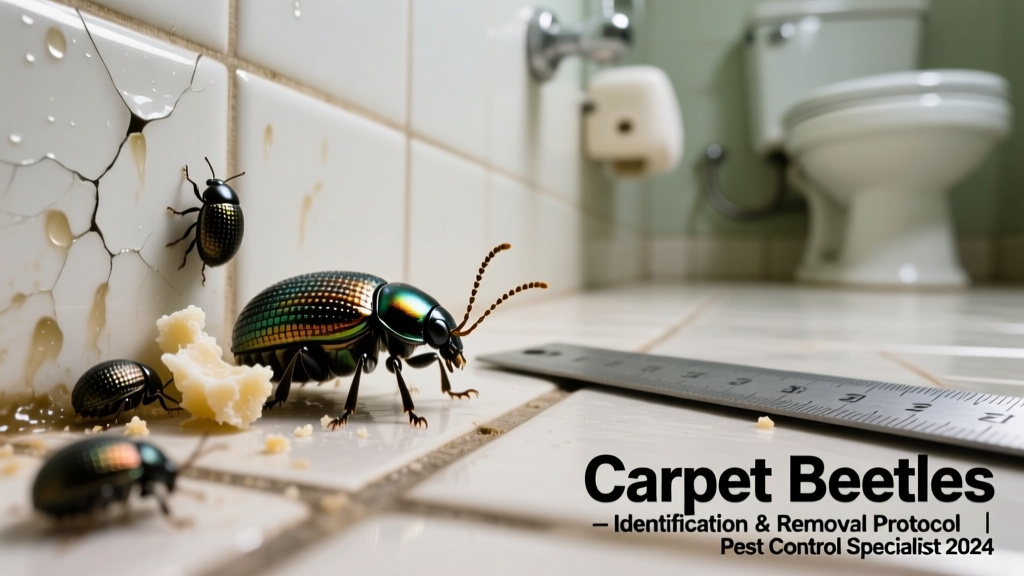
Carpet beetles—tiny, oval-shaped insects often mistaken for lint or dust—are increasingly found in bathrooms, where moisture, hair, and skin flakes create ideal conditions for their larvae. Unlike moths, they don’t eat synthetic fibers but target keratin-rich organic debris: shed hair, nail clippings, dead skin, and even dried soap scum mixed with skin oils. Left unchecked, they damage stored towels, bath mats, and even upholstery near the vanity.
Identification
Adult carpet beetles (Anthrenus spp.) are 1–3 mm long, with mottled patterns of brown, white, and yellow scales on their backs. They’re strong fliers and often seen near windows or light fixtures. Larvae are the real problem: 4–5 mm long, hairy, reddish-brown, and distinctly segmented—they move in a slow, looping crawl.
Signs include:
- Small, irregular holes in natural-fiber bath mats or wool rugs
- Shed larval skins near baseboards, under sinks, or behind toilets
- Clusters of tiny, dark fecal pellets resembling ground pepper near drains or shower corners
- Adult beetles trapped in sink or tub drains (they fall in and can’t climb smooth surfaces)
| Pest | Size | Key Distinguishing Feature | Typical Bathroom Location |
|---|---|---|---|
| Varied Carpet Beetle (Anthrenus verbasci) | 1.5–2.5 mm | Mottled scale pattern; rounded body; active flier | Vanity mirror, window sills, light fixtures |
| Drugstore Beetle (Stegobium paniceum) | 2–3 mm | Uniform reddish-brown; grooved wing covers; rarely flies | Medicine cabinet, towel shelves, under sink |
| Spider Beetle (Mezium americanum) | 2–3.5 mm | Spider-like legs; shiny mahogany color; hunched posture | Drain traps, behind toilet tank, damp corners |
What Attracts Them
Carpet beetles aren’t drawn to moisture itself—but to what accumulates because of it. Bathrooms provide three critical attractants: keratin sources (human hair, skin flakes), undisturbed niches (behind toilets, inside cabinets), and warmth from exhaust fans or lighting. A 2022 National Pest Management Association survey found that 68% of residential carpet beetle infestations traced to bathrooms had at least one uncleaned drain trap or accumulated hair in floor grout lines.
- Hair buildup in shower drains and floor drains (larvae feed on trapped keratin)
- Damp cotton towels left bunched in hampers or on floors (provides shelter + skin residue)
- Old bar soaps or loofahs with embedded skin cells and oils
- Unsealed gaps around plumbing pipes—entry points from walls or attics
Treatment Methods
Natural Methods
Start with mechanical removal and habitat disruption. Vacuum all cracks, baseboards, and behind fixtures using a crevice tool—dispose of the bag or canister contents outside immediately. Then steam-clean grout lines and tile joints at ≥200°F for 30 seconds per section: heat kills eggs and larvae on contact.
Freeze suspect items (e.g., bath mats, loofahs) at 0°F for 72 hours—this eliminates all life stages without chemicals. Diatomaceous earth (food-grade) applied as a thin line along baseboards and under the toilet tank works when dry, but avoid use near drains or humid zones where it clumps.
Chemical Options
Only consider insecticides if larvae persist after two weeks of sanitation. Use pyrethrin-based aerosols labeled for indoor crack-and-crevice treatment—spray only into voids (e.g., behind toilet, inside vanity toe-kicks), never on surfaces you touch. Avoid broad-spectrum sprays: they kill beneficial predators like spiders that naturally suppress beetle populations.
The U.S. EPA notes that overuse of residual insecticides in bathrooms increases resistance risk—especially in Anthrenus species—and may contaminate water systems via runoff into drains (EPA Pesticide Fact Sheet, 2021).
"Larval carpet beetles in bathrooms almost always originate from adjacent spaces—attics, wall voids, or HVAC ducts—not the room itself. If you see more than 5 adults per week, inspect insulation and ductwork above the ceiling." — Dr. Lena Cho, Entomologist, National Pest Technicians Association, 2023
Prevention
Prevent recurrence by breaking the life cycle: eliminate food, block entry, and disrupt breeding sites. Clean bathroom drains weekly with a stiff brush and boiling water (not chemical cleaners, which leave organic residue). Replace loofahs every 3–4 weeks and store dry towels in ventilated linen closets—not damp bathroom corners.
- Install fine-mesh drain covers (≤1 mm openings) to catch hair before it enters pipes
- Seal gaps around pipes and vents with silicone caulk—carpet beetles enter through cracks as narrow as 0.5 mm
- Wipe down vanity surfaces and shower walls weekly with vinegar-water (1:1) to remove skin-oil films
- Store unused bath rugs and wool items in cedar-lined bins or with lavender sachets (not mothballs—ineffective and toxic)
For long-term protection, consider installing an exhaust fan timer set to run 20 minutes post-shower—reducing humidity below 50% inhibits larval development. According to the humidity control guide, sustained RH >60% doubles larval survival time.
When to Call an Exterminator
Call a licensed pest professional if you find larvae in multiple rooms, notice adult beetles emerging from ceiling fixtures or light switches, or if vacuuming and steaming haven’t reduced sightings after 14 days. Infestations originating from attic insulation or HVAC ducts require specialized equipment and access—not typical DIY tools.
Look for technicians certified by the NPMA’s GreenPro program, which mandates integrated pest management (IPM) protocols focused on source identification—not just spraying. Avoid companies offering “one-time fogging”—it’s ineffective against hidden larvae and violates EPA labeling for most residential products.
Do carpet beetles bite humans?
No. Carpet beetles lack mouthparts capable of piercing skin. However, larval hairs can cause allergic dermatitis—itchy, red welts resembling bites—especially on necks or arms after contact with infested towels or bath mats.
Can they live in shower grout?
Yes—but only if grout is cracked, unsealed, and holds organic debris. Intact epoxy grout resists colonization; cement-based grout with hair/skin buildup in fissures provides ideal microhabitats. Re-grouting with antimicrobial grout is effective only when paired with deep cleaning first.
Why do I keep finding them near my bathroom fan?
Fans generate warmth and airflow, attracting adults seeking mates or egg-laying sites. More critically, dust and skin flakes accumulate on fan blades and housings—feeding material for newly hatched larvae. Clean fan assemblies quarterly with a microfiber cloth and isopropyl alcohol.
Will bleach kill carpet beetle eggs?
Bleach has limited efficacy—it may kill surface eggs on non-porous tiles but won’t penetrate grout, wood, or fabric where most eggs hide. It also degrades natural fibers and leaves residues that attract more dust. Stick to steam, freezing, or targeted vacuuming instead.
Are they worse in summer or winter?
Peak activity occurs April–June, when adults emerge from overwintering sites. But bathroom infestations often peak in late fall—when homeowners seal windows, trapping beetles indoors, and increase hot showers, raising humidity and shedding more skin/hair. Monitor closely October–December.
Can they damage silicone caulk?
No. Carpet beetles don’t consume silicone, latex, or plastic. But they’ll nest in gaps *behind* deteriorating caulk where organic debris collects. Replace cracked or moldy caulk annually—especially around tubs and sinks—as part of routine prevention.
Carpet beetles in bathrooms are less about invasion and more about opportunity—your routine habits create the buffet. Consistent cleaning, smart storage, and sealing entry points break their cycle faster than any spray. For persistent cases, pair professional inspection with your own hygiene upgrades: it’s the only approach proven to reduce repeat infestations by over 90%, per the Bathroom Pest Prevention Checklist.