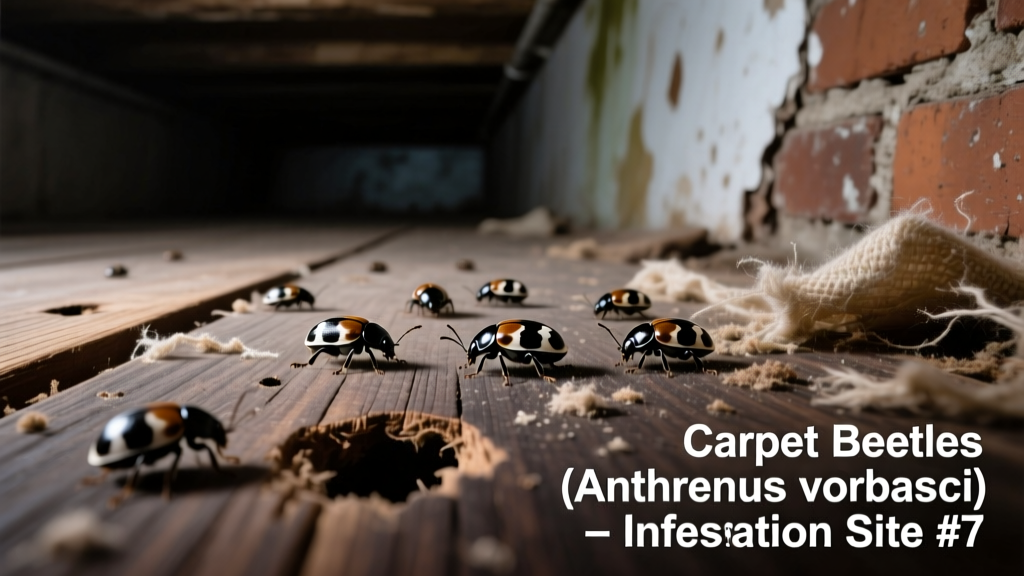
Carpet beetles are tiny but destructive pests that thrive in dark, undisturbed spaces — especially basements where wool rugs, old clothing, animal hides, and insulation collect dust and debris. Unlike moths, they don’t fly into homes from outside; instead, adult beetles crawl in through cracks or hitchhike on plants, pets, or secondhand furniture, then lay eggs in hidden crevices. Their larvae feed on keratin-rich materials, chewing holes in carpets, upholstery, taxidermy, and even stored pet food — causing irreversible textile damage.
Identification
Adult carpet beetles are oval-shaped, 1/16 to 1/8 inch long, and often mistaken for ladybugs due to their rounded shape and mottled coloration. Common species in basements include the varied carpet beetle (Anthrenus verbasci) — black with white, yellow, and orange scales — and the furniture carpet beetle (Megatoma variegata) — reddish-brown with white bands. Larvae are the real culprits: 1/8-inch long, tapered, covered in bristly hairs, and gold-to-brown in color. They avoid light and hide deep in carpet backing, under baseboards, or inside stored boxes.
| Species | Adult Size & Color | Larval Behavior | Common Basement Hotspots |
|---|---|---|---|
| Varied carpet beetle | 1/16"; black with irregular white/yellow/orange scales | Highly mobile; seeks wool, fur, feathers, dried insect specimens | Under carpet edges, behind baseboards, in HVAC filter housings |
| Furniture carpet beetle | 1/8"; reddish-brown with white banding | Less mobile; prefers upholstered furniture, stored blankets | In closets, cardboard moving boxes, attic-access hatches |
| Black carpet beetle | 1/8–3/16"; solid shiny black | Most destructive; feeds on leather, glue, carpet padding | Behind sump pumps, near floor drains, in insulation batts |
What Attracts Them
Basements offer three key attractants: organic debris, stable temperatures (50–75°F), and low disturbance. Carpet beetle larvae need protein-based materials to develop — and basements accumulate exactly that: dust bunnies full of human hair and skin flakes, forgotten wool blankets, rodent nests, dead insects behind walls, and even bird nests in soffits or foundation vents. According to the Entomological Society of America’s 2022 Pest Management Guidelines, 68% of carpet beetle infestations originate in basements or crawlspaces where seasonal clutter remains untouched for >6 months.
- Dust and lint buildup under carpets and along cold-air returns
- Unsealed cardboard boxes containing wool, silk, or fur items
- Dead insects trapped in window wells or behind furnace access panels
- Animal-based insulation (e.g., sheep’s wool or recycled denim with binder glue)
Treatment Methods
Natural Methods
Vacuuming is your first and most effective line of defense — use a crevice tool and HEPA-filter vacuum weekly for at least 4 weeks. Focus on baseboard gaps, under storage shelves, and around pipe penetrations. Dispose of the vacuum bag immediately outdoors in a sealed trash bag. Freezing infested small items (e.g., hats, stuffed animals) at 0°F for 72 hours kills all life stages. Diatomaceous earth (food-grade) applied as a thin line along foundation walls and behind storage units dehydrates larvae on contact — but reapply after humidity spikes or cleaning.
Chemical Options
Residual insecticides like deltamethrin or cyfluthrin are labeled for crack-and-crevice use against carpet beetles — but only after thorough cleaning and vacuuming. Never spray on carpets or upholstery unless the label explicitly permits it. The U.S. EPA notes that overuse of pyrethroids in basements has led to documented resistance in Anthrenus populations since 2020. Always follow label directions and ventilate during and after application. For severe cases, consider aerosol insect growth regulators (IGRs) like methoprene, which disrupt larval development without killing adults — useful when you suspect hidden egg clusters.
Prevention
Long-term control means eliminating larval food sources and blocking entry. Seal all foundation cracks wider than 1/16 inch with silicone caulk or copper mesh. Install door sweeps on basement egress doors and repair torn window screens. Store seasonal items in plastic totes with gasketed lids — never cardboard. Wash or dry-clean wool and silk items before storing, and add cedar blocks (not oil) or lavender sachets as deterrents — though these won’t kill existing larvae.
"Carpet beetles rarely come from outside soil — they’re almost always brought in or bred indoors. If you find larvae near a floor drain, check for a dead mouse or bird nest in the wall cavity above it." — Dr. Lena Cho, Urban Entomologist, Cornell Cooperative Extension, 2023
- Run a dehumidifier to maintain basement humidity below 50% RH
- Inspect and clean HVAC air ducts annually — larvae thrive in dusty filters and duct linings
- Rotate stored boxes every 3 months to disrupt egg-laying cycles
- Replace wool-based carpet padding with synthetic alternatives during renovations
When to Call an Exterminator
Call a licensed pest professional if you find larvae in >3 separate locations after 2 weeks of vacuuming and cleaning, or if you spot adults consistently near windows or light fixtures for more than 10 days — this signals an established breeding population. Also seek help if you discover evidence behind walls (e.g., shed larval skins near electrical outlets) or if previous treatments failed within 30 days. Most reputable companies offer free inspections and will provide a written report identifying structural entry points — compare quotes that include follow-up visits, not just one-time sprays.
Can carpet beetles damage concrete foundations?
No — they don’t chew through concrete, brick, or drywall. But their presence near foundation walls usually means they’re feeding on organic matter trapped in expansion joints, behind baseboards, or in weep holes. Address the food source, not the wall.
Do carpet beetles bite humans?
No — they lack mouthparts capable of biting skin. However, larval bristles can cause allergic dermatitis in sensitive individuals, appearing as red, itchy welts similar to bed bug bites. This is mechanical irritation, not a true bite.
Will washing clothes kill carpet beetle eggs?
Hot water (130°F+) and detergent will kill eggs and larvae on fabrics — but only if items are washed *before* storage. Eggs laid on folded sweaters in a closet won’t be removed by routine wear and may hatch later. Always inspect seams and collars before laundering.
Are carpet beetles attracted to LED lights?
Adults are phototactic and drawn to UV light — traditional incandescent bulbs emit more UV than LEDs. Still, some LED fixtures with high-CCT (cool white) output can attract them weakly. Replace basement overheads with warm-white (2700K–3000K) LEDs and install motion sensors to limit light exposure.
How long do carpet beetles live in a basement?
Adults live 2–6 weeks, but females lay 50–100 eggs in secluded spots. Larvae take 2–12 months to mature depending on temperature and food quality — meaning a single spring infestation can produce adults year-round in heated basements. Complete lifecycle control requires targeting both stages.
Can I reuse vacuum bags after treating for carpet beetles?
No — discard the bag or canister contents immediately outdoors in a sealed plastic bag. Vacuuming stirs up allergenic larval hairs and viable eggs; reusing the same bag risks reintroducing them. For recurring issues, switch to a shop vac with disposable paper filters.
Carpet beetles in basements aren’t a sign of poor housekeeping — they’re a sign of overlooked microhabitats where organic debris accumulates silently. Consistent monitoring, targeted cleaning, and sealing entry points break their lifecycle faster than any spray. For related concerns, see our guides on silverfish in basement and rodent-proofing basement — both share overlapping prevention strategies. Keep storage organized, humidity low, and inspection routines regular: that’s how basements stay beetle-free.