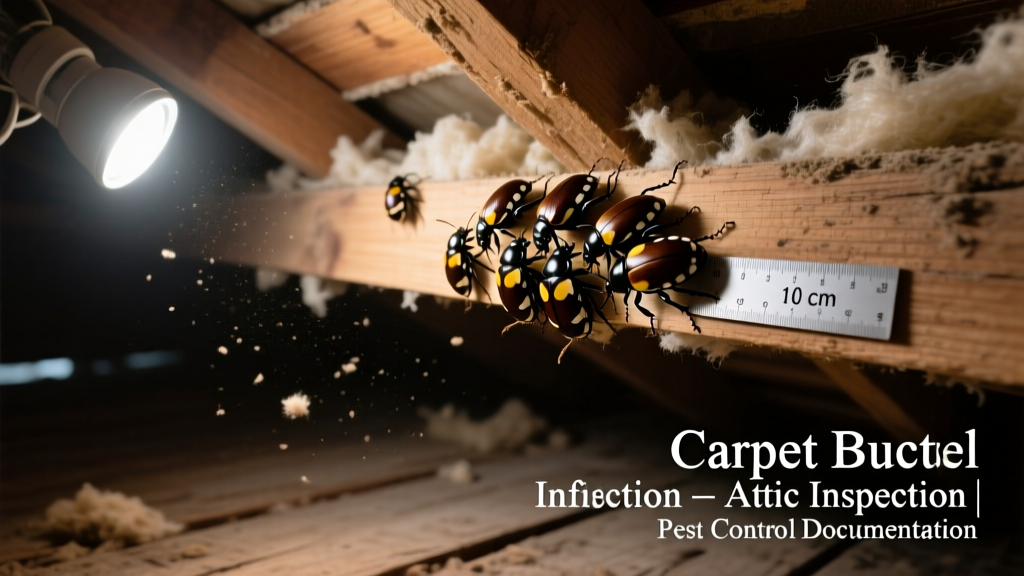
Carpet beetles are tiny, oval-shaped pests that rarely bite—but their larvae chew through natural fibers like wool, silk, feathers, and fur. In attics, they thrive where old insulation, rodent nests, bird droppings, or stored textiles provide ideal food and shelter. Left unchecked, a single infestation can damage heirloom blankets, taxidermy mounts, and even structural wool-based insulation over time.
Identification
Adult carpet beetles (Anthrenus spp.) are 1–3 mm long, roundish, and often mottled with white, brown, and yellow scales—resembling miniature ladybugs. Larvae are the real threat: 4–5 mm long, hairy, reddish-brown, and distinctly segmented, with bristly tufts at the rear. They avoid light and burrow deep into insulation, behind baseboards, or inside stored boxes.
| Pest | Size | Key Visual Clue | Typical Attic Location |
|---|---|---|---|
| Varied carpet beetle (Anthrenus verbasci) | 1.5–2.5 mm | Mottled scale pattern; short antennae | Inside fiberglass batts with rodent debris |
| Larder beetle (Dermestes lardarius) | 7–10 mm | Black body with single tan band across wing covers | Near dead rodents or bird carcasses |
| Drugstore beetle (Stegobium paniceum) | 2–3 mm | Uniform reddish-brown; grooved wing covers | Stored dried goods (rare in clean attics) |
Signs of infestation include:
- Shed larval skins near insulation seams or box corners
- Small, irregular holes in woolen rugs or clothing stored in trunks
- Clusters of adult beetles near attic windows or soffit vents (especially April–June)
- Fine, sand-like frass (larval excrement) caught in cobwebs or under eaves
What Attracts Them
Carpet beetles don’t seek attics for warmth—they follow food. Their larvae feed exclusively on keratin and chitin, making these attic features prime targets:
- Rodent or bird nests (feathers, fur, dander, carcasses)
- Old wool or horsehair insulation (common in homes built before 1950)
- Unsealed storage bins containing wool sweaters, leather books, or taxidermy
- Dead insects trapped in soffits or behind baffles (e.g., cluster flies, wasps)
According to the University of Kentucky Entomology Department’s Entomology Fact Sheet E-19 (2022), 68% of attic carpet beetle infestations originate within 3 feet of an animal nest or carcass—often hidden behind insulation or under floorboards.
Treatment Methods
Natural Methods
Start here if you have minimal activity (fewer than 5 adults seen weekly) or prefer non-toxic options:
- Vacuum thoroughly using a HEPA-filter vacuum—focus on insulation edges, joist cavities, and soffit gaps. Seal and discard the bag immediately outside.
- Freeze infested small items (e.g., hats, gloves) at 0°F for 72 hours to kill eggs and larvae.
- Apply food-grade diatomaceous earth (DE) as a 1/8-inch band along rafters and insulation seams—reapply after humidity spikes or disturbance.
- Install fine-mesh (16-mesh) vent screens to block adult entry without reducing airflow.
Chemical Methods
Use only when larvae are confirmed in insulation or nesting material—and always follow label directions:
- Pyrethrin-based aerosols (e.g., Bedlam Plus) for spot-treating visible larvae in accessible crevices
- Boric acid dust applied with a bellows duster into wall voids adjacent to attic access points
- Insect growth regulators (IGRs) like methoprene (found in Gentrol IGR Aerosol) to disrupt larval development—effective for up to 3 months
"Carpet beetle larvae won’t move far to feed—so targeted treatment within 6 inches of their food source is more effective than broad spraying." — Dr. Ric Bessin, UK Entomology Extension, 2022
Prevention
Long-term success hinges on eliminating food sources and sealing entry paths:
- Remove all animal nests during spring cleanup—wear N95 masks and gloves; double-bag and dispose off-site.
- Replace wool/horsehair insulation with borate-treated cellulose or closed-cell spray foam (which lacks keratin).
- Store seasonal items in rigid plastic bins with gasket seals—not cardboard or fabric bags.
- Clean soffits annually with a shop vac and inspect for insect buildup behind baffles.
For persistent issues, consider upgrading attic ventilation to reduce humidity—carpet beetle larvae develop fastest at 50–70% RH. The U.S. EPA notes that proper attic airflow cuts pest-friendly microclimates by up to 40% (Energy Star Home Ventilation Guide, 2021).
When to Call an Exterminator
Call a licensed pest professional if:
- You find live larvae inside wall voids or HVAC ductwork
- More than 10 adults appear weekly near windows for three consecutive weeks
- Insulation shows visible tunneling or webbing (indicating heavy, established activity)
- You suspect rodent activity but can’t locate the nest—professionals use thermal imaging and borescopes
Look for providers certified in attic pest inspection and ask whether they offer post-treatment monitoring—many include 90-day follow-ups for carpet beetles due to their long life cycle.
Do carpet beetles come from the roof?
No—they don’t nest in shingles or roofing felt. But roof leaks create damp spots where insects die and accumulate, attracting carpet beetles indirectly. Fix leaks first, then inspect nearby insulation.
Can they damage fiberglass insulation?
Not directly—their mouthparts can’t digest glass fibers. However, fiberglass batts often contain paper facing or binder glue with starches and proteins that larvae will graze on. Borate-treated fiberglass resists this.
Why do I see them in my bathroom?
Adults fly toward light and moisture. If they’re emerging from attic vents or ceiling fixtures, they may land on bathroom mirrors or tiles. It’s a sign of upward movement—not a bathroom infestation.
Are carpet beetles dangerous to pets?
Larvae don’t bite or parasitize animals, but pet hair and dander on floors or furniture can support small populations. Vacuum pet areas weekly and wash pet bedding in hot water monthly.
How long does an attic infestation last?
Without intervention, carpet beetles complete one generation every 2–12 months depending on temperature and food availability. A full resolution typically takes 3–6 months—even with treatment—because pupation occurs in hidden locations and adults emerge asynchronously.
Will cleaning the attic alone get rid of them?
Only if you remove *all* organic food sources—including nests, dead insects, and soiled insulation. Surface sweeping misses larvae buried 2+ inches deep. Combine cleaning with targeted treatment and exclusion.
If you’ve found shed skins near your attic hatch or spotted adults fluttering near a dormer window, act now—carpet beetles rarely stay confined to one zone. For help identifying larvae in insulation samples, refer to our carpet beetle larvae photo guide. And if rodent proofing is part of your plan, review our attic rodent exclusion checklist—since 80% of carpet beetle infestations start with a mouse problem.