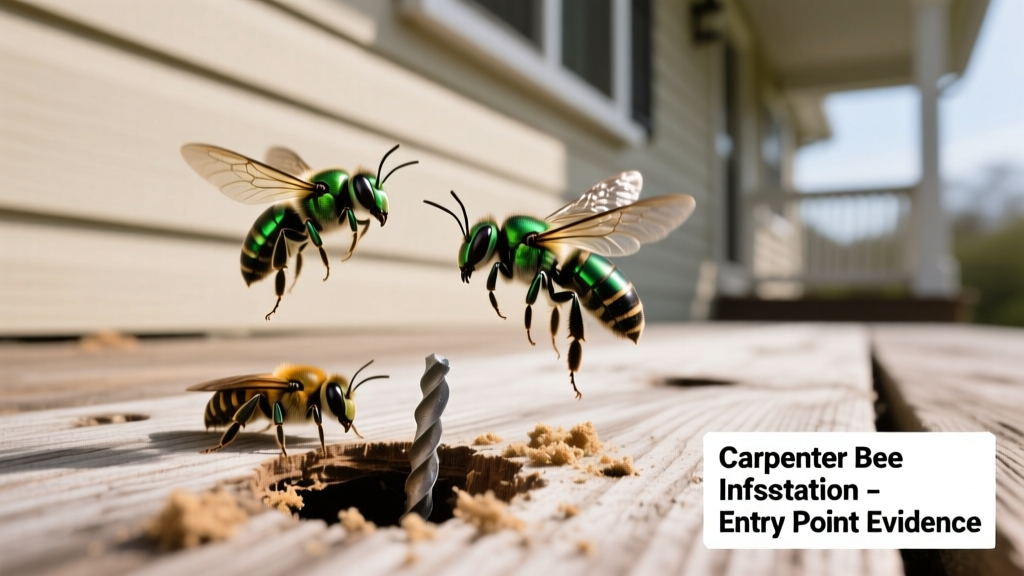
Carpenter bees are solitary, wood-boring insects that tunnel into untreated or weathered softwoods—especially decks, railings, and fascia boards—to lay eggs and overwinter. Unlike termites, they don’t eat wood, but their repeated nesting weakens structural integrity over time and invites secondary pests like woodpeckers and carpenter ants.
Identification
Carpenter bees (Xylocopa spp.) are often mistaken for bumblebees due to similar size and coloration—but key differences matter. Adult carpenter bees are ½–1 inch long, with a shiny, hairless black abdomen (bumblebees have fuzzy, striped abdomens). Males hover aggressively near nests but lack stingers; females can sting but rarely do unless handled.
Look for these signs on your deck:
- Perfectly round, ½-inch diameter entrance holes—usually on the underside of boards or along grain lines
- Fine sawdust (frass) piles beneath holes, especially in spring
- Yellowish pollen stains near entrances from male territorial marking
- Soft buzzing sounds coming from inside the wood during warm afternoons
| Pest | Key Physical Trait | Nesting Behavior | Damage Pattern |
|---|---|---|---|
| Carpenter Bee | Shiny black, hairless abdomen; no yellow stripes | Bore straight 6–10 inch tunnels, then turn 90° to create brood chambers | Clean, circular holes; frass piles directly below |
| Bumblebee | Fuzzy, yellow-and-black striped abdomen | Nest in soil cavities or insulation—not wood | No wood damage; may nest under deck—but not inside it |
| Termite | Small (¼ inch), pale, straight antennae, no waist | Live inside wood, feeding on cellulose | Mud tubes on surface; hollow-sounding wood; no frass piles |
What Attracts Them
Carpenter bees prefer bare, unpainted, or weathered softwoods—especially cedar, redwood, pine, and fir. Your deck becomes attractive when:
- It’s been left unfinished for more than one season
- There are existing holes or cracks from prior nesting (they reuse old tunnels)
- Overhanging eaves or shaded undersides provide shelter from rain and predators
- Flowering plants or shrubs nearby supply nectar—making your yard a foraging corridor
According to the University of Florida IFAS Extension’s 2022 Urban Entomology Bulletin, 78% of carpenter bee infestations occur in structures with at least two years of exposed, untreated wood.
Treatment Methods
Natural Methods
Start with non-toxic interventions—especially if you’re treating a deck used by children or pets:
- Spray a 50/50 vinegar-water solution into active holes at dusk (when bees are inside); repeat for three nights
- Plug holes with steel wool first, then seal with wood filler or caulk—this blocks re-entry without trapping live bees
- Hang decoy nests (drilled blocks of hardwood mounted 10+ feet away) to divert new females before they settle on your deck
- Apply almond oil or citrus oil spray to vulnerable surfaces—bees avoid these scents
Chemical Methods
Only use labeled insecticides as a last resort—and never aerosol “wasp sprays” (they don’t penetrate deep enough). Effective options include:
- Dust formulations containing carbaryl (Sevin Dust) or deltamethrin applied directly into holes with a bulb duster
- Residual liquid sprays (e.g., Cyonara 9.7) applied to entry points and adjacent 6-inch zones—wait 48 hours before sealing
- Avoid broad-spectrum neonicotinoids: they harm native pollinators and violate EPA restrictions on residential outdoor use as of 2023
"Carpenter bees respond best to precision treatment—not blanket spraying. Treat only active holes, wait 3–5 days for adults to die or vacate, then seal. Rushing the seal step traps live bees, leading to swarming and secondary damage." — Dr. Karen Lopez, Entomologist, NC State Extension, 2023
Prevention
Long-term prevention focuses on making your deck uninviting—not just fixing current holes. Start now, even if activity has slowed:
- Paint or stain all exposed wood surfaces every 2–3 years; solid-color acrylic latex paint is most effective (stains with UV inhibitors also work)
- Fill existing holes with epoxy wood filler before recoating—never leave voids open
- Install aluminum or vinyl fascia caps over vulnerable beam ends
- Trim back vines and flowering perennials within 3 feet of deck edges to reduce foraging traffic
For deeper protection, consider replacing high-risk trim boards with composite alternatives like composite decking, which carpenter bees cannot bore into.
When to Call an Exterminator
Hire a licensed pest management professional if:
- You count more than 12 active holes across your deck
- Structural members (joists, beams, or posts) show signs of internal tunneling (hollow sound when tapped, sagging, or visible exit holes on multiple sides)
- Previous DIY treatments failed after two full seasons
- You suspect co-infestation with carpenter ants (look for frass with insect parts) or powderpost beetles (fine, flour-like dust)
Reputable providers will inspect with a borescope, document tunnel depth, and offer a written warranty covering retreatment for up to 12 months. Avoid companies that push whole-deck fumigation—it’s unnecessary and unsafe.
Why do carpenter bees prefer my deck over my neighbor’s?
Your deck likely has older, more porous wood—or lacks consistent maintenance. Neighbors who repaint every 18 months or use composite materials rarely see activity. Also check for subtle differences: your deck may be shaded longer each day, or sit closer to flowering trees like cherry or redbud—both top carpenter bee forage sources.
Can carpenter bees damage pressure-treated wood?
Yes—but less readily. Pressure-treated lumber resists decay and some insects, but carpenter bees still bore into it if the surface is rough, cracked, or weathered. The preservative doesn’t repel them; smooth, sealed surfaces do. Always prime and paint PT wood before installation.
Do carpenter bees return to the same hole year after year?
They often do—especially females who successfully raised offspring there. Studies tracking marked bees found 63% reused original tunnels in the following spring (USDA Forest Service, 2021). That’s why sealing *after* treatment is critical—not before.
Are carpenter bees beneficial?
Yes—in gardens and wild areas. They’re powerful pollinators for tomatoes, eggplants, and blueberries via “buzz pollination.” But on decks? Their ecological benefit is zero—and structural risk is real. Redirect them with native bee houses placed 30+ feet away, not elimination.
Will painting over active holes kill the bees inside?
No—and it’s harmful. Sealing active holes traps adults and larvae, causing them to chew escape routes through finished surfaces or drywall behind deck walls. Always confirm inactivity (no sawdust for 5+ days, no buzzing) before sealing. Use a stethoscope or smartphone mic app to listen for movement.
How long does a carpenter bee live?
Adults live about one year. New adults emerge in late summer, feed, then overwinter in abandoned tunnels. They mate in spring, and females begin boring new galleries or refurbishing old ones by early April—so timing matters for intervention.
If your deck shows fresh holes this spring, act before mid-May—the window for non-lethal deterrents narrows fast. For ongoing support, explore our wood-boring insects identification chart or compare solutions in our deck pest damage repair guide. Prevention isn’t perfect—but consistency cuts recurrence by over 90%.