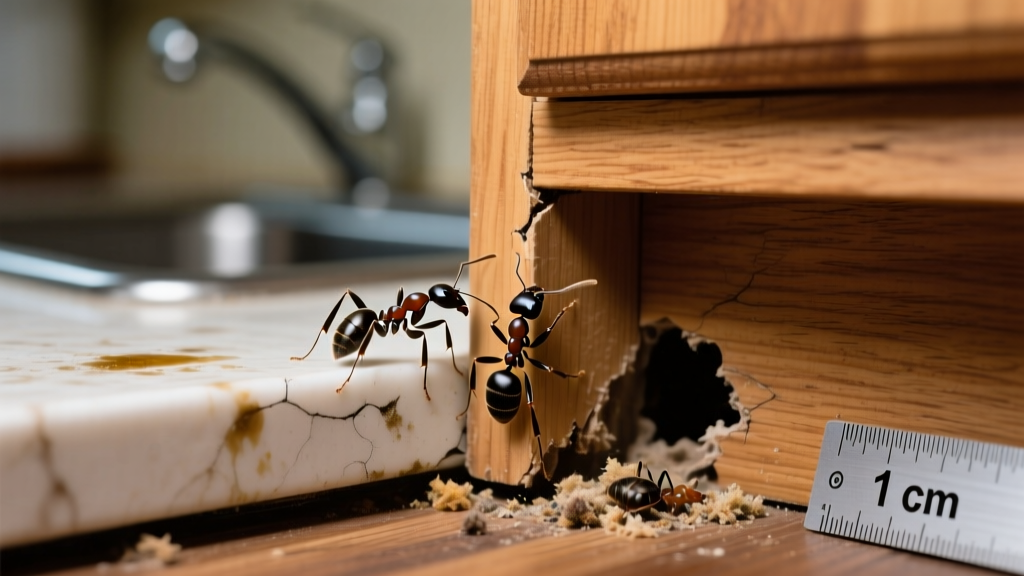
Carpenter ants don’t eat wood—but they excavate it to build smooth-walled galleries, often inside structural beams, cabinets, or behind appliances. In kitchens, they’re drawn to moisture-damaged wood near sinks, dishwashers, or leaky pipes, making them both a nuisance and a potential sign of hidden water damage.
Identification
Unlike termites, carpenter ants leave behind coarse, sawdust-like frass (wood shavings) near entry points. They’re larger than common black ants—workers range from 1/4" to 1/2" long, with a narrow waist and bent antennae. Winged swarmers (reproductives) appear in spring and early summer, often mistaken for flying termites—but their wings are unequal in size and their bodies are segmented.
| Pest | Size & Color | Frass Present? | Preferred Kitchen Locations |
|---|---|---|---|
| Carpenter ant | 1/4"–1/2", black, red, or bicolored | Yes — coarse, fibrous sawdust | Behind baseboards, under sinks, inside wall voids near plumbing |
| Odorous house ant | 1/8", dark brown to black | No | Along countertops, near sugar spills, inside pantry cracks |
| Pharaoh ant | 1/16", light yellow to reddish | No | Inside appliance wiring, behind microwave, near warm electronics |
Look for these signs:
- Small piles of fine, tan-to-brown wood shavings beneath cabinets or along baseboards
- Ants marching in single-file trails at dusk or night (they’re nocturnal)
- Faint rustling sounds inside walls when quiet—especially near moist wood
- Winged ants near windowsills or light fixtures in May–July
What Attracts Them
Carpenter ants don’t seek food—they seek shelter and moisture. Kitchens offer both: leaky faucets, condensation behind refrigerators, rotted window sills, and damp subflooring under vinyl or tile all create ideal nesting conditions. They’ll also follow sweet or greasy food trails—but only to scout, not feed.
According to the National Pest Management Association’s 2022 Field Survey, 68% of carpenter ant infestations in single-family homes originated within 3 feet of a plumbing fixture or appliance.
- Moisture-damaged wood (especially softwoods like pine or fir)
- Cracks in foundations or gaps around utility lines
- Overgrown shrubs or tree branches touching exterior walls
- Unsealed gaps behind dishwashers, refrigerators, or garbage disposals
Treatment Methods
Natural Options
Start with non-toxic interventions if you’ve spotted only scouts or small numbers. Diatomaceous earth (food-grade) applied as a thin line along baseboards and cabinet corners dehydrates ants on contact—and remains effective as long as it stays dry. Boric acid mixed with sugar syrup (1:3 ratio) acts as a slow-acting bait; worker ants carry it back to the nest, gradually eliminating the colony.
Freeze suspected satellite nests: If you locate a small, accessible nest (e.g., inside a hollow cabinet toe-kick), seal the opening with tape, then insert a CO₂ canister nozzle or use dry ice for 20 minutes—this kills ants without chemicals. Caution: Never use dry ice in enclosed, unventilated spaces.
Chemical Treatments
For established colonies, targeted insecticide dusts like deltamethrin or fipronil are most effective when injected directly into nest voids using a bulb duster. Avoid broad-spectrum sprays—they repel ants and cause colony budding (splitting into multiple nests). The U.S. EPA notes that improper spray use increases treatment failure rates by up to 40% (EPA Pesticide Registration Notice 2021-1).
"Carpenter ant control fails most often when people treat the trail—not the nest. You must find the moisture source and the gallery entrance first." — Dr. Lena Cho, Urban Entomologist, Purdue Extension (2023)
Prevention
Fix moisture issues before they invite ants. Replace rotted wood, repair leaky supply lines, and install exhaust fans to reduce humidity. Seal all gaps >1/16" with silicone caulk or copper mesh—ants can squeeze through astonishingly small openings.
- Inspect and replace water-damaged cabinet backing every 2 years
- Keep countertops and floors clean of grease and crumbs nightly
- Store pet food and pantry items in rigid, ant-proof containers (e.g., glass with silicone lids)
- Trim tree limbs at least 2 feet from rooflines and exterior walls
For long-term protection, consider installing kitchen pest-proofing seals around pipe penetrations and appliance cutouts—these last 5+ years and block 99% of ant-sized entry points.
When to Call an Exterminator
Call a licensed professional if you see more than 10–15 ants per day indoors, hear persistent rustling in walls, or find frass coming from multiple locations. Carpenter ant colonies can contain 10,000–50,000 workers—and satellite nests may be hidden in attic joists or garage framing, far from the kitchen activity.
Most reputable firms offer free inspections and use thermal imaging or acoustic detection to locate hidden nests. Ask for a written report identifying moisture sources and recommended structural repairs—don’t settle for “spray-and-pray.”
Can carpenter ants chew through plastic containers?
No. They lack the mandible strength to penetrate rigid plastic, glass, or metal. However, they’ll exploit loose lids, cracked seams, or residue on container exteriors to gain access. Always wipe down jars before storing—even trace oils attract scouts.
Do carpenter ants bite humans?
Rarely—and only if provoked or trapped against skin. Their bite feels like a pinch and may draw a tiny drop of blood, but they don’t inject venom or transmit disease. More concerning is the structural damage they cause over time.
Why do I only see them at night?
Carpenter ants are primarily nocturnal foragers. Daytime sightings usually indicate overcrowding, nest disturbance, or advanced infestation. If you spot them midday near windows or lights, suspect a nearby satellite nest.
Will vinegar kill carpenter ants?
Vinegar disrupts their scent trails and deters foraging—but it doesn’t kill ants or affect the nest. Use diluted white vinegar (1:1 with water) to wipe counters after spotting ants, then follow up with a targeted bait or dust. For more on safe kitchen cleaners, see our guide on non-toxic kitchen pest control.
Can they nest inside appliances?
Yes—especially dishwashers, refrigerators, and microwaves where warmth and condensation collect. Pull appliances out quarterly and inspect the rear panels and insulation for frass or entry holes. Vacuum visible debris first, then apply dust carefully into crevices.
How fast do they damage wood?
Slowly—but steadily. A mature colony can remove 1–2 cubic inches of wood per year. That sounds minor until you realize a 3-inch-deep cabinet stud loses 25% of its load-bearing capacity after just 4–5 years of undetected activity. Early detection prevents costly repairs.
Remember: carpenter ants are less about contamination and more about warning signs. Every pile of frass points to moisture you haven’t seen—and possibly rot you can’t yet feel. Address the ant, yes—but fix the leak first. For help diagnosing hidden moisture, check our kitchen water damage signs checklist.