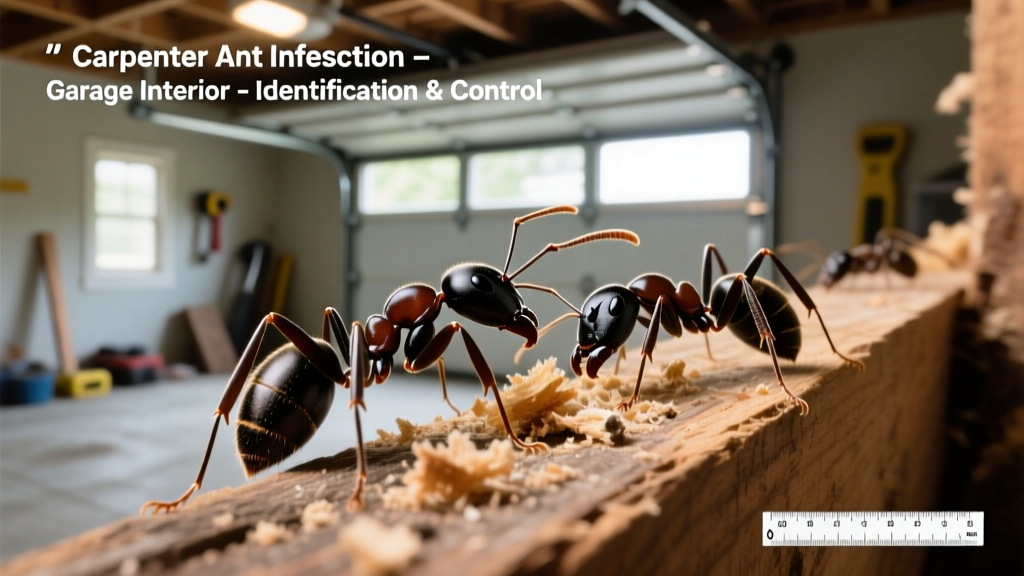
Carpenter ants don’t eat wood—but they excavate it to build smooth-walled galleries for nesting. In garages, where moisture, wood decay, and clutter often converge, they find ideal conditions to establish satellite colonies. Left unchecked, these ants can compromise structural framing, insulation, and stored items—especially if nests expand into adjacent living spaces.
Identification
Carpenter ants in garages are typically the black carpenter ant (Camponotus pennsylvanicus) or smaller reddish-brown variants. Workers range from 1/4 to 5/8 inch long, with a single-node waist, evenly rounded thorax, and bent (elbowed) antennae. Unlike termites, they have wings only during swarming season—and those wings are unequal in size (front pair larger).
| Feature | Carpenter Ant | Termite | Odorous House Ant |
|---|---|---|---|
| Waist | Narrow, pinched (one-segmented) | Broad, no constriction | Pinched, but less defined |
| Antennae | Elbowed | Straight | Elbowed |
| Wings (swarmers) | Front wings longer than hind; veined | Equal length; milky, opaque | No wings (workers never swarm) |
| Frass | Coarse sawdust-like shavings (often with insect parts) | Hard, pellet-shaped fecal droppings | None |
Look for these signs in your garage:
- Faint rustling sounds inside walls or overhead beams (especially at night)
- Piles of fine, light-colored wood shavings near baseboards, door frames, or garage door tracks
- Foraging trails along floor joists, electrical conduits, or foundation cracks
- Swarmers appearing indoors March–May, often near windows or light fixtures
What Attracts Them
Carpenter ants seek three things: moisture, shelter, and food. Garages deliver all three—often unintentionally. Leaky gutters dripping onto fascia boards, cracked concrete allowing groundwater seepage, or poorly vented attic spaces above the garage create damp wood perfect for tunneling. Cluttered storage (cardboard boxes, firewood stacked against walls, old furniture) provides cover and nesting sites. Even pet food left out overnight or spilled motor oil residue attracts scouts.
According to the National Pest Management Association’s 2022 Field Survey, 68% of carpenter ant calls involving attached garages cited roof leaks or failed flashing as the primary moisture source enabling infestation.
- Wood-to-soil contact (e.g., untreated 2x4s resting on concrete)
- Insulation soaked from roof or window leaks
- Cracks >1/16 inch in foundation or garage door seals
- Unsealed gaps around utility lines entering the wall
Treatment Methods
Natural Options
Start with non-toxic interventions—especially if you store vehicles, tools, or children’s bikes in the garage. Diatomaceous earth (food-grade) applied as a thin line along baseboards and wall-floor junctions dehydrates ants on contact. Boric acid mixed with sugar syrup (1:3 ratio) in shallow bottle caps works as a slow-acting bait; place near trails but away from pets. Essential oils like peppermint or tea tree (10 drops per ounce of water) sprayed along entry points disrupt pheromone trails.
Never use vinegar or citrus sprays alone—they mask scent trails temporarily but don’t kill colonies. And skip cinnamon: while it repels, it doesn’t eliminate.
Chemical Treatments
When natural methods stall after 10–14 days, targeted chemical options become necessary. Use gel baits containing fipronil or hydramethylnon (e.g., Maxforce Carpenter Ant Bait Gel) directly into nest voids—accessible via drill holes in soffits or behind trim. For perimeter control, apply a liquid residual spray like Termidor SC (active ingredient: fipronil) to garage door thresholds, foundation cracks, and weep holes. Do not spray inside vehicle interiors or near stored gasoline containers.
The U.S. EPA notes that fipronil-based products applied correctly show >90% colony elimination within 3 weeks when bait is accepted by foragers (EPA Pesticide Registration Review, 2021).
"Carpenter ants rarely stay in one spot—if you see 5–10 workers in daylight, there’s likely a nest within 30 feet. Follow the trail, not the ant." — Dr. Lena Cho, Urban Entomologist, Purdue Extension, 2023
Prevention
Garage-specific prevention hinges on moisture control and exclusion. Install gutter extensions that direct runoff at least 5 feet from the foundation. Replace rotted fascia boards or garage door headers before they become nesting sites. Seal gaps around pipes and wires with copper mesh + acoustical sealant—ants won’t chew through the mesh, and sealant blocks residual openings.
Store firewood at least 20 feet from the garage and elevate it on pallets—not directly on soil or concrete. Keep cardboard boxes off garage floors; use plastic totes with locking lids instead. Inspect garage door weatherstripping twice yearly and replace if cracked or compressed.
- Install a dehumidifier if relative humidity exceeds 60% consistently
- Trim tree branches 6+ feet from garage roofline to block aerial access
- Vacuum frass piles daily during active treatment—don’t sweep (spreads pheromones)
When to Call an Exterminator
Call a licensed pest professional if:
- You hear persistent hollow-tapping sounds inside walls or ceiling joists for more than 3 days
- You find winged ants indoors outside of spring (indicating an established, mature colony)
- More than 20 workers appear daily despite baiting for over 2 weeks
- You suspect nesting in inaccessible areas—like behind drywall or inside garage door springs
Most reputable companies offer free inspections and will provide a written report identifying moisture sources, entry points, and recommended repairs—not just pesticide applications. Ask if they’re certified by the Carpenter Ant Inspection Checklist standard used by the NPMA.
Do carpenter ants damage garage doors?
Yes—especially older wooden or insulated steel doors with compromised seals. They tunnel into rotting bottom rails or hollow core sections to nest. If your garage door sticks, rattles, or shows visible sawdust at the threshold, inspect the lower 12 inches closely. Repair or replace affected sections before treating.
Can they get into my car parked in the garage?
Rarely—but possible if food debris remains inside or if the vehicle has pre-existing moisture damage (e.g., wet carpet from a leak). They won’t nest in cars, but may forage across dashboards or under seats looking for crumbs. Vacuum regularly and avoid storing snacks or fast-food bags in the cabin.
Why do I only see them at night?
Carpenter ants are largely nocturnal foragers. Their peak activity occurs between 10 p.m. and 4 a.m., especially in warm, humid conditions. Daytime sightings usually mean the colony is stressed—either from disturbance or resource scarcity—and scouts are expanding search radius.
Will sealing cracks stop them completely?
Sealing helps—but isn’t enough alone. A mature colony may already be inside. Focus first on moisture reduction and baiting; then seal *after* activity drops for 7 consecutive days. Otherwise, you’ll trap ants inside walls, prompting them to chew new exit paths elsewhere.
Are they dangerous to pets or kids?
No. Carpenter ants don’t sting or transmit disease. However, their presence signals underlying moisture damage that could lead to mold growth or structural weakening—both hazards worth addressing promptly. Bait gels should always be placed in child- and pet-proof stations, like the Safe Pest Bait Stations we recommend for garages.
How long does treatment take to work?
Expect 10–21 days for full colony collapse using effective baits. Gel formulations take longer to spread than dusts but are safer in multi-use spaces. If no reduction in activity occurs after 14 days, reevaluate bait placement—you may be targeting a satellite colony, not the main nest. Confirm location using a stethoscope or infrared thermometer to detect heat/movement behind walls.
Garages are transitional zones—between outdoors and home, tools and timber, dry storage and hidden dampness. That makes them both vulnerable and highly responsive to focused action. Fix the leak, clear the clutter, and monitor weekly. Most garage carpenter ant issues resolve fully within a month when moisture and access are controlled. For ongoing support, see our Garage Pest Prevention Calendar—a printable monthly checklist tailored to seasonal risks.