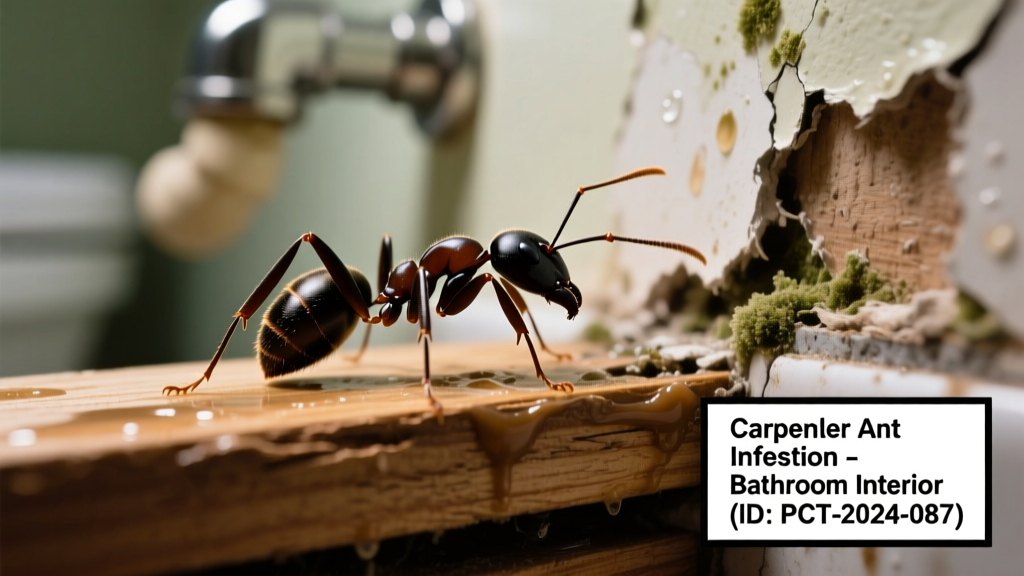
Carpenter ants don’t eat wood—but they excavate moist, decaying timber to build smooth-walled galleries, and your bathroom’s humidity, leaks, and hidden rot make it prime real estate. Left unchecked, a satellite colony here can expand into the wall cavity behind your shower or under the vanity, compromising framing and drywall in as little as 6–12 months.
Identification
Carpenter ants in bathrooms are usually the black or reddish-black Camponotus pennsylvanicus or Camponotus modoc. Unlike termites, they leave no mud tubes—just fine, pellet-like sawdust (frass) near baseboards, sink cabinets, or around exhaust fan housings. You’ll often see them at night, especially between 10 p.m. and 2 a.m., moving in single-file trails along grout lines or pipe chases.
| Pest | Size & Color | Key Sign in Bathroom | Wood Damage? |
|---|---|---|---|
| Carpenter ant | ¼–½ inch; black, red/black, or brown | Frass piles near damp baseboards or vanity backs | Yes—smooth tunnels in softened wood |
| Termite | ⅛ inch; pale, soft-bodied | Mud tubes on tile edges or behind toilet tanks | Yes—rough, soil-lined galleries |
| Pharaoh ant | 1/16 inch; light yellow/brown | Tiny trails near soap dishes or toothbrush holders | No—nest in insulation or wall voids |
| Odorous house ant | 1/8 inch; dark brown | Strong coconut-like smell when crushed; near leaky faucets | No—prefer damp wall voids, not wood |
What Attracts Them
Bathrooms offer three critical resources carpenter ants need: moisture, shelter, and proximity to food. They’re drawn to chronic leaks under sinks (37% of infestations start there, per the National Pest Management Association’s 2022 Residential Infestation Survey), condensation behind tile backer board, and rotting subflooring beneath vinyl or linoleum. Even minor gaps—like a 1/16-inch crack where the tub meets the wall—serve as entry points for scouts.
- Leaky faucet aerators dripping >1 drop/minute
- Grout cracks wider than 1/32 inch near shower bases
- Vanity cabinets with particleboard bottoms swollen from splash exposure
- Exhaust fan ducts lacking insulated flex liner (causing condensation inside walls)
Treatment Methods
Natural Options
Start with non-toxic interventions if you’ve spotted only foragers—not satellites. Diatomaceous earth (food-grade) works best when puffed into wall voids via an applicator bulb behind outlet plates or into cabinet toe-kicks. Boric acid gel bait (0.5% concentration) placed in tiny dabs behind the toilet tank or under the sink—never on tile—gets carried back to the nest. According to Cornell University’s Integrated Pest Management program (2021), boric acid baits achieve >80% colony elimination within 10–14 days when applied correctly.
Chemical Treatments
For confirmed satellite colonies, use a micro-injection approach: drill 1/16-inch holes into suspected wall voids (e.g., behind the shower valve or under the vanity) and inject dust formulations like deltamethrin or bendiocarb using a hand duster. Avoid liquid sprays—they repel ants and scatter colonies. Always wear N95 and gloves; never apply near plumbing joints or electrical boxes. The U.S. EPA restricts indoor use of pyrethroids in homes with children or pets unless applied by licensed professionals—check label language carefully.
Prevention
Fix the moisture first—no treatment lasts without it. Replace rotted subflooring under the vanity with pressure-treated plywood or marine-grade OSB. Seal all grout lines annually with silicone-based caulk (not acrylic). Install a humidity-sensing exhaust fan that runs 20 minutes after the light switches off—this cuts wall cavity RH below 60%, making it uninhabitable for carpenter ants.
- Check under every bathroom sink quarterly for dampness or swelling
- Replace rubber supply lines older than 5 years (they weep micro-drips)
- Use a moisture meter on wall studs behind tile—readings above 18% indicate decay
- Install door sweeps on bathroom entrances if adjacent to crawlspaces or garages
When to Call an Exterminator
Call a licensed pest pro if you find frass more than 6 inches from visible water sources, hear rustling in walls during quiet hours, or spot winged reproductives (swarmers) indoors—especially between March and June. These indicate a mature parent colony is nearby, likely in the attic, roofline, or exterior foundation. A reputable company will perform infrared scanning and provide a written inspection report with moisture mapping, not just a spray-and-go service.
Why do I only see carpenter ants at night in my bathroom?
They’re nocturnal foragers avoiding dehydration and predators. Bathroom humidity peaks at night due to cooler air holding less moisture—so evaporation slows, and surfaces stay damp longer. That’s why you’ll catch them most often between 11 p.m. and 3 a.m., tracing pipes or climbing shower curtain rods.
Can carpenter ants come up through the drain?
No—they lack the body structure to navigate P-traps or vertical drainpipes. What you’re seeing are foragers entering through gaps around the drain flange, overflow holes, or where the tub surround meets the floor. Inspect those seams with a flashlight and mirror.
Will vinegar kill carpenter ants in the bathroom?
Vinegar disrupts scent trails but doesn’t kill adults or larvae. A 50/50 white vinegar–water spray may deter foragers temporarily, but it won’t reach nests embedded in wall insulation or wet framing. Save it for cleaning surfaces—not pest control.
Do carpenter ants bite humans?
Yes—but rarely. They’ll only bite if handled or threatened, delivering a mild pinch and sometimes a small amount of formic acid. It stings briefly but causes no lasting harm. Their jaws aren’t strong enough to break skin on most adults—unlike fire ants or harvester ants.
How long does it take to eliminate a bathroom colony?
Small satellite colonies (<500 workers) respond to baiting in 7–12 days. Larger nests tied to exterior moisture sources (e.g., a leaking roof vent) may require 3–6 weeks of combined baiting, moisture repair, and targeted dusting. Monitor daily with marked bait stations—you’ll know it’s working when forager traffic drops by >90% within 72 hours.
Is it safe to ignore a few carpenter ants in the bathroom?
No. Finding even two or three foragers indoors signals an established colony nearby. The NPMA estimates that 68% of homes with observed carpenter ant activity have at least one satellite nest—and 29% have structural damage requiring repair within 18 months if untreated (Pest Control Technology, 2023 Field Audit).
"Carpenter ants in bathrooms are almost always a symptom—not the disease. The real problem is hidden moisture. Treat the ant, and you buy time. Fix the leak, and you solve it." — Dr. Lena Cho, Entomologist, University of Florida IFAS Extension (2022)
Once you’ve addressed moisture, sealed entry points, and eliminated the colony, maintain vigilance: inspect bathroom walls and cabinets every 90 days with a moisture meter, replace worn caulk before cracks widen, and keep spare boric acid gel on hand for early-stage recurrences. For related help, see our guides on leaky faucet repair and bathroom mold removal, both of which tackle root causes that attract carpenter ants. Also review drywood termites in bathroom if you’re unsure whether you’re dealing with ants or termites—mistaking one for the other delays proper treatment.