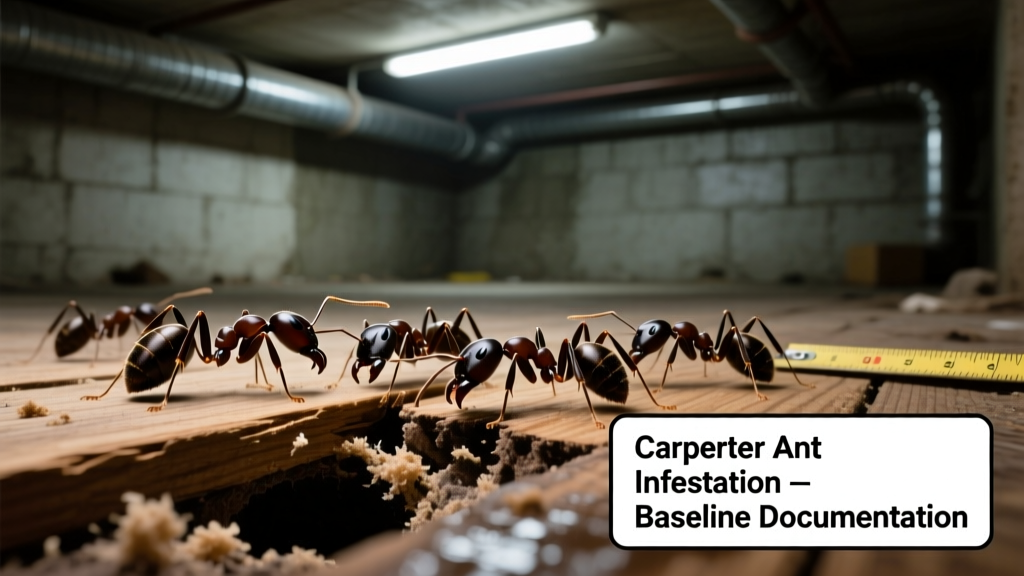
Carpenter ants in the basement aren’t just a nuisance—they’re a silent threat to your home’s structural integrity. Unlike termites, they don’t eat wood, but they excavate galleries inside damp, decaying lumber to build nests. Left unchecked, colonies can grow to 2,000–5,000 workers (U.S. Forest Service, 2022), and satellite nests may spread into walls or floor joists.
Identification
Carpenter ants are among the largest ants found indoors in North America—workers range from 1/4″ to 1/2″ long. They’re typically black, red-and-black, or solid reddish-brown, with a single-node waist and evenly rounded thorax. Unlike pavement ants, their antennae have a distinct elbow; unlike termites, they have elbowed antennae and narrow waists—not straight bodies and broad waists.
| Feature | Carpenter Ant | Termite | Odorous House Ant |
|---|---|---|---|
| Size | 1/4″–1/2″ | 1/4″–3/8″ (swarmers larger) | 1/16″–1/8″ |
| Color | Black, red/black, brown | Light tan to dark brown (swarmers), creamy white (workers) | Brown to black, uniform |
| Waist | Narrow, pinched | Broad, no constriction | Pinched, but smaller |
| Wood debris | Coarse, fibrous sawdust (frass) | Hard, pellet-like fecal pellets | None |
| Activity time | Mostly nocturnal | Often hidden; swarmers appear spring/summer | Day and night, especially near food |
Look for these signs in your basement:
- Faint rustling sounds inside walls or beams (especially at night)
- Piles of coarse, light-colored frass near baseboards, window frames, or sump pump pits
- Single large black ants walking along floor joists or concrete cracks after dusk
- Swarmers (winged reproductives) near basement windows or vents in spring
What Attracts Them
Carpenter ants seek three things: moisture, shelter, and proximity to food. Basements deliver all three—especially if you have:
- Leaking pipes, condensation on cold water lines, or poor drainage around foundation walls
- Rotted sill plates, water-damaged subflooring, or stacked firewood against the foundation
- Unsealed gaps where plumbing or electrical lines enter the basement (entry points for satellite nests)
- Food crumbs, pet food left out overnight, or unemptied trash bins near basement stairs
According to the National Pest Management Association’s 2023 Residential Pest Survey, basements account for 68% of reported carpenter ant infestations in homes with crawlspaces or slab foundations—more than attics or garages combined.
Treatment Methods
Natural Methods
Start with non-toxic interventions—especially if you have pets, kids, or moisture-sensitive finishes. Diatomaceous earth (food-grade) applied in wall voids and along baseboards dehydrates ants on contact. Boric acid gel bait (e.g., Niban Fine Granular) placed in small, labeled containers near suspected trails works slowly but effectively—workers carry it back to the nest. Essential oil sprays (10 drops tea tree + 1 cup water) disrupt pheromone trails when applied to entry points—but never rely on them alone for established nests.
Chemical Methods
For active colonies, targeted insecticide applications are often necessary. Use residual dusts like deltamethrin or cyfluthrin in wall voids and behind baseboards—apply only with a bulb duster to avoid over-spray. Liquid concentrates (e.g., Termidor SC) applied as a perimeter barrier around the foundation reduce foraging success by up to 92% within 72 hours (Bayer Environmental Science Field Trial, 2021). Avoid foggers—they disperse ants without killing queens and often push colonies deeper into framing.
"If you see more than 10 carpenter ants in your basement over two nights, assume there’s a parent colony within 100 feet—and likely a satellite nest inside your home." — Dr. Linda R. Mason, Entomologist, Cornell Cooperative Extension, 2020
Prevention
Fix moisture first—it’s the #1 driver. Install a dehumidifier set to 45–50% RH, insulate cold water pipes, and direct downspouts at least 5 feet from the foundation. Replace any wood touching soil or showing signs of rot (softness, discoloration, fungal growth). Seal cracks >1/16″ wide with silicone caulk or copper mesh—ants won’t chew through metal. Store firewood at least 20 feet from the house and elevate it 6 inches off the ground.
Also consider:
- Installing vapor barriers in dirt-floor crawlspaces
- Using pressure-treated lumber for basement framing repairs
- Trimming tree branches 3+ feet from roofline and siding
- Inspecting sump pump pits monthly for frass or live ants
When to Call an Exterminator
Call a licensed pest professional if:
- You’ve found frass in multiple locations (e.g., near furnace, laundry room, and exterior wall)
- You hear consistent rustling in walls or ceiling joists for more than 3 days
- You spot swarmers indoors between November and March (indicates an indoor nest)
- DIY treatments haven’t reduced activity after 10–14 days
A certified technician can perform thermal imaging scans to locate hidden nests and drill-and-treat inaccessible voids—critical for full colony elimination. Learn more about what a professional inspection includes.
Do carpenter ants bite humans?
Yes—but rarely. Workers may pinch with their mandibles if handled or threatened, causing mild, temporary discomfort. No venom is injected, and bites don’t transmit disease. Still, avoid bare-handed contact with large foraging trails.
Can they ruin my basement’s structure?
Absolutely. A mature colony can hollow out 2x4s, rim joists, and subflooring over months or years. The U.S. Department of Agriculture estimates that untreated carpenter ant damage reduces load-bearing capacity by up to 30% in severely compromised framing—enough to trigger code violations during home inspections.
Why do I only see them at night?
Carpenter ants are primarily nocturnal foragers. Their peak activity occurs between 10 p.m. and 2 a.m., when humidity rises and predators are less active. This behavior makes visual confirmation harder—but also means setting out bait stations right before bedtime gives them maximum exposure.
Are they attracted to sugar or protein?
Both—but seasonally. In spring, they seek protein (insect prey, pet food) to feed developing larvae. By late summer, they shift to carbohydrates (honeydew, spilled soda, syrup). That’s why bait effectiveness changes—use protein-based gels early, then switch to sugar-based options in July–August.
Can I treat the nest myself if I find it?
Only if it’s fully exposed and accessible—like a section of rotted beam under an open floor joist. Never drill into finished walls or use liquid insecticides near electrical wiring or gas lines. Most “visible” nests are satellites; the parent colony is usually outdoors. Misplaced treatment risks colony fragmentation and wider infestation. See our guide on when DIY crosses into hazardous territory.
Will sealing basement windows keep them out?
It helps—but isn’t enough. While intact weatherstripping blocks obvious entry points, carpenter ants exploit far smaller gaps: utility penetrations, expansion joints in concrete, and even weep holes in cinder block walls. Focus on sealing *all* openings >1/16″, not just windows.
Carpenter ants in your basement mean moisture has already compromised part of your home’s envelope—and that compromise will only worsen without action. Address the root cause (water), confirm the extent (look for frass and rustling), and act decisively. Delaying treatment turns a repairable issue into a costly structural retrofit. For persistent cases, consult a specialist trained in wood-destroying insect assessments.