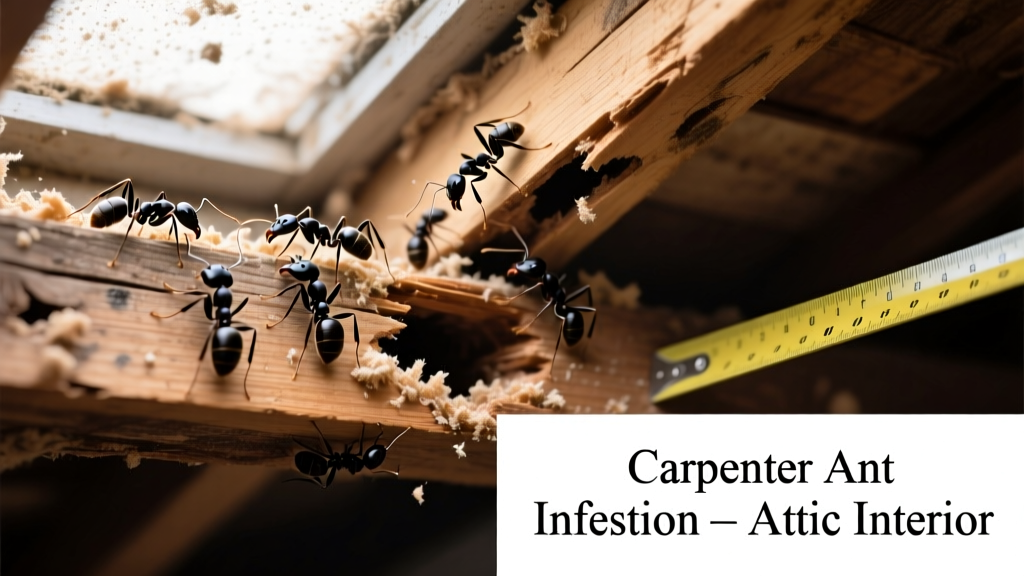
Carpenter ants don’t eat wood—but they excavate it to build smooth, hollow galleries for nesting. When they move into your attic, they’re often drawn by moisture-damaged framing, insulation gaps, or abandoned bird nests. Left unchecked, colonies can grow to 2,000–5,000 workers (University of Minnesota Extension, 2022) and compromise structural integrity over time.
Identification
Unlike termites, carpenter ants leave behind coarse, sawdust-like frass—often piled near entry points or along rafters. Workers are typically black or reddish-black, 1/4″ to 1/2″ long, with a single-segmented waist and bent antennae. Winged swarmers (reproductives) appear in spring and early summer, especially after warm, humid weather.
| Pest | Frass Appearance | Wood Damage Pattern | Active Hours |
|---|---|---|---|
| Carpenter ant | Coarse, fibrous, mixed with insect parts | Smooth, gallery-like tunnels; no mud tubes | Nocturnal, peak activity 10 PM–2 AM |
| Termites | Fine, uniform, pellet-like (drywood) or muddy (subterranean) | Layered, honeycombed, often with mud tubes | Mostly hidden; subterranean types active day/night |
| Beetles (e.g., powderpost) | Extremely fine, flour-like dust | Small round exit holes (1/32″–1/8″), surface-only | Day-active; rarely seen indoors |
Look for these signs in your attic:
- Small piles of frass beneath eaves, soffits, or around roof vents
- Faint rustling sounds inside walls or insulation at night
- Live ants trailing along roof sheathing, joists, or HVAC duct boots
- Discarded wings near windowsills or light fixtures (swarmer evidence)
What Attracts Them
Carpenter ants seek three things: moisture, shelter, and proximity to food. In attics, moisture is the biggest draw—especially from roof leaks, poor ventilation, or condensation on cold water pipes. They favor soft, rotting wood like pine or spruce framing that’s been damp for >6 months. Insulation gaps also act as thermal highways, letting them travel unseen between floors.
Common attic attractants include:
- Rotted roof decking or fascia boards (moisture content >20%)
- Abandoned bird or squirrel nests (provide warmth + nesting material)
- Unsealed attic access hatches or gaps around plumbing/chimney chases
- Stored cardboard boxes, firewood, or old lumber leaning against framing
Treatment Methods
Natural Options
Diatomaceous earth (food-grade) works well in dry attic voids—sprinkle lightly along baseplates, joist ends, and near suspected entry points. It dehydrates ants on contact but loses effectiveness if damp. Boric acid gel baits (e.g., Niban Fine Granular) placed in bait stations near trails can be effective—but only where pets/kids won’t access them. Essential oil sprays (peppermint + clove) may deter foraging, though they won’t eliminate nests.
Chemical Treatments
For confirmed nest locations, dusting with deltamethrin or cyfluthrin directly into wall voids or rotted wood cavities delivers fast knockdown. The U.S. EPA notes that properly applied residual dusts remain active for up to 6 months indoors (EPA Pesticide Registration Manual, 2021). Avoid liquid sprays in attics—they soak into insulation and reduce R-value while failing to reach deep galleries.
"Carpenter ant colonies in attics are rarely single-nest systems. We find satellite nests in wall voids 70% of the time—even when the main colony is overhead." — Dr. Karen Lopez, Entomologist, Pest Management Professional Magazine, 2023
Prevention
Fix moisture issues first: install ridge vents and soffit baffles to improve airflow, repair flashing around chimneys and skylights, and insulate cold water pipes to stop condensation. Seal all openings >1/8″ with copper mesh and silicone caulk—especially where electrical conduits, plumbing stacks, or HVAC ducts penetrate attic floors.
Proactive steps include:
- Cleaning gutters twice yearly to prevent overflow onto roof edges
- Storing firewood at least 20 feet from the house and off the ground
- Replacing water-damaged OSB or plywood sheathing before re-roofing
- Installing LED motion-sensor lights in attic access points to disrupt nocturnal activity
When to Call an Exterminator
Call a licensed pest professional if you see more than 15–20 ants per day in the attic, hear persistent rustling behind insulation, or find frass near multiple structural members. Licensed technicians use borescopes to locate nests without tearing open drywall—and apply micro-injection treatments directly into galleries. According to the National Pest Management Association, 68% of carpenter ant jobs require two or more service visits to fully eliminate satellite colonies (carpenter ant treatment cost varies widely based on scope).
Can carpenter ants damage roof trusses?
Yes—especially if trusses contain untreated pine or have sustained chronic moisture exposure. They avoid pressure-treated lumber but will tunnel through adjacent untreated blocking or sheathing. A 2021 study by the Forest Products Laboratory found that untreated southern yellow pine lost 32% load-bearing capacity after 18 months of carpenter ant excavation.
Do carpenter ants come from outside or inside the house?
Almost always from outside. They enter via tree branches touching roofs, utility lines, or foundation cracks—then migrate upward seeking warmth and moisture. Rarely do they originate indoors unless a prior infestation went undetected for years. Trim branches at least 6 feet from rooflines and inspect attic vent inspection points for gaps.
Will attic fans help deter them?
Only if they reduce humidity below 55% RH consistently. Whole-house fans alone won’t cut it—most attic fans move air but don’t address vapor drive from living spaces. Pair them with proper vapor barriers and sealed ceiling penetrations for real impact.
How long does it take to get rid of them?
DIY efforts may take 4–12 weeks depending on colony size and accessibility. Professional treatments often show reduction within 72 hours, but full elimination—including satellite nests—typically requires 3–6 weeks and follow-up inspections. Don’t assume silence means success: ants may shift galleries silently after initial treatment.
Are carpenter ants dangerous to humans?
No—they don’t sting or transmit disease. But their presence signals underlying moisture damage that could lead to mold growth or structural failure. That’s why every attic mold signs assessment should include a carpenter ant sweep.
Can I spray insecticide in my attic myself?
You can—but only with EPA-registered products labeled for enclosed attic use, and only after identifying exact nest locations. Over-spraying contaminates insulation, violates building codes in many jurisdictions, and risks inhalation exposure. Dust formulations are safer for voids; liquids belong outdoors or on perimeter foundations.
If you’ve addressed moisture, sealed entry points, and confirmed no active foraging for 30 days, you’re likely clear. Still, schedule annual attic inspections—especially after winter ice dams or summer monsoons. Carpenter ants rarely return to repaired, dry wood, but they’ll exploit new weaknesses fast.