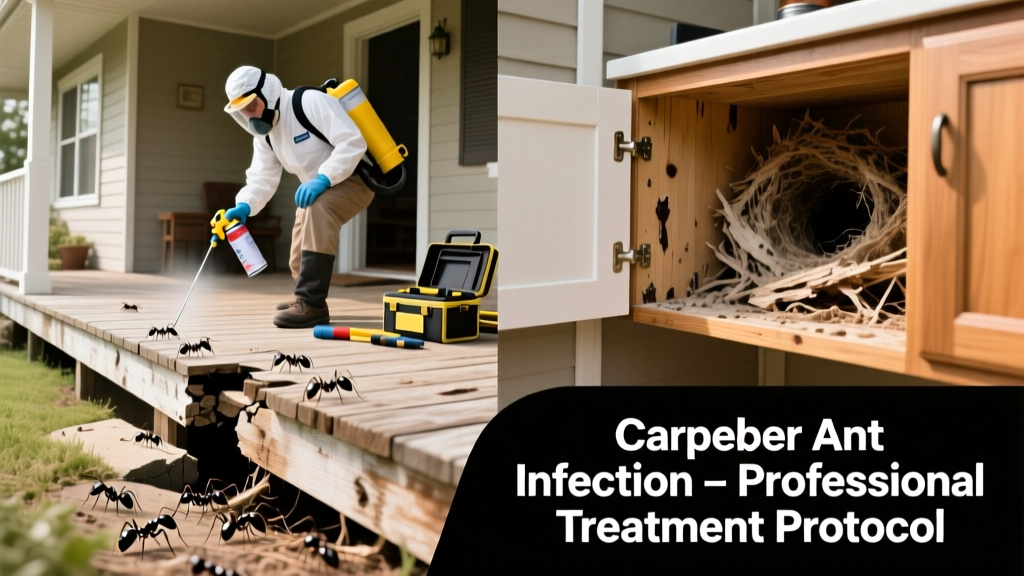
Carpenter ants don’t eat wood—but they excavate it to build nests, weakening structural beams, floor joists, and window frames over time. Left unchecked, a mature colony can contain 10,000–20,000 workers and cause costly repairs, especially in homes with chronic moisture issues.
Identification
Carpenter ants are larger than common household ants—workers range from ¼ to ½ inch long, often black, red-and-black, or brown. They have a single-segmented waist (petiole) and evenly rounded thorax (unlike the uneven, humped profile of pavement ants). Winged swarmers appear in spring and early summer; their front wings are longer than their hind wings—a key ID marker.
Look for these signs:
- Fine, sawdust-like frass (wood shavings) piled near baseboards, windowsills, or doorframes
- Smooth, hollow-sounding galleries inside damp or decaying wood
- Large ants walking alone or in trails at night (they’re nocturnal)
- Rustling sounds inside walls when ambient noise is low
| Feature | Carpenter Ant | Odorous House Ant | Pavement Ant |
|---|---|---|---|
| Size | ¼–½ inch | 1/8 inch | 1/8 inch |
| Color | Black, red/black, brown | Brown to black | Dark brown to black |
| Waist Shape | Single node, smooth curve | Single node, uneven bump | Two nodes, angled |
| Wood Damage? | Yes—excavates galleries | No | No |
What Attracts Them
Carpenter ants seek three things: moisture, shelter, and food. They rarely invade dry, sound wood—instead, they target areas compromised by leaks, poor ventilation, or prior water damage. Common entry points include roof valleys with missing shingles, cracked foundation vents, and gaps around plumbing pipes.
They’re drawn to sugary foods (honeydew from aphids, spilled syrup), proteins (pet food, grease), and decaying organic matter. According to the University of Minnesota Extension’s Ant Management Guide (2022), over 85% of carpenter ant infestations begin within 3 feet of a moisture source like a leaking sink, clogged gutter, or poorly graded soil against the foundation.
- Rotted window sills or fascia boards
- Insulation soaked from roof leaks
- Firewood stacked against exterior walls
- Tree branches touching rooflines or eaves
Treatment Methods
Natural Methods
For small, newly discovered colonies—or if you prefer non-toxic options—start with physical removal and deterrents. Vacuum visible ants with a shop vac (dispose of the bag immediately outdoors). Seal cracks with caulk and replace wet, damaged wood where possible.
Apply diatomaceous earth (food-grade) into wall voids or along baseboards: its microscopic shards dehydrate ants’ exoskeletons. Boric acid mixed with sugar syrup (1:3 ratio) acts as a slow-acting bait—workers carry it back to the nest. Avoid spraying vinegar or essential oils alone; research from the Journal of Economic Entomology (2021) shows they repel but don’t eliminate colonies.
Chemical Treatments
For established infestations, targeted insecticides deliver faster results. Dust formulations like deltamethrin or fipronil applied directly into nest voids (behind outlets, under sinks, in attic access points) kill on contact and persist for weeks. Liquid sprays containing bifenthrin create residual barriers along foundations and entry paths—but avoid overspraying indoors unless labeled for indoor use.
"Never spray perimeter insecticides without first locating the nest—carpenter ants avoid treated surfaces and will simply reroute, making the problem harder to solve." — Dr. Karen Lopez, Urban Entomologist, Cornell Cooperative Extension, 2023
Prevention
Long-term prevention hinges on moisture control and exclusion. Install gutter guards and extend downspouts at least 5 feet from your foundation. Trim tree limbs and shrubs so they’re at least 2 feet from siding or roofs. Replace rotted wood during routine home maintenance—not just when it’s visibly crumbling.
Store firewood at least 20 feet from your house and elevate it off the ground on pallets. Seal gaps around utility lines, windows, and doors with silicone caulk or copper mesh (ants won’t chew through copper).
- Inspect crawl spaces and basements twice yearly for condensation or mold
- Run bathroom and kitchen exhaust fans for 20+ minutes after showers or cooking
- Use dehumidifiers in basements with relative humidity above 60%
When to Call an Exterminator
Hire a licensed pest professional if you see more than 10–15 large ants daily indoors, hear persistent rustling in walls, or find frass in multiple rooms. A certified technician can perform thermal imaging or acoustic detection to locate hidden nests—and many offer warranties covering retreatments for up to 12 months.
The National Pest Management Association reports that 68% of carpenter ant jobs require structural inspection and integrated treatment plans beyond DIY methods (NPMA Pest Trends Report, 2024). Delaying intervention risks both structural integrity and higher repair costs.
Do carpenter ants bite humans?
Yes—but only if provoked or handled. Their mandibles can break skin, causing mild, temporary pain and tiny puncture marks. They don’t transmit disease, and bites rarely require medical attention. More concerning is the structural threat they pose behind the scenes.
Can carpenter ants live in dry wood?
Not permanently. They need high-moisture wood (typically >15% moisture content) to excavate galleries and raise brood. However, satellite colonies—containing workers and older larvae but no queen—can survive in drier areas if connected via trail to a parent nest in damp wood.
How fast do carpenter ants destroy wood?
Slowly—but steadily. A mature colony may remove 1–2 cubic inches of wood per year. That sounds minor, but over 3–5 years, it weakens load-bearing studs or rim joists enough to fail under stress. The U.S. Department of Agriculture estimates untreated infestations reduce timber strength by up to 30% after four years.
Are carpenter ants active in winter?
In heated homes, yes—they remain active year-round. Outdoors, they enter dormancy below 50°F, but interior heating keeps colonies functional even in January. That’s why winter sightings often indicate a well-established, indoor nest.
Does bleach kill carpenter ants?
It may kill individual ants on contact, but bleach doesn’t penetrate wood or reach the nest. Worse, it can damage finishes and fails to address colony structure. Skip it—use proven baits or dusts instead.
Can I treat carpenter ants myself if I find one nest?
You can—but success depends on finding *all* nests. Colonies often split into primary (with queen, usually outdoors) and multiple satellite nests (indoors). Treating only the visible satellite nest leaves the reproductive core intact. That’s why ant bait stations work best when paired with thorough inspection, and why many homeowners opt for a professional inspection checklist before acting.
Early detection and moisture control are your strongest tools. Replace soggy insulation, fix leaky faucets, and keep mulch 12 inches from your foundation. For persistent activity, pair targeted treatment with ongoing monitoring—like checking for new frass weekly in suspect zones. If you’ve already replaced wet wood in your garage ceiling and still see ants near the laundry room, that’s a sign of a secondary nest—time to bring in help or deploy drill-and-treat methods with precision.