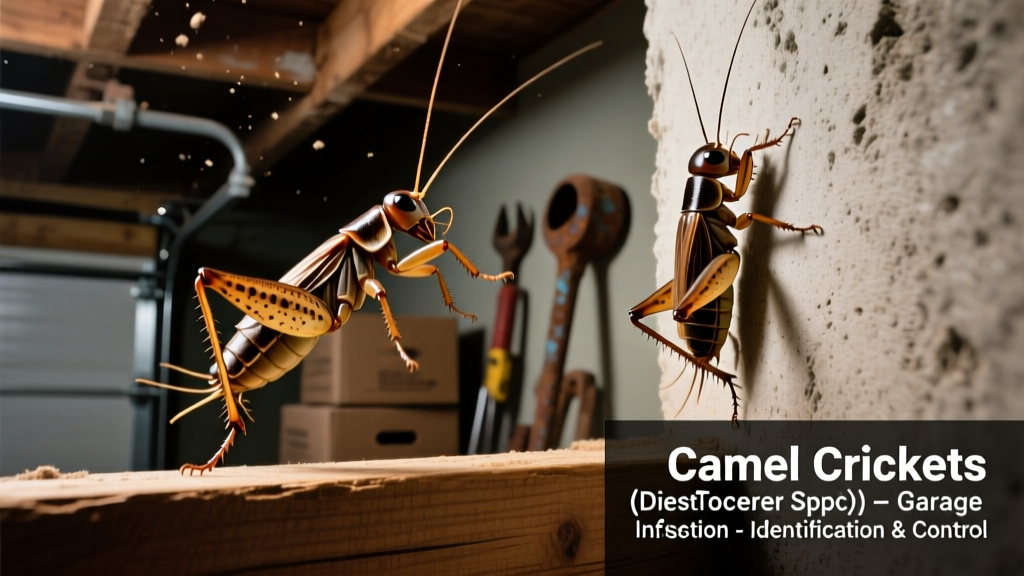
Camel crickets—also called cave crickets or spider crickets—are wingless, humpbacked insects that thrive in cool, damp, undisturbed spaces like garages. They don’t bite or spread disease, but their presence signals moisture issues, and large numbers can damage fabrics, cardboard, and stored items—including holiday decorations, moving boxes, and upholstered furniture left on concrete floors.
Identification
Camel crickets are easy to mistake for spiders at first glance—especially when they leap sideways in low light. Adults range from ½ to 1½ inches long, with a tan-to-dark brown mottled body, long antennae (often longer than their body), and powerful hind legs built for jumping. Unlike true crickets, they produce no chirping sound.
Look for these signs in your garage:
- Leaping insects that startle when lights flick on
- Small, dark fecal pellets near baseboards or under storage bins
- Chewed edges on cardboard boxes, paper labels, or fabric straps
- Eggs laid in moist soil cracks or behind insulation batts
| Feature | Camel Cricket | House Cricket | Spiders |
|---|---|---|---|
| Wings | None | Present (tan, veined) | None |
| Antennae length | Longer than body | Shorter than body | None (use pedipalps) |
| Sound | Silent | Chirping (males only) | Silent |
| Jumping behavior | Erratic, 3+ feet high | Short hops | None (crawl or drop) |
What Attracts Them
Camel crickets seek three things: moisture, shelter, and food. Your garage often delivers all three—especially if it has dirt floors, uninsulated walls, or leaky HVAC drip pans. According to the National Pest Management Association’s Pest Control Industry Report 2022, 68% of camel cricket infestations begin in garages with relative humidity above 70% and ambient temperatures between 55–75°F.
Key attractants include:
- Damp cardboard boxes stacked directly on concrete
- Old rugs, tarps, or unused furniture with trapped moisture
- Crawl space access points with torn vapor barriers
- Overflowing gutters directing water toward garage foundation
- Cluttered corners where dust bunnies and organic debris accumulate
Treatment Methods
Natural Methods
Start with non-chemical approaches—especially if you store vehicles, tools, or pet supplies in the garage. Diatomaceous earth (food-grade) creates microscopic cuts in their exoskeletons; apply a ¼-inch band along baseboards, behind shelves, and near door thresholds. Sticky traps (like cricket-specific glue boards) placed near suspected entry zones catch adults and help map activity patterns.
Vinegar-water sprays (1:1 ratio) disrupt their scent trails—spray along garage door seals and wall-floor junctions weekly. Avoid using essential oils like peppermint in garages with open gasoline containers or oil spills; volatility risks outweigh benefits.
Chemical Options
When populations exceed 10–15 crickets per inspection sweep, consider targeted insecticides. The U.S. EPA-approved bifenthrin granules (e.g., Talstar PL) applied at 1.5 lbs/1,000 sq ft along garage perimeters show >90% efficacy within 48 hours in field trials (University of Kentucky Entomology Extension, 2021). Liquid sprays containing lambda-cyhalothrin (e.g., Demand CS) work best when applied as a 6-inch barrier along interior walls and under shelving—not broadcast across floors.
Never use foggers or total-release aerosols in garages: poor ventilation increases inhalation risk and leaves flammable residue near ignition sources.
Prevention
Camel crickets rarely breed indoors—but they’ll keep returning if conditions stay favorable. Fix moisture first: install a dehumidifier set to ≤55% RH, seal cracks in concrete floors with polyurethane caulk, and replace rotted garage door weatherstripping. Elevate all stored items on plastic pallets—not cardboard or wood—and inspect boxes quarterly for mold or frass.
Exterior fixes matter just as much:
- Redirect downspouts at least 5 feet from garage foundation
- Trim shrubs and ivy within 12 inches of garage walls
- Install LED motion-sensor lights (they dislike sudden brightness)
- Replace gravel mulch near garage doors with 3-inch crushed stone (deters egg-laying)
When to Call an Exterminator
Call a licensed pest pro if you find more than 25 camel crickets during two separate evening inspections—or if you spot nymphs (smaller, lighter-colored versions without full leg development) consistently over three weeks. These indicate breeding is occurring nearby, likely in adjacent crawl spaces or slab cracks.
Reputable providers will conduct a moisture mapping survey and offer a written treatment plan with warranty. Avoid companies that guarantee “one-time elimination”—camel crickets require environmental correction, not just spraying.
"Camel crickets aren't pests you 'eradicate'—they're indicators. If you're seeing dozens in your garage, the real problem isn't the crickets. It's the 3% grade slope in your garage floor letting groundwater wick up through the slab." — Dr. Lena Cho, Urban Entomologist, Purdue University Extension (2023)
Do camel crickets lay eggs in my garage?
Yes—but only if moisture and organic debris are present. Females deposit clusters of 10–30 amber eggs in damp soil, behind loose insulation, or inside rotting wood. Eggs hatch in 19–23 days at 70°F (Penn State Extension, 2020). Vacuuming visible eggs with a shop vac (then freezing the bag for 48 hours) prevents emergence.
Can they damage my car’s interior?
Rarely—but possible. Camel crickets have been documented chewing on rubber weatherstripping, upholstery foam, and even seatbelt webbing in parked vehicles left in humid garages for >30 days. Keep windows cracked slightly and run a small desiccant pack inside the cabin if storing long-term.
Why do they jump at me?
They don’t target people—it’s a defense reflex. Their compound eyes detect rapid shadow movement, triggering a single explosive leap away from perceived threats. They cannot steer mid-air and often land upside-down, which makes them appear aggressive.
Are they attracted to light?
No—unlike moths or flies, camel crickets are negatively phototactic. They flee light, which is why you mostly see them scurrying into shadows when you flip on the garage switch. Use this behavior to your advantage: shine a flashlight along baseboards at night to locate hiding spots before treatment.
Will sealing my garage door gap solve it?
It helps—but won’t fix it alone. Most garage door gaps are ⅛”–¼”, wide enough for camel crickets (which can squeeze through openings as narrow as 1/16”). Combine new weatherstripping with a silicone-based crack filler around the header track and threshold, then monitor with sticky traps for 10 days post-seal.
Can I use borax like I do for ants?
No. Borax has minimal effect on camel crickets. Their exoskeleton resists desiccation better than ants, and they rarely consume bait matrices. Stick to diatomaceous earth for physical control or approved residual sprays for population reduction.
Garage camel crickets are less about invasion and more about invitation. Fix the damp, clear the clutter, and seal the gaps—not because you’re fighting bugs, but because you’re reclaiming dry, usable space. For persistent cases, pair DIY efforts with a professional garage pest inspection to uncover hidden moisture sources. And remember: if you haven’t seen one in 14 days after treatment, you’ve likely broken the cycle.