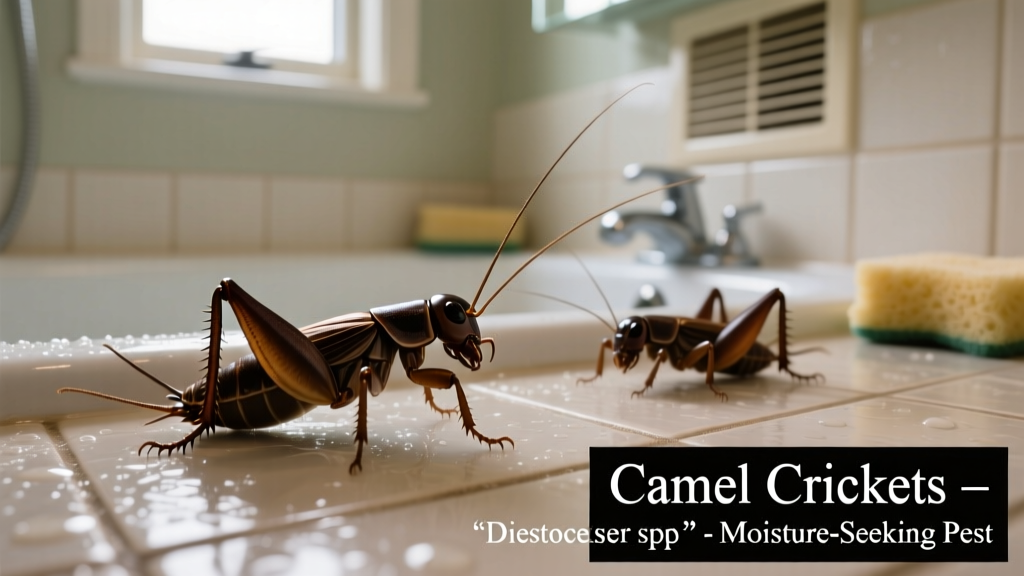
Camel crickets—also called cave crickets or spider crickets—are wingless, humpbacked insects that thrive in cool, damp, dark spaces. Bathrooms are prime real estate for them: high humidity, poor ventilation, and hidden voids behind toilets or under vanities offer ideal shelter. While they don’t bite or spread disease, their presence signals moisture problems—and large numbers can damage fabrics, paper, and stored items.
Identification
Camel crickets are easy to mistake for spiders at first glance. They’re tan to light brown, ½–1½ inches long, with long antennae (often longer than their body), powerful hind legs for jumping, and a distinctive humped thorax. Unlike true crickets, they make no chirping sound.
Look for these signs in your bathroom:
- Jumping erratically when lights flip on at night
- Shed exoskeletons near baseboards or under the sink
- Small, dark fecal smudges on tile grout or shower corners
- Clusters hiding behind the toilet tank or inside wall voids near plumbing leaks
| Insect | Size | Wings? | Key Distinguisher |
|---|---|---|---|
| Camel cricket | ½–1½ in | No | Humped back; long antennae; jumps sideways |
| House cricket | ¾ in | Yes (folded over back) | Chirps; prefers warmer, drier areas |
| Silverfish | ¼–½ in | No | Slender, silvery, wiggles like a fish; avoids light |
| Springtail | ~1 mm | No | Tiny, jumps 1–2 mm; found on wet surfaces, not walls |
What Attracts Them
Camel crickets aren’t wandering in randomly—they’re drawn by three consistent conditions:
- Moisture: Relative humidity above 60%—common in poorly vented bathrooms after showers
- Shelter: Gaps around pipes, cracked caulk, loose baseboards, or hollow vanity cabinets
- Food sources: Mold spores, mildew, lint, pet hair, or paper debris—especially behind toilets or in overflow drains
According to the National Pest Management Association’s 2022 Field Survey, 73% of confirmed camel cricket infestations in residential bathrooms were linked to unaddressed plumbing leaks or missing exhaust fan ducting.
Treatment Methods
Natural Methods
Start here—especially if you have kids, pets, or prefer low-toxicity options:
- Sticky traps: Place flat glue boards along baseboards and behind the toilet (not near water). Replace weekly.
- Vinegar-water spray: Mix 1:1 white vinegar and water; mist cracks and crevices—disrupts scent trails and deters entry.
- Diatomaceous earth (food-grade): Dust a thin line along pipe penetrations and under the vanity—dehydrates crickets on contact.
- Dehumidify: Run a portable dehumidifier set to 45–50% RH for 72 hours straight—it forces crickets to relocate or desiccate.
Chemical Options
Only use if natural methods fail after 10–14 days and you’ve confirmed active harborage:
- Pyrethroid-based aerosol (e.g., Suspend SC diluted per label): Spot-treat voids behind tiles and under sinks—not broad-spray. Avoid spraying near drains or ventilation fans.
- Boric acid dust: Apply sparingly into wall voids via an applicator bulb—only if no children or pets access the area.
- Do NOT use foggers: They disperse ineffectively in small, sealed bathrooms and pose inhalation risk without proper PPE.
"Camel crickets rarely breed indoors—but a single undetected female in a wall void can lay 100+ eggs in 3 weeks. If you see more than 5 adults in one week, assume breeding is occurring." — Dr. Lena Cho, Entomologist, Purdue University Extension, 2023
Prevention
Elimination means nothing without long-term prevention. Focus on moisture control and exclusion:
- Install and run an exhaust fan rated for ≥50 CFM during and 20 minutes after every shower.
- Fix leaky faucets, showerheads, and toilet flappers—even slow drips raise localized humidity.
- Caulk gaps >1/8” around pipes, baseboards, and where the tub meets the wall using mold-resistant silicone.
- Store towels, bath mats, and toiletries off the floor—reduce harborages and improve air circulation.
- Inspect and replace damaged grout or cracked caulk in shower corners annually.
When to Call an Exterminator
Call a licensed pest professional if:
- You find live crickets behind walls or inside ceiling tiles (requires drilling/injection)
- More than 10 crickets appear in 48 hours despite treatment
- You suspect a colony is entering from the crawl space or basement (needs exterior trenching or foam barrier)
- Mold growth is visible on drywall or subfloor—this requires integrated remediation
Reputable firms will conduct a moisture audit and seal entry points—not just spray. Ask for a written inspection report before signing any contract.
Why do camel crickets jump at me?
They don’t target people—they’re startled by vibration and light changes. Their erratic jumps are escape behavior, not aggression. Wearing slippers and turning on lights before stepping into the bathroom reduces encounters.
Can camel crickets damage my bathroom?
Yes—but indirectly. They chew on cotton, linen, and cardboard stored in damp cabinets. More critically, their presence confirms chronic moisture issues that can rot subflooring or grow toxic mold within 6–12 months.
Do they lay eggs in my shower drain?
Rarely. Camel crickets prefer moist soil or decaying organic matter—not standing water. However, they’ll lay eggs in damp, fibrous debris trapped in overflow channels or behind drain covers—clean those monthly with a pipe brush.
Are they attracted to light?
No—they’re negatively phototactic (avoid light). You see them at night because they emerge when lights go off and move toward residual warmth or moisture gradients, like near a warm pipe or humid shower stall.
Can I vacuum them up?
Yes—with a shop vac on low suction and a hose attachment. Empty the canister outside immediately. Do not use a household vacuum: their legs clog filters and they may survive inside the bag.
Will sealing my bathroom door gap help?
Yes—if the gap exceeds ¼”. Install a vinyl door sweep rated for moisture resistance. But prioritize fixing interior moisture sources first—sealing won’t stop crickets already living in your walls.
Camel crickets in the bathroom are less about invasion and more about invitation. Fix the humidity, seal the cracks, and clean the clutter—and you’ll break the cycle for good. For persistent cases, pair a digital hygrometer with routine visual checks behind fixtures. Consistency beats crisis response every time.