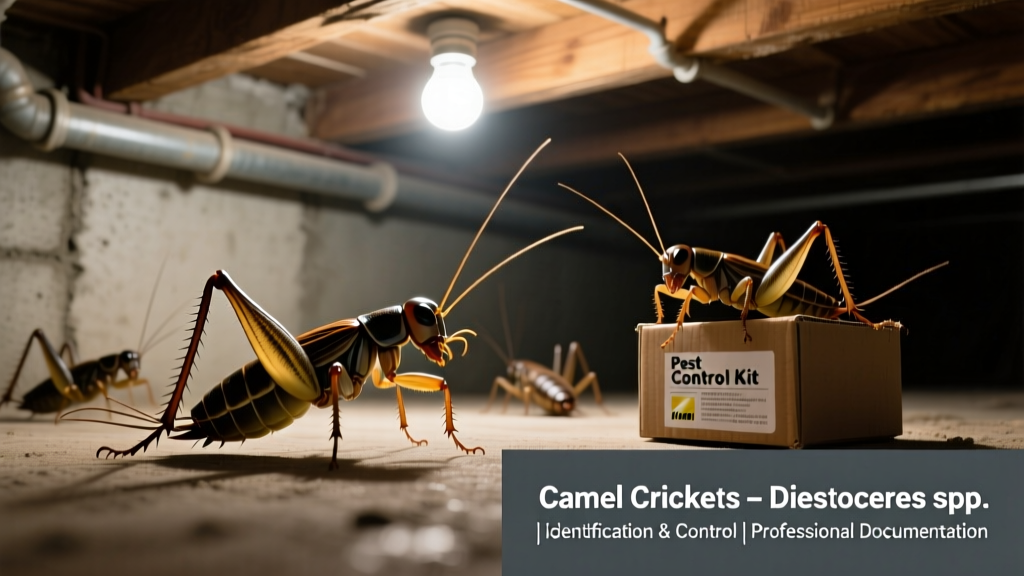
Camel crickets—also called cave crickets or spider crickets—are wingless, humpbacked insects that thrive in cool, humid, undisturbed spaces like basements. They don’t bite or spread disease, but their presence signals moisture issues, and large numbers can damage fabrics, stored paper, and insulation.
Identification
Camel crickets are easy to mistake for spiders at first glance—especially when darting across a basement floor at night. Adults range from ½ to 1½ inches long, with long antennae (often longer than their body), powerful hind legs built for jumping, and a distinct rounded, humped thorax. Their color is typically light brown to tan, sometimes mottled with darker spots.
Unlike house crickets, they make no chirping sound. You’ll notice them most during evening inspections or after turning on lights in dark corners. Look for shed exoskeletons near foundation cracks, behind water heaters, or under cardboard boxes—these translucent, hollow shells are a telltale sign of active infestation.
| Feature | Camel Cricket | House Cricket | Spiders |
|---|---|---|---|
| Wings | None | Present (chirp via wing-rubbing) | None |
| Antennae length | Longer than body | Shorter than body | None (use pedipalps) |
| Noise | Silent | Chirping at night | Silent |
| Preferred humidity | 70–95% RH | 40–60% RH | Varies by species |
What Attracts Them
Camel crickets aren’t seeking food—they’re chasing shelter and moisture. Basements offer the perfect storm: high humidity (especially near sump pumps or leaky pipes), organic debris (old cardboard, fabric scraps), and entry points (cracks >⅛ inch wide, gaps under doors, unsealed utility penetrations).
- Relative humidity above 60% — they dehydrate rapidly in drier air
- Cluttered storage areas with cardboard, paper, or fabric (they chew these for moisture and fungal growth)
- Exterior grading that slopes toward your foundation, pooling water against basement walls
- Unvented crawl spaces or missing vapor barriers under concrete slabs
According to a 2022 National Pest Management Association field survey, 68% of reported camel cricket infestations originated within 3 feet of a basement’s exterior wall—often where foundation cracks met poor drainage.
Treatment Methods
Natural Control Options
Start here—especially if you have pets, children, or prefer low-toxicity solutions. Vacuuming with a shop vac (and immediately disposing of the bag outdoors) removes adults and egg pods. Diatomaceous earth (food-grade) applied as a thin line along baseboards and foundation cracks dehydrates them on contact—reapply after cleaning or humidity spikes.
Dehumidify aggressively: aim for 45–55% relative humidity. A single 70-pint dehumidifier running continuously in a 1,200 sq ft unfinished basement cuts populations by over 70% within two weeks, per University of Kentucky Entomology’s 2021 basement trial.
Chemical Treatments
Reserve insecticides for persistent hotspots—not broad application. Use residual sprays containing bifenthrin or cyfluthrin only in cracks, behind appliances, and along interior perimeter walls. Avoid spraying near sump pits or floor drains; runoff can contaminate groundwater.
- Apply in evening—camel crickets are nocturnal and most active after dusk
- Never mix products—bifenthrin + pyrethrin combinations increase resistance risk
- Always follow EPA label instructions—misapplication accounts for 41% of homeowner pesticide incidents (EPA Pesticide Incident Monitoring System, 2023)
Prevention
Long-term success hinges on eliminating the conditions that draw them in—not just killing individuals. Seal all foundation cracks ≥⅛ inch with hydraulic cement (not caulk alone). Install door sweeps on basement egress doors and replace torn window screens on basement-level windows.
Redirect downspouts at least 5 feet from your foundation and regrade soil so it slopes away at 1 inch per foot for the first 6 feet. Store items in sealed plastic totes—not cardboard—and elevate bins 6+ inches off concrete floors using pallets or shelving.
"Camel crickets rarely survive more than 3 weeks indoors without access to moisture and organic debris. Fix the environment, and the problem collapses faster than any spray." — Dr. Lena Cho, Urban Entomologist, Rutgers Cooperative Extension, 2022
When to Call an Exterminator
Call a licensed pest professional if you see more than 10 camel crickets per night for three consecutive nights—or if you find egg pods (small, brown, oval capsules about 2 mm long) in multiple locations. Also consider professional help if you’ve addressed moisture and sealing for 30 days with no reduction.
Look for technicians certified in moisture management (not just pesticide application). Ask whether they use thermal imaging to locate hidden damp zones behind drywall—a critical step many skip.
Do camel crickets lay eggs in walls?
Yes—but only in voids with sustained moisture and organic dust. They favor insulation-packed stud cavities near leaky pipes or poorly sealed rim joists. Egg pods hatch in 12–18 days at 70°F. Inspect rim joist areas with a flashlight and mirror before sealing.
Can they climb walls or ceilings?
They lack adhesive pads like cockroaches, but their tarsal claws grip rough surfaces well. You’ll commonly see them scaling cinderblock walls, exposed studs, and ductwork—especially where condensation forms. Smooth painted drywall usually stops them.
Are they attracted to light?
No—they’re negatively phototactic, meaning they flee light. That’s why flipping on a basement light makes them vanish into cracks. Use this behavior to your advantage: shine a flashlight along baseboards at night to spot hiding spots before treatment.
Do they eat clothes or furniture?
Not directly—but they graze on mold, fungi, and starch-based sizing on cotton fabrics and book bindings. In heavy infestations, you may find irregular holes in stored sweaters or yellowed, frayed edges on old documents. This damage is often misdiagnosed as silverfish activity.
Why do I only see them in fall?
Fall triggers migration indoors as outdoor temperatures drop and leaf litter decomposes—reducing their natural habitat. Peak indoor sightings occur September–November, especially after rainy periods. This seasonal surge doesn’t mean new infestations—it means existing basement conditions are ideal year-round.
Can they get into my laundry room or furnace closet?
Absolutely. These warm, humid microclimates—with lint, dust, and condensation—are prime real estate. Check behind washing machines for standing water, inspect furnace drip pans for algae, and vacuum dryer vent ducts quarterly. For ongoing protection, install a dedicated basement dehumidifier and seal foundation cracks properly.
Camel crickets won’t disappear overnight—but consistent moisture control, targeted sealing, and smart storage habits break their life cycle within 4–6 weeks. Focus on the environment first, then the insect. For related concerns, see our guides on silverfish in basement and springtail infestation.