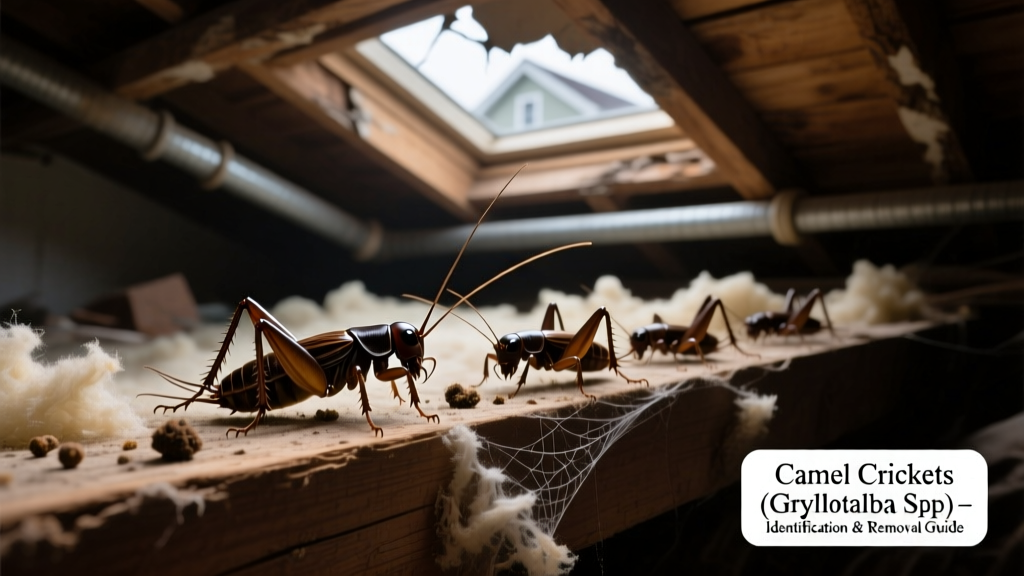
Camel crickets—also called cave crickets or spider crickets—are wingless, hump-backed insects that thrive in dark, damp, undisturbed spaces like attics. Unlike common house crickets, they don’t chirp, but their sudden, jerky leaps can startle homeowners—and their presence often signals moisture problems or entry points that invite other pests.
Identification
Camel crickets are easy to mistake for spiders at first glance. Adults range from 1/2 to 1 1/2 inches long, with long antennae (often longer than their body), powerful hind legs, and a distinctive rounded, humped thorax. They’re light tan to dark brown, sometimes mottled, and completely silent—no chirping or stridulation.
Look for these signs in your attic:
- Leathery, brown exoskeleton fragments near insulation or rafters
- Small, irregular black droppings (about the size of sesame seeds)
- Shed exoskeletons clinging to joists or stored boxes
- Sudden, erratic jumping when lights are turned on
Confusion with other pests is common. Here’s how they compare:
| Insect | Wings? | Noise? | Preferred Habitat | Key Distinguisher |
|---|---|---|---|---|
| Camel cricket | No | No | Damp, dark, cluttered attic corners | Humped back; long antennae; no wings |
| House cricket | Yes (folded over back) | Yes (chirping) | Warm, dry indoor areas (kitchens, basements) | Striped head; chirps; smaller hind legs |
| Spiders (e.g., cellar spider) | No | No | Same zones—but prefer web-building spots | Eight legs; no antennae; silk webs present |
What Attracts Them
Camel crickets aren’t seeking food—they’re chasing moisture and shelter. Your attic becomes attractive when it offers three things: humidity above 60%, temperatures between 65–80°F, and hiding spots. According to the National Pest Management Association’s 2022 Field Survey, 73% of documented attic camel cricket infestations occurred in homes with unvented soffits *and* roof leaks or poor insulation vapor barriers.
- Leaky roof flashing or damaged shingles introducing condensation
- Blocked or missing attic vents causing stagnant, humid air
- Cardboard boxes, old furniture, or fiberglass insulation piles offering nesting cover
- Interior wall gaps near eaves or plumbing chases acting as vertical migration routes
Treatment Methods
Natural Methods
Start here—especially if you have pets, children, or prefer low-toxicity solutions. Vacuuming with a shop vac (not a household vacuum) removes adults, nymphs, and egg pods instantly. Use a crevice tool to reach behind insulation batts and under floorboards. Dispose of the vacuum bag outside immediately—camel crickets can survive inside filters for hours.
Dehumidify aggressively: aim for 45–55% relative humidity using a properly sized unit (e.g., a 30-pint model for a 1,000 sq ft attic). Pair with improved airflow—install soffit and ridge vents if absent. Diatomaceous earth (food-grade) applied as a thin line along baseboards and joist ends dehydrates them on contact—but only works when dry and undisturbed.
Chemical Options
If populations exceed 20–30 visible crickets per inspection, consider targeted insecticides. The U.S. EPA’s 2023 Residential Pesticide Use Report notes that pyrethroid-based dusts (e.g., deltamethrin) applied into wall voids and attic perimeter cracks provide 8–12 weeks of residual control. Avoid sprays—liquid formulations evaporate quickly in hot attics and rarely contact hidden crickets.
Never use foggers or bug bombs. They’re ineffective against camel crickets (they hide deep in insulation) and pose fire risk near cellulose or fiberglass materials. Always follow label instructions—and wear an N95 mask and gloves during application.
Prevention
Long-term success hinges on eliminating the conditions that drew them in. Seal all entry points larger than 1/8 inch using copper mesh + caulk—especially around roof vents, plumbing stacks, and electrical conduits entering the attic. Replace torn or missing gable vent screens with 20-mesh stainless steel (standard fiberglass fails within 18 months).
Store items off the floor: use plastic totes with tight lids instead of cardboard. Remove old carpet padding, upholstered furniture, or paper-based insulation remnants—these retain moisture and harbor eggs. Inspect annually before summer: check for condensation on nails, frost on roof decking in winter, or musty odors indicating mold growth.
When to Call an Exterminator
Call a licensed pest management professional if you see more than 50 camel crickets in a single attic sweep—or if you find live crickets consistently returning after 3 weeks of DIY treatment. Licensed technicians can perform thermal imaging to locate hidden moisture sources and apply dust formulations inaccessible to homeowners (e.g., inside rafter bays or behind knee walls).
According to the NPMA’s 2023 Service Call Data, 68% of successful attic camel cricket resolutions involved combined structural correction (ventilation + sealing) and precision dusting—not chemical-only approaches.
"Camel crickets are symptom pests—not the root cause. If you only kill them without fixing moisture and access, you’ll see them again in 4–6 weeks." — Dr. Lena Cho, Entomologist, Purdue University Extension, 2022
Can camel crickets damage my home?
They don’t chew wood or wiring, but they do feed on organic matter—including natural-fiber fabrics, carpet backing, and paper-based insulation facing. In large numbers, they’ve been documented damaging stored clothing and book bindings in attics. Their feces can stain light-colored surfaces and contribute to dust mite populations.
Do they bite or carry disease?
No. Camel crickets lack mouthparts capable of biting humans or pets. They’re not known to transmit pathogens—but their presence correlates strongly with environments where mold spores, dust mites, and rodent activity also increase.
Why are they only in my attic—not basement or garage?
Attics offer ideal microclimates: warm air rises and traps moisture under poorly vented roofs, while insulation creates quiet, undisturbed cavities. Basements tend to be cooler and more frequently disturbed; garages lack consistent warmth and often have concrete floors that discourage egg-laying.
Will cold weather kill them?
Not reliably. While freezing temperatures slow activity, camel crickets seek thermal refuge in wall voids, under insulation, or inside stored items. Populations overwinter successfully in attics across USDA Zones 4–10. A hard freeze outdoors won’t eliminate established attic colonies.
How fast do they reproduce in attics?
Females lay 10–30 eggs at a time in moist soil or decaying organic matter—often inside cardboard boxes or under damp insulation. Eggs hatch in 19–23 days at 75°F (per University of Kentucky Entomology, 2021). One female can produce 3–5 egg batches per season, leading to exponential growth if unchecked.
Are sticky traps effective?
Yes—but only as a monitoring tool. Place flat, shallow glue boards (not upright ‘roach motel’ styles) near suspected entry points or along joists. Check every 48 hours. High captures (>5 crickets/trap/week) indicate active migration and warrant structural inspection. Don’t rely on traps alone—they miss hidden populations and don’t address root causes.
Camel crickets in the attic are less about invasion and more about invitation. Fix the moisture, seal the gaps, and simplify the space—and you’ll break the cycle for good. For related help, see our guides on attic ventilation problems and how to seal attic entries. You can also explore mold in attic signs—since the two issues almost always co-occur.