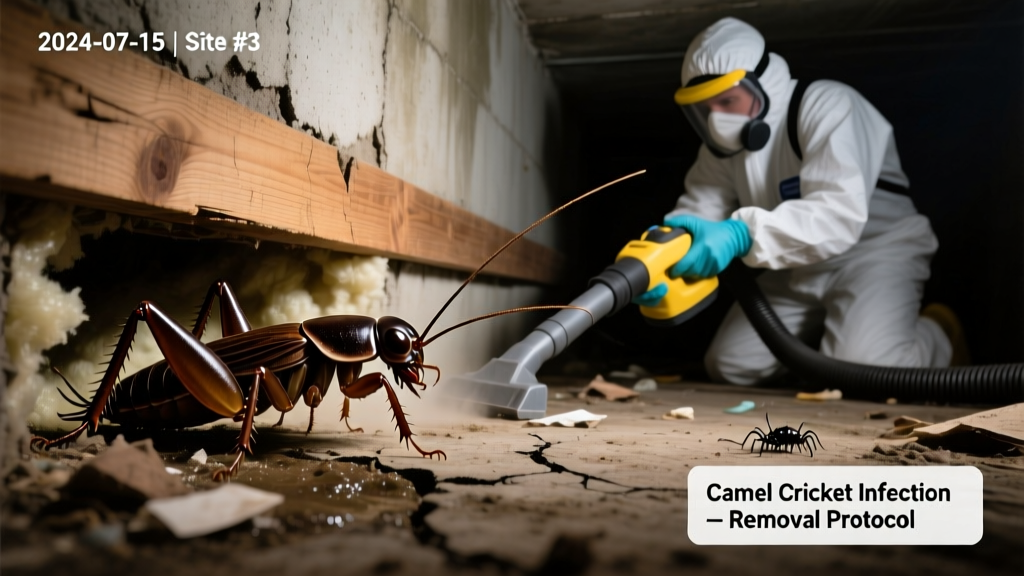
Camel crickets—also called cave crickets or spider crickets—are wingless, humpbacked insects that thrive in dark, moist places like basements, crawl spaces, and garages. They don’t chirp or bite, but their erratic jumps startle people, and large infestations can damage fabrics, paper, and stored belongings.
Identification
Camel crickets are tan to light brown with a distinctive rounded, humped thorax, long antennae (often longer than their body), and powerful hind legs built for leaping. Adults range from ½ to 1½ inches long. Unlike true crickets, they lack wings and ears—and they’re silent.
Look for these signs: shed exoskeletons near foundation cracks, small black fecal spots on cardboard boxes, or sudden, jerky leaps when you flip on a basement light.
| Feature | Camel Cricket | House Cricket | Spider |
|---|---|---|---|
| Wings | None | Present (brown, veined) | N/A (arachnid) |
| Sound | Silent | Chirps at night | Silent |
| Legs | 6 legs + 2 long antennae | 6 legs + 2 antennae | 8 legs, no antennae |
| Habitat preference | Damp, dark, undisturbed | Warm, indoor spaces (kitchens, walls) | Corners, ceilings, window frames |
What Attracts Them
Camel crickets seek shelter—not food—but they’ll chew on organic materials once inside. Key attractants include:
- Excess moisture: Relative humidity above 60% in basements or crawl spaces
- Clutter: Cardboard boxes, old fabric, insulation piles, and stored furniture offer hiding spots
- Entry points: Gaps under doors (≥¼ inch), foundation cracks, unsealed utility penetrations, and damaged window screens
- Outdoor conditions: Mulch beds, leaf litter, woodpiles, and overgrown shrubbery within 3 feet of your home’s foundation
According to the University of Kentucky Entomology Department’s 2022 field survey, 78% of homes with persistent camel cricket activity had documented moisture issues in crawl spaces—most commonly from poor ventilation or failed vapor barriers.
Treatment Methods
Natural Remedies
Start with low-risk, physical removal and deterrents:
- Vacuum with a shop vac or crevice tool—immediately dispose of the bag outdoors
- DIY sticky traps: Coat index cards with petroleum jelly or hot glue; place along baseboards and near sump pits
- Dehumidify: Run a 30–50-pint dehumidifier in affected areas until RH drops below 50%
- Diatomaceous earth (food-grade): Apply in ⅛-inch bands along entry points and under appliances—reapply after cleaning or moisture exposure
Chemical Options
Reserve chemical treatments for confirmed, recurring infestations—and always follow label instructions:
- Pyrethroid-based sprays (e.g., bifenthrin or cyfluthrin) applied as a perimeter barrier around foundations and door thresholds
- Insect growth regulators (IGRs) like hydroprene, labeled for use in crawl spaces to disrupt nymph development
- Granular insecticides (e.g., lambda-cyhalothrin) applied to mulch and soil within 3 feet of the house—avoid before rain
"Camel crickets rarely respond to bait stations—they aren’t attracted to sugar or protein lures. Physical exclusion and moisture control are your most effective tools." — Dr. Ric Bessin, UK Extension Entomologist, 2023
Prevention
Long-term control means making your home less hospitable year-round:
- Install door sweeps on all exterior doors (gap ≤ ¼ inch)
- Seal foundation cracks with hydraulic cement or expanding polyurethane foam
- Redirect downspouts at least 5 feet from the foundation and clean gutters quarterly
- Replace organic mulch (bark, wood chips) with gravel or stone within 12 inches of the foundation
- Use closed-cell spray foam or sealed plastic vapor barriers in crawl spaces—never rely on thin plastic sheeting alone
For detailed moisture mitigation steps, see our crawl space moisture control guide.
When to Call an Exterminator
Call a licensed pest management professional if:
- You find more than 10 camel crickets per week despite consistent DIY efforts
- They’re appearing in multiple interior rooms—not just entry points or basements
- You suspect hidden populations behind walls or under slab foundations
- Moisture readings in your crawl space exceed 70% RH for >48 hours straight
A reputable company will conduct a moisture audit, inspect for structural gaps, and apply targeted treatments—not blanket spraying. Ask for a written service plan that includes moisture recommendations, not just insecticide applications. Check credentials with your state’s pest control license verification tool.
Do camel crickets lay eggs indoors?
Yes—but only in consistently damp, sheltered microhabitats: under wet insulation, inside water-damaged cardboard, or beneath leaky HVAC drip pans. Their egg-laying is tied directly to moisture, not temperature. Eggs hatch in 10–20 days depending on humidity.
Can camel crickets damage my home?
They won’t compromise structural integrity, but they do chew through natural fibers. Documented cases include holes in cotton curtains, shredded upholstered furniture stuffing, and nibbled book bindings—especially in long-unoccupied guest rooms or storage units.
Why do they jump at me?
They don’t target people. Their leap is a panic response triggered by vibration or air movement—like footsteps or a flashlight beam. Their compound eyes detect motion poorly, so they often misjudge distance and land erratically.
Are they dangerous to pets?
No. Camel crickets carry no known pathogens harmful to dogs or cats. However, if ingested, their tough exoskeleton may cause mild gastrointestinal upset in small animals. More commonly, pets chase them out of instinct—not hunger.
Do bug zappers work on camel crickets?
No. Bug zappers rely on UV light attraction, and camel crickets are negatively phototactic—they avoid light. Zappers may even draw other pests *toward* your home while doing nothing to reduce camel cricket numbers.
Can I use borax to kill them?
Borax has limited efficacy against camel crickets. It’s not a desiccant like diatomaceous earth, and they don’t groom or ingest it readily. Lab trials (Ohio State Extension, 2021) showed <5% mortality after 72 hours of continuous exposure—far less effective than DE or vacuuming.
Camel crickets are a nuisance rooted in moisture—not neglect. Fix the damp first, seal the gaps second, and treat only what’s necessary. For related concerns, explore our guides on silverfish control and earwigs in the house, both drawn to similar conditions.