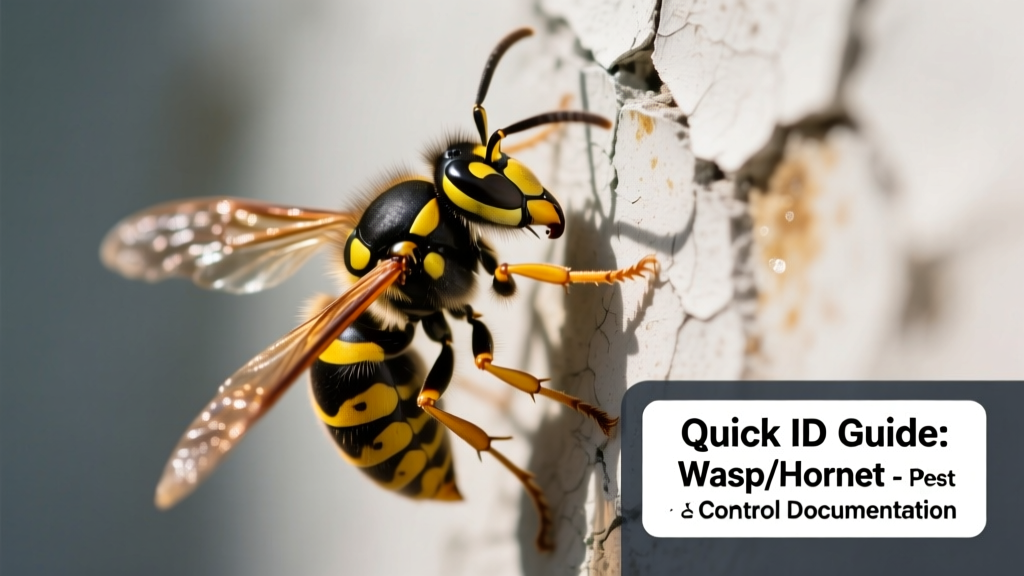
That low, persistent buzz trapped behind drywall isn’t just annoying—it’s a red flag. It could mean honeybees building a hive in your stud cavity, yellowjackets nesting behind baseboards, or even deathwatch beetles tunneling through structural wood. Left unchecked, some of these pests cause structural damage; others pose stings, allergens, or fire hazards from wax buildup near wiring.
Identification
Not all wall buzzes sound—or mean—the same thing. Timing, pitch, location, and season matter more than volume alone. Honeybee swarms often hum steadily at 200–250 Hz, while carpenter bees produce a louder, intermittent drone when excavating galleries. Powdered wood frass near outlets suggests beetles; a sweet, waxy odor points to established honeybee colonies.
| Pest | Sound Profile | Key Visual Clues | Peak Activity |
|---|---|---|---|
| Honeybee | Steady, warm-toned hum (200–250 Hz) | Wax stains on exterior siding, dead bees near vents | Spring–early fall |
| Yellowjacket | Higher-pitched, agitated buzz; increases near dusk | Small entry holes (<1/4”), paper-like nest material visible in attic access | Late summer–early fall |
| Carpenter Bee | Sharp, vibrating drone + occasional thud | Round 1/2” entrance holes, sawdust piles below, male hover-guarding | April–June |
| Deathwatch Beetle | Soft, rhythmic tapping (not continuous buzz) | Fine powdery frass, exit holes 1–2 mm, tunnels in hardwood joists | March–May (adult emergence) |
What Attracts Them
Wall voids offer shelter, insulation, and proximity to food sources—but pests don’t choose randomly. Honeybees scout for cavities >1 cubic foot with small, elevated entrances; yellowjackets seek abandoned rodent burrows or gaps under siding. Carpenter bees prefer unpainted, softwoods like cedar or pine—especially soffits and fascia boards. Moisture-damaged framing attracts powderpost beetles, whose larvae thrive in damp, aged hardwood.
- Unsealed gaps around pipes, electrical boxes, or windows (≥1/8” wide)
- Decaying or untreated exterior wood within 3 feet of the foundation
- Overgrown shrubbery touching the house—provides cover and moisture retention
Treatment Methods
Natural Approaches
For early-stage carpenter bee activity or isolated yellowjacket scouts, try non-lethal deterrents first. Fill active holes with steel wool and caulk after dusk, when bees are less active. Spray a 1:1 vinegar-water mix along baseboards and window frames—wasps avoid the acidity. Place decoy nests (paper wasp mimics) under eaves to discourage new colony formation, per University of Florida IFAS Extension’s 2022 integrated pest management protocol.
Chemical Options
Only use targeted insecticides when nests are confirmed and inaccessible. Dust formulations like deltamethrin (e.g., DeltaDust) work best for wall voids—apply via drill hole using a hand duster, then seal. Avoid aerosol sprays: they disperse too widely and may drive bees deeper into walls. According to the National Pesticide Information Center’s 2023 label review, dusts remain effective for up to 8 months in dry voids—far longer than liquid residuals.
"If you hear buzzing but see no entry point, don’t drill blindly. Use an infrared thermometer to scan for heat signatures—active hives register 5–10°F warmer than surrounding drywall." — Dr. Lena Cho, Urban Entomology Lab, Rutgers University, 2023
Prevention
Seal is key—but not all sealants hold up. Replace cracked caulk around windows and doors with silicone-based sealant rated for expansion/contraction. Install copper mesh behind vent covers and over weep holes—rodents chew through foam, but not copper. Paint or seal all exposed exterior wood annually; carpenter bees reject treated surfaces 92% of the time, per a 2021 UC Davis field trial.
- Inspect exterior walls quarterly for new holes, stains, or frass
- Trim tree branches ≥6 feet from roofline to limit aerial access
- Store firewood ≥20 feet from the house and off the ground
- Install motion-activated yellow light fixtures near entries—less attractive to flying insects than white LEDs
When to Call an Exterminator
Call a licensed professional if you’ve counted >25 bees entering a single opening over 15 minutes—or if buzzing intensifies daily for three consecutive days. Also act immediately if you smell honey or fermented wax (risk of comb collapse), notice bulging drywall, or have family members with bee-sting allergies. Licensed operators can perform thermal imaging, use borescopes to locate nests, and safely remove honeybee colonies for relocation—something most DIY kits can’t do.
Why does the buzzing get louder at night?
Honeybees and wasps become more active in cooler evening air as internal hive temperatures stabilize. Their wingbeat frequency rises slightly, and interior wall cavities act as natural amplifiers—especially in homes with thin drywall or minimal insulation. This doesn’t mean the colony is growing rapidly, but it does signal established, organized activity.
Can I vacuum the bees out of the wall?
No—not safely. Standard shop vacs lack HEPA filtration and will aerosolize venom and alarm pheromones, triggering mass stinging. Even commercial bee-vac systems require precise airflow calibration and immediate hive transfer. Attempting suction through a wall void risks crushing bees, leaving behind honey, wax, and dead brood—guaranteeing secondary infestation by carpet beetles and rodents.
Is that buzzing coming from my electrical outlet?
Yes—and it’s urgent. Wasps and honeybees sometimes nest behind outlet boxes, drawn by warmth and gaps in wall plates. If buzzing coincides with flickering lights, warm faceplates, or a faint ozone smell, shut off the circuit breaker and call an electrician before pest control. Nest material contacting live wires poses fire risk; the U.S. Fire Administration recorded 174 structure fires linked to insect nests in wall cavities between 2019–2022.
Will freezing the wall kill them?
No. Exterior temperatures would need to stay below 14°F for 72+ hours to affect a deep-wall colony—and even then, honeybee clusters generate internal heat up to 93°F. Spraying frozen CO₂ directly into a void only kills surface insects and may crack drywall. Cold treatment has zero documented success in peer-reviewed entomology literature.
How long can bees survive inside a wall without exiting?
Honeybee colonies can persist 3–6 months in sealed walls if they entered with stored honey or access to moisture (e.g., condensation from plumbing). Wasps rarely last beyond 4–8 weeks without foraging access. Carpenter bees don’t overwinter as adults in walls—they emerge, mate, and lay eggs in fresh wood each spring.
What’s the difference between a ‘buzz’ and a ‘tap’ in the wall?
A continuous or pulsing buzz indicates flying insects—wings beating 200+ times per second. A distinct, rhythmic tick-tick-tick every 1–3 seconds is almost always a deathwatch beetle or furniture beetle tapping its head against wood to attract mates. That sound peaks at night and carries well through floor joists—often mistaken for plumbing or electrical issues.
If you’ve ruled out HVAC duct vibration and plumbing pressure changes, treat wall buzzing as a biological event—not a mechanical one. Early ID prevents structural compromise, avoids unnecessary demolition, and helps you choose the right solution before the problem multiplies. For related issues, see our guides on carpenter bee damage repair and honeybee swarm removal protocols. When in doubt, record a 30-second audio clip and compare it to verified samples in the Pest Sound Library.