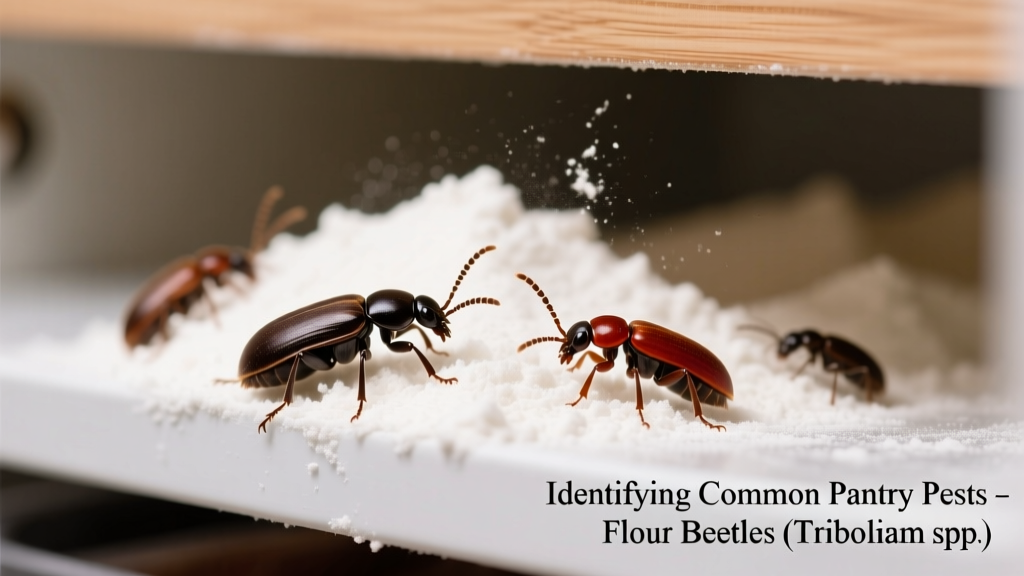
Flour that’s crawling with tiny bugs isn’t just unsettling—it’s a sign of an active pantry pest infestation. These pests don’t just ruin flour; they contaminate entire cabinets with frass, webbing, and eggs, risking spoilage across rice, oats, pasta, and cereal.
Identification
Three pests commonly invade flour: the red flour beetle (Tribolium castaneum), the confused flour beetle (Tribolium confusum), and the Indian meal moth (Plodia interpunctella). All thrive in warm, humid storage conditions and reproduce rapidly—red flour beetles lay up to 400 eggs in their 1–3-year lifespan (University of Kentucky Entomology, 2022).
| Pest | Size & Color | Wings/Flight | Signs in Flour |
|---|---|---|---|
| Red flour beetle | 3–4 mm, reddish-brown, shiny | Can fly; often found near light sources | Fine dust, musty odor, live adults crawling at surface |
| Confused flour beetle | 3–4 mm, reddish-brown, duller sheen | Cannot fly; crawls only | Same as red beetle—but rarely near windows or lamps |
| Indian meal moth | Larvae: ½ inch, off-white with brown head; Adults: ⅝ inch wingspan, coppery outer wings | Larvae don’t fly; adults do—and leave silken webbing | Clumped grains, silk threads, pupal cocoons stuck to container walls |
What Attracts Them
These pests rarely enter homes from outdoors. Instead, they hitchhike in pre-infested products—especially bulk bins, discount store flour, or old stock with compromised packaging. Once inside, they multiply fastest where temperature stays above 70°F and humidity exceeds 60%.
- Flour stored longer than 6 months (even unopened)
- Bags with micro-tears or resealed plastic clips
- Containers kept near stoves, dishwashers, or laundry rooms (heat + moisture)
- Unwashed canisters previously holding infested product
Treatment Methods
Natural Methods
Start here—especially if you’re treating food-grade areas or households with kids or pets. Freezing flour at 0°F for 4 days kills all life stages (eggs, larvae, adults). For larger batches, heat treatment at 130°F for 30 minutes works—but requires precise oven thermometers and shallow pans to avoid scorching.
- Discard all suspect flour, baking mixes, and adjacent dry goods—even if no bugs are visible
- Vacuum cabinet shelves thoroughly, then wipe with 5% vinegar solution to remove pheromone trails
- Place bay leaves or whole cloves in new containers (not a repellent, but disrupts mating per Cornell Cooperative Extension, 2021)
Chemical Options
Only use EPA-registered insecticides labeled for indoor pantry use—and never apply directly to food surfaces. DeltaDust (deltamethrin) applied in wall voids or behind baseboards can halt migration, but it’s ineffective against hidden larvae inside sealed bags.
"Most 'flour bugs' aren’t coming from your kitchen—they’re already in the bag when you buy it. That’s why checking expiration dates and buying smaller quantities matters more than spraying." — Dr. Ric Bessin, University of Kentucky Extension Entomologist, 2023
Prevention
Prevention hinges on breaking the reproductive cycle before eggs hatch. Transfer all new flour, cornmeal, and cereal into rigid, airtight containers—glass or thick HDPE plastic with gasket seals—not zip-top bags or thin plastic tubs. Label containers with purchase date and rotate stock using “first in, first out.”
- Inspect every new bag for pinprick holes, discoloration, or faint webbing before bringing it home
- Store flour in cool, dry locations—ideally below 70°F and under 55% RH (U.S. FDA Food Code, 2022)
- Clean pantry shelves monthly with soapy water, then inspect corners and crevices with a flashlight
- Replace cardboard boxes immediately—pests chew through them in under 48 hours
When to Call an Exterminator
Call a licensed pest professional if you find live adults or larvae in three or more unrelated food items (e.g., flour, birdseed, and dried fruit), or if you spot moths flying indoors more than once per week for two consecutive weeks. Persistent infestations often mean pests have moved into wall voids or behind appliances—areas DIY methods can’t reach.
Can flour weevils make me sick?
No. Neither flour beetles nor Indian meal moth larvae carry human pathogens. Eating a few accidentally poses no health risk—though the U.S. FDA allows up to 75 insect fragments per 50g of flour (FDA Defect Levels Handbook, 2023). Still, discard infested product for quality and hygiene.
Do these bugs bite or crawl on people?
No. These are strict grain feeders. They lack mouthparts capable of piercing skin and show zero interest in blood meals or human contact. If you feel crawling sensations, consider bed bugs or environmental irritants instead.
Why do I keep finding them even after cleaning?
Likely because eggs remain in seams, drawer tracks, or inside unused containers. Larvae can survive up to 10 days without food—and adult beetles live months without reproducing. A full reset takes 6–8 weeks of strict sanitation and monitoring with pheromone traps.
Are organic flours more likely to have bugs?
No—but they’re more likely to be stored longer pre-sale and lack preservatives like propionic acid, which deters beetle development. Always check best-by dates regardless of certification.
Can I save flour if I see just one bug?
Not safely. One adult signals dozens of eggs already laid. Even freezing won’t guarantee 100% mortality if eggs are deeply embedded in clumps. When in doubt, toss it—and inspect everything within 3 feet of that bag, including spices and pet food. For long-term storage solutions, see our guide on pantry pest-proof containers.
Will cold weather outside kill them in my pantry?
No. Indoor pantries stay warm year-round. Outdoor cold has zero effect unless you’re storing flour in an unheated garage or shed—and even then, most pantry pests die only below 15°F for 72+ hours.
Once you’ve cleared the immediate infestation, maintain vigilance—not just with flour, but with all dry goods. Rotate stock, seal containers tightly, and treat your pantry like a lab: clean, controlled, and inspected weekly. For help identifying unknown insects caught in sticky traps, visit our bug identification guide.