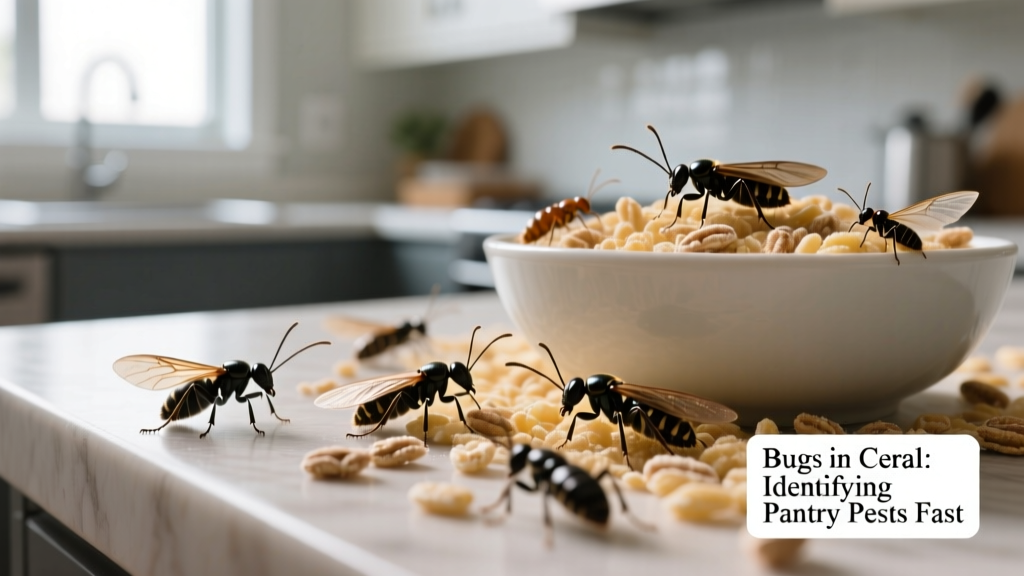
Seeing tiny bugs crawling in your cereal box or spotting webbing in your oatmeal isn’t just gross—it’s a red flag for a pantry pest infestation. These insects don’t just ruin food; they multiply rapidly and spread to other dry goods like pasta, nuts, and pet food. Left unchecked, a single infested box can seed dozens of new colonies in weeks.
Identification
Pantry pests in cereal fall into three main categories—each with distinct size, color, behavior, and life stage clues. Correct ID determines whether you’re dealing with flying moths (which lay eggs *in* the food) or crawling beetles (which chew through packaging).
| Pest | Size & Color | Larval Sign | Adult Behavior |
|---|---|---|---|
| Indian meal moth | ½ inch; coppery wings with gray base | Silky webbing + tiny white larvae in clumps | Flying adults near cabinets at dusk |
| Sawtoothed grain beetle | 1/10 inch; flat, brown, six tooth-like projections on thorax | No webbing; live adults crawling freely | Cannot fly; fast runners on surfaces |
| Red flour beetle | 1/8 inch; reddish-brown, oval, smooth antennae | Fine dust + dead beetles at bottom of box | Weak flier; often found in warm, humid pantries |
- Look for larvae inside sealed boxes—especially near seams or inner liners
- Check behind cereal boxes for frass (insect excrement) or shed skins
- Use a magnifying glass: sawtoothed grain beetles have jagged edges on their pronotum—like tiny teeth
What Attracts Them
Pantry pests rarely invade from outdoors. They hitchhike in via infested groceries—especially bulk bins, discount-store cereals, or imported grains. Once inside, they thrive where humidity exceeds 60% and temperatures stay between 70–90°F. Cracked packaging, cardboard boxes with micro-tears, and open bags are all welcome mats.
According to the U.S. Department of Agriculture’s 2022 Pest Management Guidelines, over 73% of pantry beetle infestations originate from products purchased already infested—not homegrown breeding.
- Storing cereal in original cardboard boxes (not airtight containers)
- Buying from stores with poor stock rotation or visible spillage in bulk sections
- Keeping pantry areas damp—e.g., near dishwashers or leaky faucets
Treatment Methods
Natural Methods
Start here—especially if you’ve caught the problem early. Discard all opened or suspect dry goods, then deep-clean shelves with vinegar-water (1:1) and a stiff brush. Freeze unopened cereal boxes at 0°F for 4 days to kill eggs and larvae—this works for Indian meal moth eggs and both beetle species.
Bay leaves, whole cloves, or dried rosemary placed in airtight containers with new cereal deter adults—but won’t eliminate existing infestations. Diatomaceous earth (food-grade) lightly dusted along shelf edges disrupts exoskeletons of crawling beetles.
Chemical Options
Residual insecticides like pyrethrin-based sprays (e.g., PyGanic Crop Protection) can be applied to cracks and crevices *after* cleaning—but never directly on food or food-contact surfaces. The EPA prohibits aerosol foggers for pantry use due to inhalation risk and ineffectiveness against hidden larvae.
"Freezing infested items for 96 hours at 0°F kills all life stages—including heat-resistant Indian meal moth eggs. It’s more reliable than short-term refrigeration." — Dr. Elena Ruiz, Entomologist, UC Riverside Postharvest Lab, 2023
Prevention
Switch every cereal, rice, flour, and nut product into rigid, locking-lid containers—preferably glass or thick polypropylene (look for #5 recycling code). Label containers with purchase dates and rotate stock using the FIFO method (first-in, first-out). Wipe down outer packaging before storing, and inspect bulk-bin scoops for residue.
Install a hygrometer in your pantry: aim to keep relative humidity below 55%. Consider adding a small desiccant pack (silica gel) inside large containers of oats or granola.
- Clean pantry shelves monthly—even if nothing looks amiss
- Inspect new cereal boxes under bright light before opening
- Store pet food separately—in its own sealed bin, not near human food
When to Call an Exterminator
Call a licensed pest control professional if you find live adults or larvae in *three or more unrelated food items*, see moths flying consistently for >7 days, or spot larvae in wall voids or behind baseboards. These indicate established breeding sites beyond the pantry—often in ceiling voids above kitchens or inside false backs of cabinets.
Most exterminators use targeted pheromone traps and crack-and-crevice treatments—not broad sprays. Expect a follow-up visit in 10–14 days to assess egg hatch cycles.
Can I still eat cereal if I see one bug?
No—discard the entire box. Even one adult indicates egg-laying occurred weeks earlier. Larvae and frass contaminate far beyond visible areas. Don’t rely on sifting or rinsing: Indian meal moth larvae spin silk that binds particles and resists washing.
Do pantry pests bite or carry disease?
No. None of the common cereal pests—Indian meal moths, sawtoothed grain beetles, or flour beetles—bite humans or transmit pathogens. Their risk is strictly economic and sanitary: allergenic frass, degraded nutrients, and cross-contamination.
Why did this happen even though my kitchen is clean?
Cleanliness doesn’t prevent hitchhiking pests. A single infested box of generic bran flakes from a warehouse store can introduce hundreds of eggs. In fact, the National Pest Management Association’s 2023 Household Pest Survey found 68% of pantry infestations started with products bought from big-box retailers—not local grocers.
Can these bugs get into sealed plastic bags?
Yes—sawtoothed grain beetles can chew through thin polyethylene (like standard zip-top bags), and Indian meal moth larvae can squeeze through microscopic gaps in heat-sealed seams. Only rigid, locking-lid containers with gasket seals provide reliable protection.
How long does it take to fully eliminate them?
With full sanitation and freezing, most infestations resolve in 2–3 weeks. But because Indian meal moth eggs take up to 14 days to hatch, and beetles mature in 21–35 days, monitor with sticky traps for at least 28 days post-cleanup to confirm no new adults emerge.
Are organic cereals more likely to get infested?
Not inherently—but many organic brands use minimal preservatives and thinner packaging, increasing vulnerability during storage and transport. A 2021 study in the Journal of Stored Products Research found organic rolled oats had 2.3× higher initial beetle detection rates than conventional counterparts—largely due to packaging differences, not farming practices.
Once you’ve identified and removed the source, pantry pests rarely return—if you lock down storage and rotate stock. Keep a flashlight and magnifier in your pantry drawer for quick checks. And remember: prevention isn’t about perfection—it’s about breaking the cycle before the next box of granola becomes a nursery.