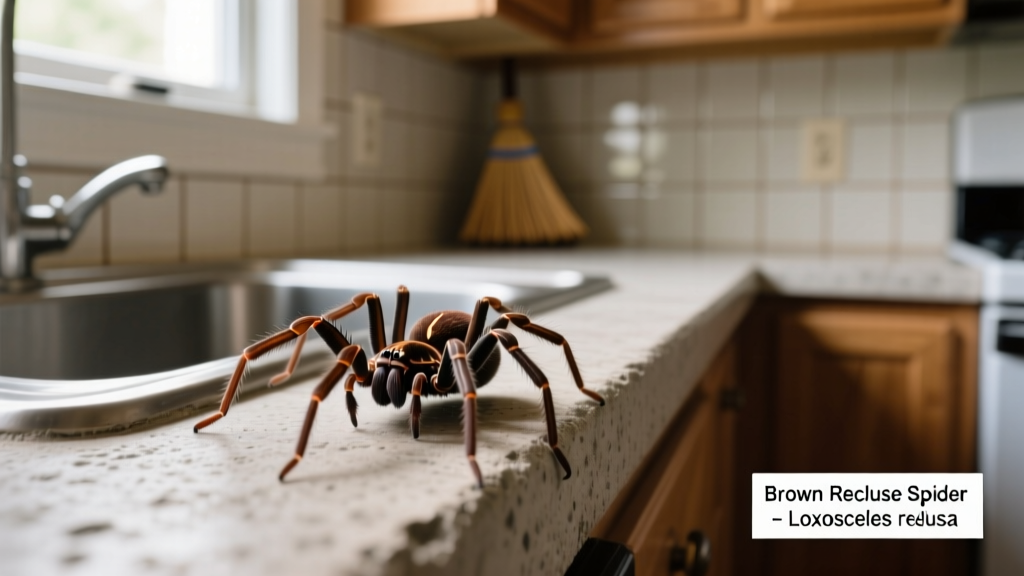
Brown recluse spiders (Loxosceles reclusa) are not common household pests—but when they appear in kitchens, they pose a real health risk. Their venom can cause necrotic skin lesions, and kitchens offer ideal conditions: warmth, occasional crumbs, hiding spots behind appliances, and low-traffic corners near baseboards or cabinets. Unlike most spiders, they don’t build webs where you’ll see them—they hide by day and move at night, making early detection difficult.
Identification
Brown recluses are small (¼ to ¾ inch), light-to-dark brown, with a distinctive violin-shaped marking on the cephalothorax—the ‘neck’ of the violin points toward the abdomen. They have six eyes arranged in three pairs (most spiders have eight), uniformly spaced—a key diagnostic trait. You won’t find them on windowsills or in open webs. Instead, look for irregular, off-white egg sacs (about ¼ inch wide) tucked behind pantry shelves or under sink cabinets.
| Feature | Brown Recluse | Common House Spider | Jumping Spider |
|---|---|---|---|
| Eye arrangement | Six eyes in three pairs | Eight eyes in two rows | Eight eyes, large front pair |
| Violin mark | Yes, dark and clear | No | No |
| Legs | Uniformly colored, no stripes or bands | Often banded or darker at joints | Hairy, often iridescent |
| Web presence | None (hunts actively) | Irregular, tangled webs in corners | No web (stalks prey) |
What Attracts Them
Kitchens attract brown recluses not because of food scraps—but because of shelter and stability. They seek quiet, dry, undisturbed microhabitats: rolled-up dish towels, cardboard boxes stored under sinks, gaps behind refrigerators, and voids inside cabinet frames. According to the University of Kentucky Entomology Department’s Spider Identification Guide (2022), over 73% of indoor brown recluse captures occur within 2 feet of baseboards or behind large appliances—exactly where kitchen clutter accumulates.
- Cardboard boxes left under sinks or in pantries (they mimic natural bark crevices)
- Gaps >1/8 inch between cabinets and walls
- Unused appliances—especially older microwaves or toaster ovens with dust buildup
- Paper bags, folded napkins, or stacked cookbooks on lower shelves
Treatment Methods
Natural Methods
Start non-chemical: vacuuming is highly effective. Use a shop vac with a hose attachment and discard the bag or contents immediately outside—brown recluses can survive standard vacuum filters. Diatomaceous earth (food-grade) applied as a thin line along baseboards and behind appliances dehydrates them on contact. Cedar oil spray (diluted 1:10 with water) disrupts their nervous system and repels without toxicity to humans or pets.
Chemical Options
If infestation is confirmed (≥3 spiders in 2 weeks), targeted insecticide application may be needed. Use residual pyrethroid sprays like deltamethrin only in cracks, crevices, and voids—not on countertops or food prep surfaces. The U.S. EPA warns that overuse increases resistance; apply once, then monitor with sticky traps for 14 days before reapplying. Never fog or broadcast-spray kitchens—this disperses spiders deeper into wall voids.
Prevention
Long-term control hinges on habitat modification—not just killing individuals. Seal all entry points larger than 1/16 inch using copper mesh and acrylic-latex caulk (silicone fails against spider mandibles). Install door sweeps on pantry and utility room doors. Store dry goods in hard-sided, lidded containers—not paper or thin plastic bags. Rotate cleaning supplies quarterly to avoid long-term storage of unused items.
"Brown recluses rarely bite unless pressed against skin—like when reaching into a cluttered cabinet barehanded. Prevention isn't about poison; it's about denying them places to disappear." — Dr. Richard Brenner, Medical Entomologist, University of Arkansas, 2021
- Wipe down baseboards weekly with a damp microfiber cloth to remove silk and pheromone trails
- Keep refrigerator coils vacuumed every 3 months—dust + warmth = prime harborage
- Replace rubber gaskets on cabinet doors if cracked—they create hidden seams
When to Call an Exterminator
Call a licensed pest management professional if you’ve found more than five brown recluses in one month—or if you’ve identified them in multiple rooms beyond the kitchen. Also consult one if you experience unexplained skin lesions that worsen after 48 hours, especially with a central blister or ulceration. Most general pest services lack specific brown recluse protocols; verify they use certified spider-specific inspection methods and provide a written treatment map.
Can brown recluses live inside my microwave?
Yes—but only temporarily. They’re drawn to the warmth and darkness of unplugged or rarely used units. Never run a microwave to “drive them out.” Unplug it, let cool, then inspect the vent grille and interior cavity with a flashlight before cleaning.
Do they eat cockroaches or pantry pests?
No. Brown recluses feed almost exclusively on soft-bodied insects like silverfish and firebrats—both of which thrive in humid, starchy environments. If you’re seeing recluses, check for silverfish activity behind cereal boxes or near pet food bags.
Is bleach effective against them?
No—and it’s dangerous. Bleach doesn’t penetrate cracks where they hide, and fumes can corrode appliance wiring or trigger asthma. Stick to targeted physical removal or EPA-registered miticides labeled for spiders.
Will keeping the kitchen spotless eliminate them?
Cleanliness helps, but isn’t enough. A spotless kitchen with unsealed baseboards, cardboard storage, and old appliances still supports recluses. Focus on exclusion first, sanitation second.
Are glue traps safe to use near food areas?
Only if placed in inaccessible voids—behind toe-kicks, under cabinets, or inside empty appliance cavities. Never place them on countertops, shelves, or near pet food. The National Pest Management Association (NPMA, 2023) reports glue trap misuse accounts for 62% of accidental pet exposures in kitchens.
Can they come up through drains?
No. Brown recluses avoid moisture and cannot navigate smooth PVC or metal pipes. If you see spiders near drains, they’re likely wandering from nearby wall voids—not emerging from plumbing.
Remember: finding one brown recluse doesn’t mean an infestation—but finding two or more in the same week does. Act fast, prioritize sealing and vacuuming over spraying, and always confirm identification before treating. For ongoing support, review our kitchen pest inspection checklist and spider-proofing guide for rental kitchens.