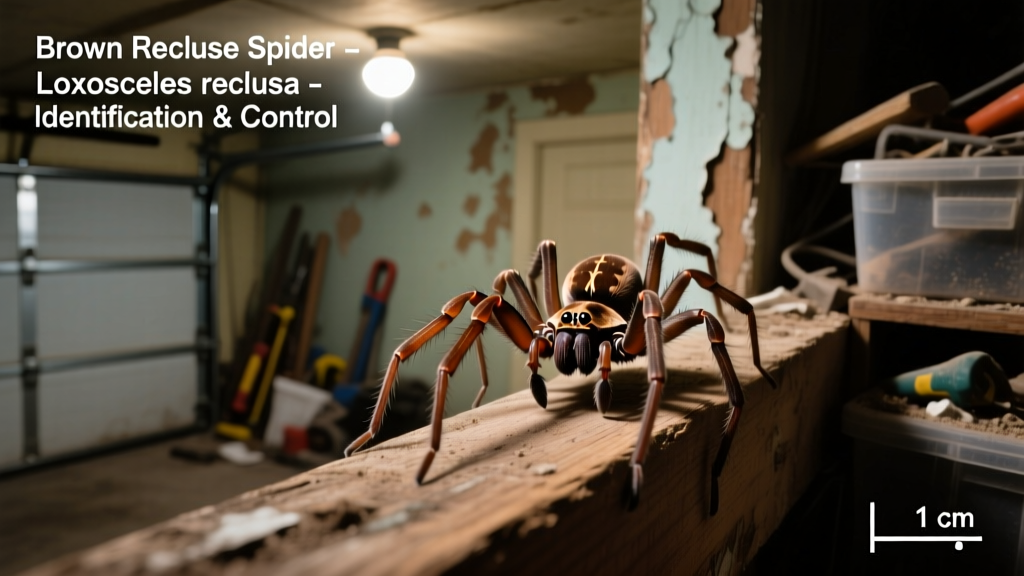
Brown recluse spiders (Loxosceles reclusa) are venomous arachnids rarely found outside the central and southern U.S., but garages—especially cluttered, undisturbed ones—are among their top indoor habitats. Their bite can cause necrotic skin lesions in some people, and because they’re nocturnal and reclusive, infestations often go unnoticed until multiple spiders or bites appear.
Identification
Brown recluses are small (¼ to ¾ inch), light-to-dark brown, and most reliably identified by a dark violin-shaped marking on the cephalothorax—with the 'neck' pointing toward the abdomen. They have six eyes arranged in three pairs (unlike most spiders’ eight), uniformly fine hairs (no spines), and legs lacking banding or stripes.
Signs include irregular, non-sticky webs in corners, behind stored items, or inside cardboard boxes—not for catching prey, but as retreats. You may also find molted exoskeletons or egg sacs: off-white, silken, and about ¼ inch in diameter.
| Feature | Brown Recluse | House Spider | Cellar Spider |
|---|---|---|---|
| Eye arrangement | Six eyes in three pairs | Eight eyes in two rows | Eight eyes clustered |
| Violin mark | Present (dark, consistent) | Absent | Absent |
| Leg texture | Uniformly fine hair, no spines | Hairy with visible spines | Long, thin, fragile |
| Web location | Undisturbed corners, boxes, clothing piles | Window frames, ceiling corners | Damp, low-ceiling areas like floor drains |
What Attracts Them
Brown recluses don’t seek humans—they seek shelter, prey, and stability. Garages offer all three: stacked boxes provide nesting crevices; cardboard and paper attract their primary food source (silverfish, firebrats, and other small arthropods); and inconsistent temperatures, poor sealing, and moisture buildup create microhabitats they favor.
- Cluttered storage—especially cardboard, old clothing, or unused furniture
- Cracks in foundation walls or gaps under garage doors (≥1/8 inch)
- High humidity (>60% RH) near water heaters, sump pumps, or leaky hoses
- Outdoor lighting that draws flying insects—and thus their predators—near entry points
Treatment Methods
Natural Methods
Start with mechanical and physical controls before introducing chemicals. Vacuuming with a shop vac (immediately disposing of the bag outdoors) removes spiders, egg sacs, and prey insects. Diatomaceous earth (food-grade) applied in thin lines along baseboards and behind stored items dehydrates spiders on contact—but only works when dry and undisturbed.
Essential oil sprays (e.g., peppermint or tea tree at 10–15 drops per oz of water) may deter movement but offer no kill effect or residual control. Sticky traps placed along walls and behind shelves catch active spiders and help map hotspots—replace weekly.
Chemical Methods
For confirmed infestations, use EPA-registered residual insecticides labeled for Loxosceles control indoors. Pyrethroids like cyfluthrin or bifenthrin (e.g., Tempo SC Ultra) applied as a crack-and-crevice treatment along baseboards, door frames, and behind storage units deliver 4–6 weeks of activity. Avoid broadcast spraying—brown recluses avoid open spaces, so precision matters more than coverage.
The U.S. EPA estimates that improper pesticide application accounts for over 60% of ineffective spider treatments in residential garages (EPA Pesticide Registration Review, 2022).
"Brown recluses won't run toward a spray bottle—they'll retreat deeper into clutter. Always remove harborages first, then treat. Otherwise, you're just pushing them into your tool chest." — Dr. Sarah Lin, Urban Arachnologist, University of Arkansas Entomology, 2023
Prevention
Long-term control hinges on habitat modification. Seal all gaps >1/16 inch using silicone caulk or copper mesh—especially where utility lines enter, around overhead door tracks, and at the garage-door threshold. Install door sweeps rated for ≤1/8-inch gaps.
- Store items in sealed plastic bins—not cardboard or fabric bags
- Keep floors swept weekly and inspect behind freezers, water heaters, and lawnmowers monthly
- Use LED motion-sensor lights instead of dusk-to-dawn fixtures to reduce insect attraction
- Maintain indoor humidity below 50% with a dehumidifier if your garage is insulated and climate-buffered
Pair these steps with seasonal spider-proof garage checklist and regular monitoring using sticky trap placement guide.
When to Call an Exterminator
Contact a licensed pest management professional if you’ve found five or more live brown recluses in one month—or if anyone in the household has sustained a suspected bite with blistering, ulceration, or systemic symptoms (fever, nausea). DIY efforts rarely resolve established populations because egg sacs survive vacuuming and many harborages go unseen.
Certified technicians use thermal imaging to locate wall voids and apply microencapsulated formulations that resist washing and last up to 90 days—critical in dusty, high-traffic garages. According to the National Pest Management Association’s 2023 Field Survey, 78% of successful brown recluse eradication cases involved ≥2 follow-up visits and structural inspection.
Can brown recluses climb walls or ceilings?
Yes—but reluctantly. They prefer horizontal surfaces and tight crevices. Unlike jumping or cobweb spiders, they rarely traverse smooth vertical walls or ceilings unless forced by flooding or extreme heat. Most garage sightings occur on floors, inside boxes, or under stored tools.
Do brown recluses live in groups?
No—they’re solitary and cannibalistic. What looks like a ‘colony’ is usually scattered individuals drawn to the same favorable conditions. Finding multiple spiders signals ideal habitat—not social behavior.
Are glue traps safe around pets and kids?
Not unattended. While effective, exposed sticky traps pose ingestion or entanglement risks. Mount them flush against walls, behind appliances, or inside enclosed bait stations. For households with children or pets, opt for pet-safe pest control for garages alternatives like diatomaceous earth in inaccessible zones.
Does cold weather kill brown recluse spiders?
Not reliably. They tolerate short freezes (down to 25°F) by retreating into insulated wall voids or beneath concrete slabs. In heated garages—even in Minnesota—they remain active year-round. Sustained sub-15°F exposure for 72+ hours is required for mortality, per USDA ARS lab trials (2021).
Can I relocate a brown recluse outside?
Technically yes—but strongly discouraged. Relocation rarely works: most released spiders die within days due to unfamiliar territory, predators, or dehydration. Worse, moving them within 100 yards of your home increases bite risk during handling. Capture and euthanize humanely (e.g., alcohol soak) or vacuum and discard.
Will sealing my garage door gap eliminate them?
It helps—but isn’t sufficient alone. Brown recluses commonly enter through weep holes in cinderblock walls, gaps around window AC units, and utility penetrations. A full exclusion audit is needed. Start with the garage exclusion checklist to prioritize vulnerabilities.
Consistent monitoring beats reactive treatment every time. Check behind your workbench once a week. Rotate stored bins seasonally. Replace cardboard with clear plastic. These aren’t chores—they’re layers of defense. Brown recluses thrive in neglect, not complexity. Meet them with attention, not alarm.