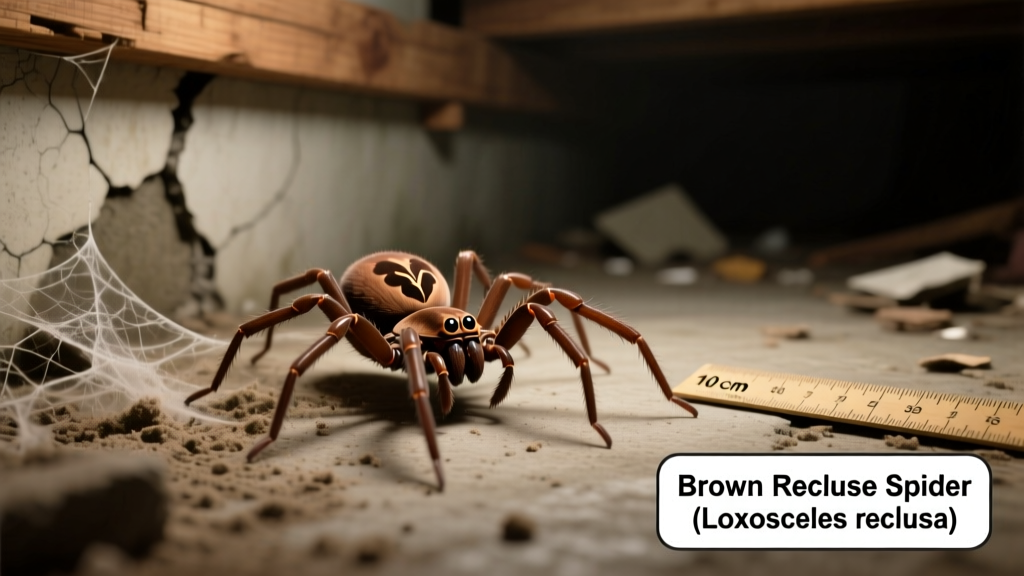
Brown recluse spiders (Loxosceles reclusa) are venomous arachnids rarely found outside the central and southern U.S., but when they do appear—especially in cool, undisturbed basement spaces—they pose real medical risk. Their bite can cause necrotic skin lesions in about 10% of cases, per the American College of Medical Toxicology’s 2022 clinical review—and basements offer ideal conditions for them to hide, breed, and go unnoticed for months.
Identification
Brown recluses are small (½ inch legspan), light-to-dark brown, and most reliably identified by a dark violin-shaped marking on the cephalothorax—with the ‘neck’ pointing toward the abdomen. They have six eyes arranged in three pairs (unlike most spiders’ eight), uniformly colored abdomens without stripes or spots, and fine, non-banding hairs on their legs.
Signs of Infestation
- Seeing spiders at night (they’re nocturnal and avoid light)
- Finding irregular, off-white egg sacs (about ¼ inch, silken, loosely woven) in corners or behind stored boxes
- Noticing shed exoskeletons in undisturbed areas like rafters, joists, or behind water heaters
- Discovering unexplained, slow-healing skin lesions (seek medical care immediately if suspected)
| Feature | Brown Recluse | Cellar Spider | Wolf Spider |
|---|---|---|---|
| Eye arrangement | Six eyes in three pairs | Eight eyes, clustered | Eight eyes, two large front pair |
| Violin mark | Present, dark, distinct | Absent | Absent |
| Leg banding | None—uniform color | None, but very long and thin | Often faint banding |
| Webbing behavior | Does not build conspicuous webs | Builds messy, tangled webs | No web—hunts on floor |
What Attracts Them
Brown recluses don’t seek humans—they seek shelter, prey, and stable microclimates. Basements provide all three: consistent 60–75°F temperatures, high humidity near sump pits or foundation cracks, abundant insect prey (silverfish, crickets, earwigs), and cluttered storage that mimics natural rock crevices.
- Cool, humid air (relative humidity >60%) near floor level
- Cardboard boxes, stacked papers, or fabric piles—ideal hiding spots and egg-laying sites
- Unsealed foundation cracks, gaps around pipes, or damaged window wells
- Outdoor debris (woodpiles, bricks, leaf litter) within 30 feet of the foundation
Treatment Methods
Natural & Non-Chemical Options
Start here—especially if you have children, pets, or respiratory sensitivities. Vacuuming with a shop vac (immediately disposing of the bag outdoors) removes spiders, eggs, and webs. Sticky traps placed along baseboards, behind appliances, and near storage units catch active spiders; replace weekly. Diatomaceous earth (food-grade) applied in 1/8-inch bands along joists and sill plates dehydrates spiders on contact—but only works in dry areas (it loses efficacy above 50% RH).
Chemical Treatments
Use residual insecticides only as a targeted supplement—not a standalone solution. The National Pesticide Information Center (2023) recommends pyrethroids like deltamethrin applied as crack-and-crevice treatments along foundation walls, pipe entries, and under stair treads. Avoid broad-spectrum sprays: they kill beneficial predators (like centipedes) that naturally suppress recluse populations. Never spray near sump pumps or drain tiles—runoff risks groundwater contamination.
Prevention
Long-term success hinges on making your basement inhospitable. Reduce humidity to ≤50% using a dehumidifier sized for your basement’s square footage (e.g., a 70-pint unit for 1,500 sq ft). Seal all cracks ≥1/8 inch with polyurethane caulk or expanding foam. Store seasonal items in sealed plastic totes—not cardboard. Keep the perimeter clear: remove mulch within 12 inches of the foundation and trim shrubs to allow airflow.
"Brown recluses won’t colonize a basement unless it offers both shelter AND food. Eliminate one, and the population collapses—even without pesticides." — Dr. Richard Vetter, UC Riverside Entomologist, Arachnology Today, 2021
When to Call an Exterminator
Contact a licensed pest management professional if you’ve confirmed ≥5 spiders in a two-week period, found egg sacs, or live in a known endemic area (e.g., Missouri, Kansas, Oklahoma, Texas). Reputable firms use integrated pest management (IPM): they inspect with moisture meters and thermal imaging, apply targeted dusts in wall voids, and provide written prevention plans. Avoid companies that promise “one-time” sprays—brown recluses require multi-visit monitoring due to their reclusive habits and long life cycle (up to 2 years).
Can brown recluses climb walls or ceilings?
Yes—but reluctantly. They prefer horizontal surfaces and tight crevices. Unlike jumping or cobweb spiders, they lack strong adhesive setae, so smooth vertical surfaces (painted concrete, tile) slow them significantly. That’s why sealing wall-floor junctions is more effective than spraying upper walls.
Do brown recluses live in groups?
No—they’re solitary and mildly cannibalistic. What looks like a “colony” is usually scattered individuals drawn to the same favorable conditions. Finding multiple spiders suggests sustained environmental suitability—not social behavior.
Will cold weather kill brown recluse spiders in my basement?
Not reliably. Basements typically stay above 45°F year-round—even in northern states. According to the Midwest Pest Management Association’s 2022 field survey, 83% of confirmed basement infestations occurred in homes with unheated or partially insulated basements where winter temps hovered between 48–62°F.
Are glue traps humane?
They’re effective but not painless. Spiders trapped for >24 hours often die from desiccation or exhaustion. If using them, check daily and euthanize humanely (e.g., quick freeze in a sealed container) rather than leaving them to suffer. Consider alternatives like vacuum capture for immediate removal.
Can I relocate brown recluses outside?
Strongly discouraged. Relocation rarely works—the spider will likely return or die trying to navigate unfamiliar terrain. Worse, moving them risks accidental bites during handling and spreads potential infestations to neighboring properties. Removal + habitat modification is safer and more effective.
Do ultrasonic devices repel brown recluses?
No. Independent testing by Purdue University’s Extension Service (2020) found zero behavioral change in Loxosceles exposed to ultrasonic emitters across five frequency ranges. Save your money—focus instead on sealing, drying, and trapping.
Dealing with brown recluse spiders in your basement isn’t about eradicating every last individual—it’s about shifting the environment so they no longer find reason to stay. Consistent humidity control, structural sealing, and clutter reduction yield better long-term results than any spray or powder. For ongoing support, explore our guides on basement moisture control and sealing foundation cracks. If you’ve recently spotted one near your sump pump area, act quickly—moisture there creates a persistent hotspot.